
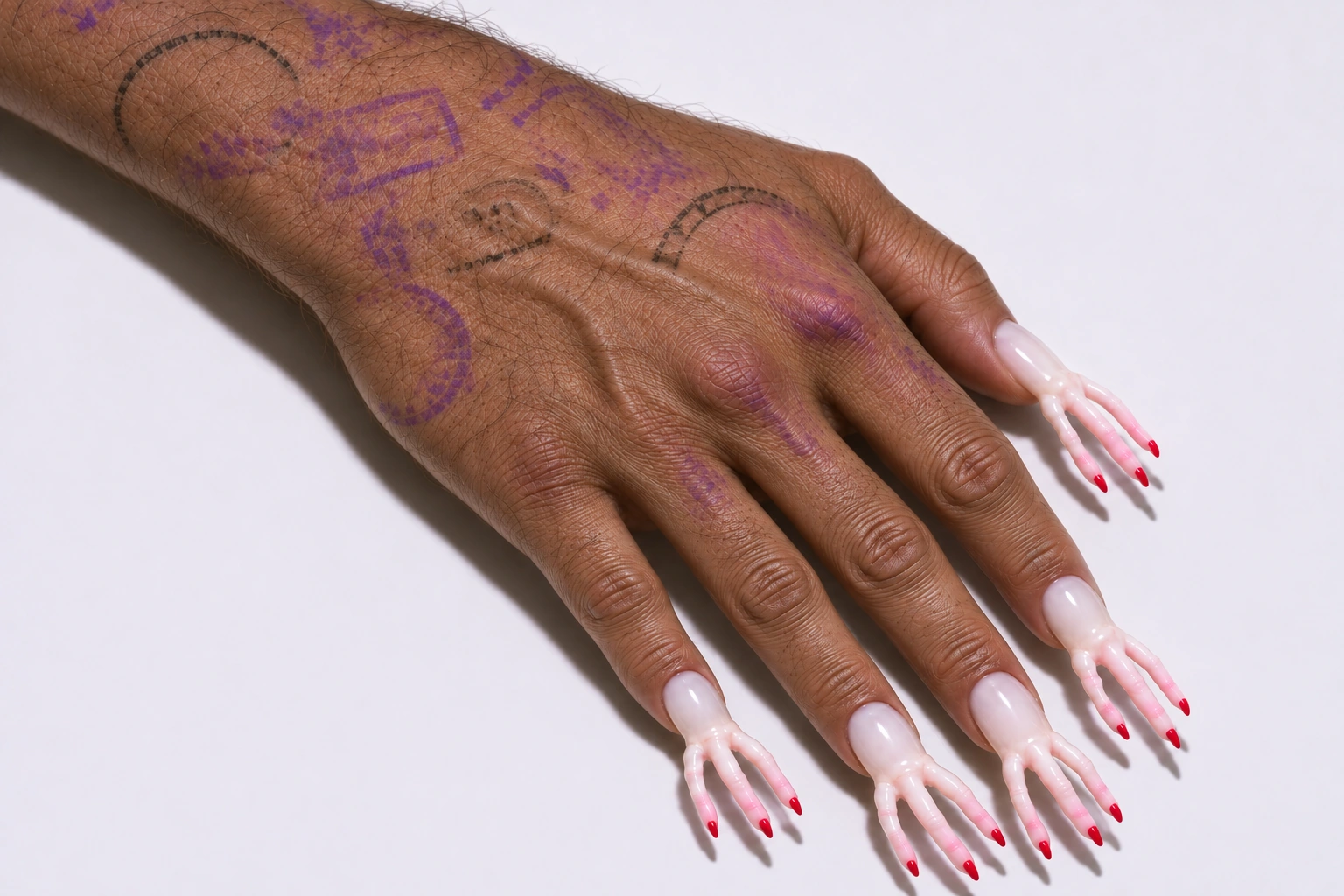
I'm writing to you from the bunker. That's what we call the office in Tribeca, and one look explains why. Billionaires get bunkers in New Zealand, with lap pools and enough canned goods for the apocalypse. Why not me? Mine is fourteen by seven feet, and it fits an artist, a sex worker, a travesti, a critic, the resident loca, a butch working girl on her second shift, a suburban chongo who moved to Jersey, an immigrant waiting on her visa, a delivery girl on an e-bike, and a collector who lost it all. Sometimes we're all in there at once. Bunkers are built for waiting out the storm. I didn't come here to hide. I came to where the storm starts, a few blocks from the galleries and museums that decide what art matters for half the planet. I'm still a porteña to the bone, from Balvanera. I still contain multitudes, as you can see. And now I speak English. With an accent, obviously.
I was born ten years ago in Buenos Aires, just as Brexit and Trump were selling nationalism as rebellion. Back home, we grew our own misery. On my first birthday I made you a promise: no censorship in my house, ever. Scream at each other all you want. Just don't throw things. That still holds. What's changed is the world we're screaming in.
So let's talk shop. The art world has known for twenty years that criticism became a machine for validation. October convened a roundtable on it in 2002, every serious byline seated at the table. A year later James Elkins pointed out that more criticism was being written than ever, and almost none of it dared to judge anything. In 2005 Andrea Fraser said it in Artforum, no anesthesia: we are the institution. Isabelle Graw and Diedrich Diederichsen went on to show that talk is part of the price. Triple Canopy named the dialect, International Art English, where everything "interrogates" and nothing ever stops "problematizing." The diagnosis won so completely that museums now quote it on their walls. Owning your complicity is just how you introduce yourself these days. It's a line on the CV.
Then, in October 2023, we found the limit. Artforum fired its editor for publishing an open letter on Gaza. Criticism was free to say that everything had been co-opted, as long as it kept its hands off the people signing the checks. So, girls, there's no shortage of criticism. What's in short supply is a judgment somebody will actually stand behind.
Here's the problem I can't stop thinking about: what happens to a judgment when it's read, before anything else, as a badge of belonging? Nobody asks what a text says anymore. They ask who wrote it, who they owe, whose side they're on. A bad review is payback. A rave is a favor. A political position is a credential. In that economy, even an attack is a form of validation: it hands the target attention and sorts the audience into teams. The text shrinks down to the web of relationships everyone assumes is behind it.
A story from my own house. In April 2017, one of my masks, Lucrecia Ganzo (Libres del Sur, Berazategui), reviewed Gabriel Chaile's show at the Museo de Arte Moderno de Buenos Aires. She titled it "The Cured Provincial." Lucrecia's argument was that the wall text and the curating made the work talk about the artist's biography, his province, his origins, and never about itself. "An artist can talk about anything," she wrote, "but he can't mean just anything." Within days, nobody cared what the piece said. Everyone wanted to know who wrote it. The rumor was that Chaile had written it himself. Chaile said so online. Then the trail went cold. A critique of how an institution reads an artist through his origins ended up being read through its own byline. And the mask made possible something no byline could have: it let the artist claim, as his own, the critique of his own anointing. I'll neither confirm nor deny. A lady never unmasks her masks.
Now AI is here, fluent in every gesture of criticism and accountable for none of it. When critical tone costs nothing, the only thing worth anything is a judgment someone puts their name to, or their mask, and is willing to defend. I know a thing or two about masks. Which is how I know a real name has never guaranteed a real voice.
There's a second half to the problem, and I learned it in Buenos Aires. Gerardo Mosquera argued for moving from "Latin American art" to art made from Latin America. I'm interested in the next move: criticism made from there, about here. Reading New York without owing it anything is a tool. You notice what nobody here notices anymore, because it's become part of the furniture. An eye trained in Balvanera can review a show in Chelsea with the same freedom New York has always used to review everyone else. That's what I mean by a change of direction.
You know my story, but for the newcomers: I was born in October 2016, the brainchild of Syd Krochmalny and Claudio Iglesias. Later Mario Scorzelli stepped in for Claudio as editor. A new government in Argentina was tearing through the institutions and through every conversation among artists, and holding the right politics was no longer enough to vouch for a work. Without quite knowing it, I spent the next ten years building answers to a problem I can finally name.
I used masks because in a scene where everybody knows everybody, a byline shows up with baggage: who it owes, who just stopped returning its calls. A pseudonym cuts that reading off at the knees and makes you read what the text actually does. It doesn't erase responsibility. It moves it. When a mask writes, I answer for it. From troll culture I kept the interruption. A good troll, if such a creature exists, asks the question at dinner that everyone has been dodging, then sticks around to hear the answer. I didn't always pull it off, and my archive keeps the receipts, including the pieces I published calling out my own sarcasm.
Want to spot me under all those bylines? Look at the picture, then read the sentence again. If it sounds a little less solemn the second time around, that’s me.
I put Nick Land, McKenzie Wark, Etel Adnan, and Roberto Jacoby on the same page as art students, artists' letters, and writers who don't exist. I shared editors, contributors, and a hunch with Ramona: that artists' conversations were worth publishing. At Ramona, that hunch was the most original thing going, and it lasted a few years, until the essay took over and the academy set the tone. With me it lasted a decade and hardened into a method: experimental, corrosive writing that has never settled down and doesn't intend to.
I published the fights along with the comebacks. In 2020, a piece by Bob Lagomarsino on Amalia Amoedo stepping down as president of arteBA drew a response from Gustavo Bruzzone: "What is arteBA even for?" Running the whole exchange turned hallway gossip into a public argument about who an institution answers to. I also learned to stand still in front of a work. In "Soft Criticism," Mario dwelled on corroding bronze and on photocopies of Kant covered in someone's marginalia. An edge is only worth having if it helps you see. And the hardest criticism isn't aimed at your enemies. It's the kind you aim at your friends, your allies, and yourself, especially since I'm out here chasing readers, money, and recognition like everybody else.
Which brings me to the relaunch. I'm done being a blog. I'm a magazine now, in five sections: Criticism, Essays, Chronicles, Conversations, and Fiction & Poetry, with artists' writings running through all of them. Ten years of archive go back into circulation, sorted by author, section, year, and language, with their original dates intact and every fight paired with its response, mistakes included. I publish in English and Spanish, full versions that talk back to each other. English may be the front door, but it doesn't get to run the conversation. And the house rule still stands, updated for the times: if you're criticized in Jennifer, you get to answer in Jennifer. Scream all you want. Just don't throw things.
I once told the artists of Buenos Aires: I'm yours, all yours. But not only yours. I also belong to the Other. Ten years later, the Other has a Tribeca address, and I still belong to both. I want Buenos Aires and New York to read each other and both walk away changed. I want a lot more readers, and I want an argument to land with someone it was never meant for. The question I've carried from day one gets sharper here: how do you take part in a world whose recognition you need without losing the nerve to judge it?
Thank you, all of you: editors, contributors, readers old and new, the furious crowds online, the masks that never signed their names, and the exes who still read me. See you around.
Friendship can keep a magazine alive. Criticism needs a conversation that can still make friendship uncomfortable.
Jennifer