Tertulias with Rosé is a series of public conversations created and hosted by Syd Krochmalny at Barro, New York. Starting with the exhibitions at the gallery, artists, curators and writers discuss art, politics, literature and the ways forms organize perception and collective life. The conversations were recorded, transcribed and edited for publication.
Conversation held on June 29, 2023.
The conversation
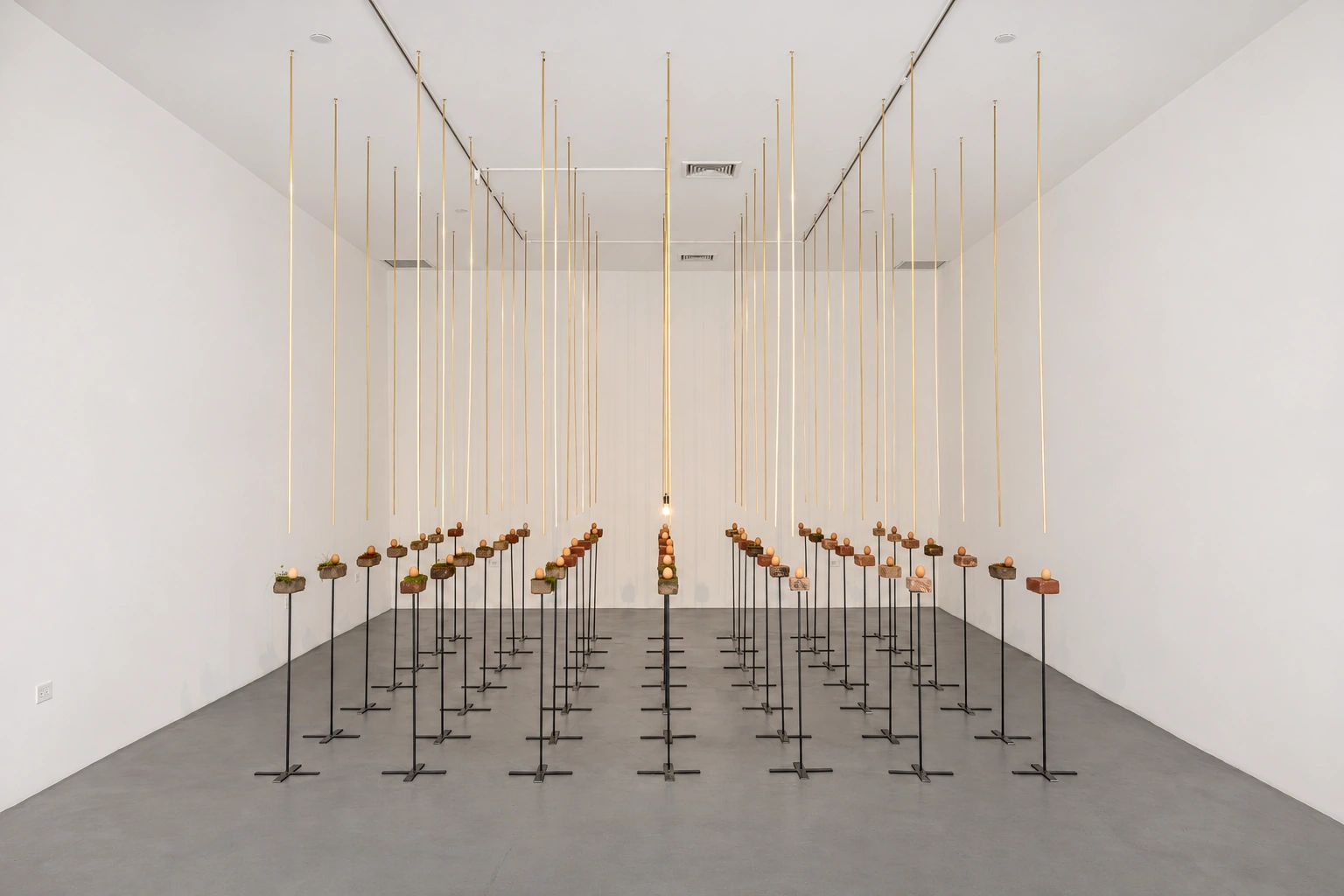
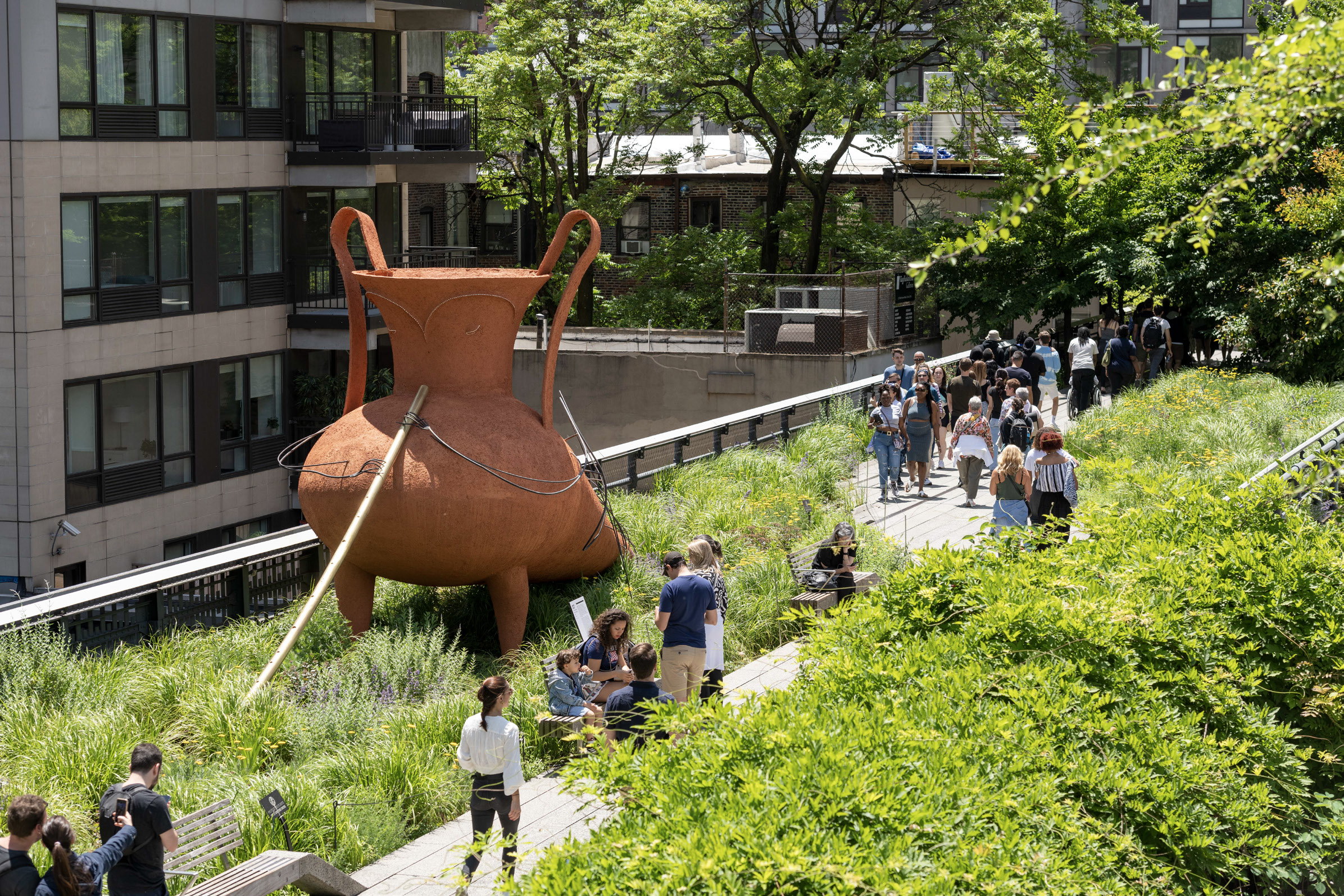
Syd Krochmalny (SK): Ladies and gentlemen, thank you for joining us today. We are grateful for your presence at the fifth edition of “Tertulias with Rosé” in Barro New York. Each exhibition gives us a starting point for a public conversation. Our current exhibition, Time, Times, and Half a Time, proudly displays a selection of artworks by Gabriel Chaile. One of the prominent pieces is Salir del surco para labrar la tierra [Leaving the Furrow When Tilling the Soil: Delusions of Grandeur II], created in 2014. Chaile first showed the piece at the Fondo Nacional de las Artes in Buenos Aires. Adjacent to this, in the next room, you can explore Proto, a film by Gabriel Chaile, produced between 2017 and 2023, which serves as the foundation for this entire project. The exhibition in Barro also converses with The Wind Blows Where It Wishes (2023), a public art sculpture commissioned for the High Line.
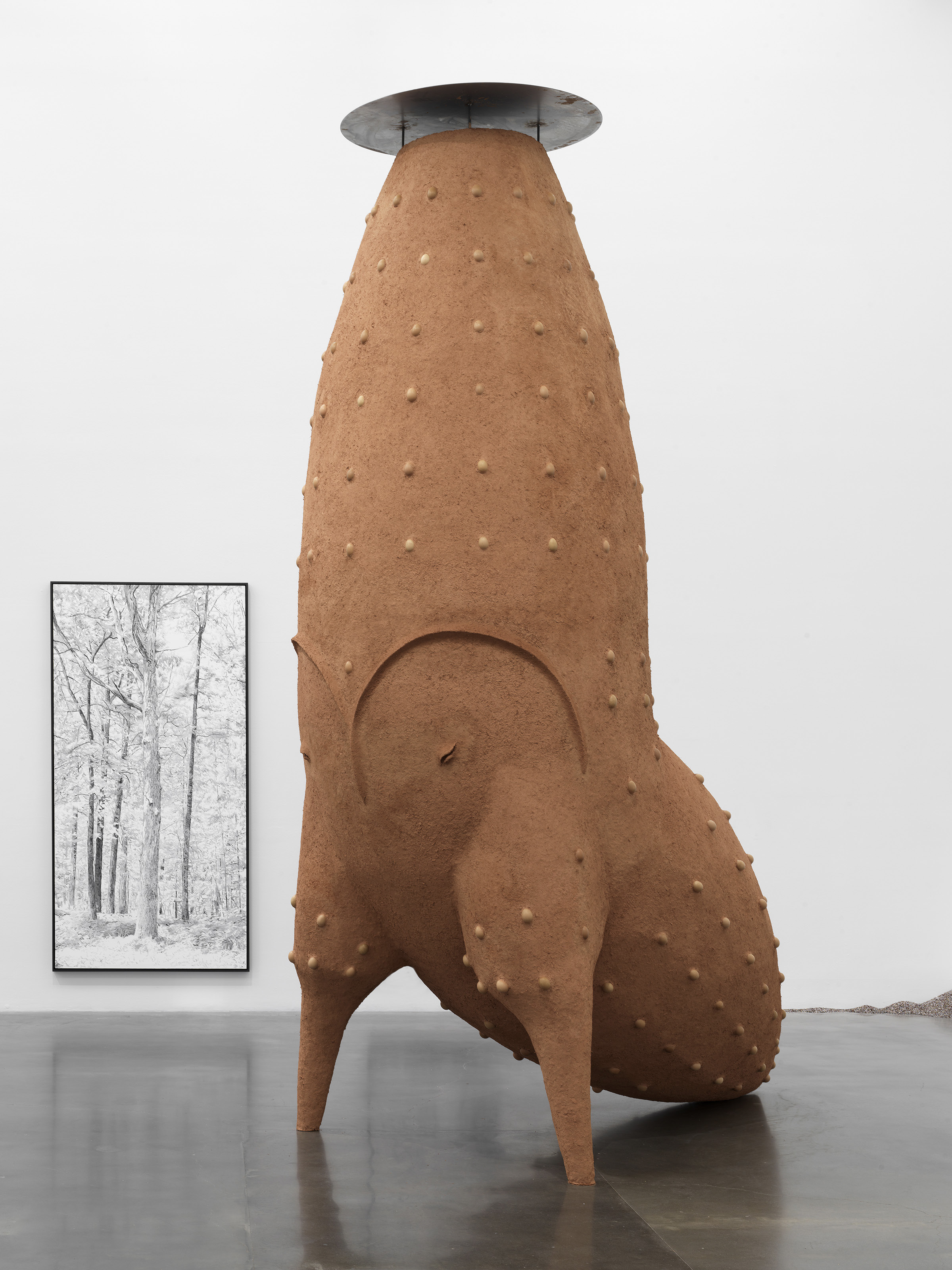
Today, we are honored to have Margot Norton with us. She is the Allen and Lola Goldring Senior Curator at the New Museum, New York. Norton notably organized the 2021 New Museum Triennial Soft Water Hard Stone, in collaboration with Jamillah James, which featured the work of Gabriel Chaile. Currently, she is curating Pepón Osorio’s exhibition at the New Museum. Margot is transitioning from her role at the New Museum to her new position as the Chief Curator at the Berkeley Art Museum and Pacific Film Archive. I invited Margot because of her past collaborations with Gabriel Chaile. She curated forty exhibitions at the New Museum, one of which, the 2021 New Museum Triennial, featured an impactful sculpture by Gabriel named Mamá Luchona (2021). This piece was pivotal in thrusting Gabriel into the international spotlight.
As we delve into our conversation today, we hope to not only discuss the artwork but also frame our dialogue within broader debates. We introduce the concept of “peripheral syncretism” to shed light on Chaile’s work. The term “syncretism” traces its roots to ancient history, first appearing in Plutarco’s writings in the first century AD. Historically, this term described the amalgamation of different religions, cultures, and arts. By the 17th century, it was adopted in English and later used by anthropologists to delineate how one culture assimilates aspects of another, often within colonial contexts.
However, Chaile’s work gives syncretism a unique twist, showcasing a deliberate journey from the periphery to the center. For instance, the title of this exhibition is a biblical quote, yet the walls feature a quote from an entirely different source. While exploring, you’ll come across various references, ranging from the influences of Walter De Maria, as seen in The Broken Kilometer (1979), to a painting that invokes the spirit of Paul Klee’s Locksmith (1940). It’s important to recognize that syncretism isn’t just about blending; it’s about forging something novel. If you visit the sculpture The Wind Blows Where It Wishes on 24th Street and 10th Avenue, you’ll see influences ranging from pre-Columbian cultures to Renaissance thinkers like Leonardo da Vinci. Chaile’s ability to intertwine these traditions sets the stage for our discussion today.
The aesthetics and politics of Gabriel Chaile incorporate different cultural elements, practices, beliefs, and traditions creating new and hybrid forms. Chaile produces sculptures, drawings, paintings, installations, poems, and performances based on his ongoing research into rituals and popular communal gatherings occurring on the periphery of cities. His art blends different cultural, religious, ideological, and artistic traditions to create a new and unified system based on two theories called The Engineering of Need and The Genealogy of Form.
The Engineering of Need consists of creating objects and structures from art that collaborate in improving the conditions of a certain borderline situation. The Genealogy of Form implies acknowledging that every object in its historical repetition provides a story to tell, that is recovered and updated in relation to the new context. Both concepts involve combining elements from different cultural sources (pre-Columbian, modern and contemporary art, Paganism, Christianity and Humanism, anime & manga, anthropology and popular culture), often resulting in a synthesis incorporating aspects of each original tradition, tracing its historicity and its incorporation into a new context.
The syncretism theory is rooted in early anthropological observations of cultural interactions and religious practices. It emerged as a way to explain the blending of different cultural elements, particularly in the context of religious beliefs and practices. Syncretism occurs through cultural contact, colonization, globalization, or migration. It involves the borrowing and incorporation of ideas, practices, symbols, and rituals from different cultural contexts.
Criticism of syncretism revolves around concerns of cultural appropriation, power imbalances, and the suppression of marginalized voices. Instead, “Peripheral Syncretism” deconstructs essentialized cultures, focuses on power dynamics, and opposes cultural imperialism. It recognizes the fluidity of cultures and the complexities of cultural borrowing and mixing.
In contemporary art, syncretism helps understand cultural processes, identity formation, and cultural adaptation. Artists like Gabriel Chaile critically incorporate elements from different cultures, highlighting power imbalances and marginalized cultures. We call this procedure “Peripheral Syncretism” because it challenges cultural authenticity and emphasizes the nuanced negotiations and power struggles that occur when cultures interact.
“Peripheral Syncretism” critiques the Eurocentric bias in studying cultural mixing and hybridity. It emphasizes non-Western cultures and their unique processes of cultural blending.
Overall, syncretism offers insights into cultural interaction, identity formation, and cultural evolution in response to changing contexts. “Peripheral Syncretism” provides a more nuanced framework for understanding the complexities of cultural borrowing and mixing.
“Peripheral Syncretism” involves a deliberate and strategic negotiation of power dynamics. Subaltern groups navigate and selectively appropriate elements of the dominant culture, transforming them to align with their own political objectives. This appropriation is not passive assimilation but an active reconfiguration and reinterpretation of cultural elements.
Margot Norton (MN): Certainly. When Syd introduced the concept of “Peripheral Syncretism” to me, I immediately thought of the title of the triennial, Soft Water and Stone. This title stems from a Brazilian proverb I learned from an artist named Gabriela Mureb from Río de Janeiro, Brazil. The full proverb in Portuguese is: Água mole em pedra dura, tanto bate até que fura, which translates to: Soft water on hard stone hits until it bores a hole. It’s believed to convey two sentiments: firstly, the notion of perseverance and the substantial impact that a seemingly minor gesture can achieve over time, and secondly, the idea that time can erode even the most formidable substances.
As we delved deeper into the origins of this proverb – as is often the case with proverbs – its genesis was elusive. While many attribute it to Ovid’s “Metamorphoses,” it’s also echoed in similar proverbs across multiple cultures. Interestingly, there’s a similar saying in the Tao Te Ching. It led me to think about the concept of “origin” and “peripheral syncretism” - pondering where an idea truly begins. Roland Barthes’ discussions on “language degree zero” came to mind, contemplating how one idea predicates another.
As you mentioned about the exhibition title, Time, Times, and Half a Time, even biblical references have predecessors. This idea of “origins” and a curious yet critical approach to the term has also come up in conversations with Chaile about his own work. He identifies with a unique combination of Afro, Arab, and Indigenous heritage. He was born and raised in the city of San Miguel de Tucumán in Argentina, and has often reflected on the uncertainty of his own lineage. His works draw upon this genealogical exploration, connecting to elements like Condorhuasi ceramics (c. 400 BC–AD 700) and other pre-Columbian artifacts – items that are often seen imprisoned behind glass in museums. Yet, through his art, he magnifies these pieces, asserting the vibrancy of these Indigenous cultures within him.
It’s a poignant statement, particularly when considering the backdrop of cultural amnesia and the loss of historical roots. The sculpture for the 2021 New Museum Triennial, Mamá Luchona, served as a testament to this approach. The term “Mamá Luchona” denotes a fierce mother, a matriarchal figure Chaile imagined as mother to all of his prior sculptures. However, it’s also colloquially used in many contexts across Latin America in a somewhat derogatory manner, referring to young mothers who may be perceived as neglectful. With Mamá Luchona, Chaile reclaims this term, redefining it as the formidable mother of his creations.
This massive sculpture, standing over four meters tall and adorned with eggs, which Chaile saw as her ammunition, drew from a plethora of inspirations. The artist cited pop cultural sources like the clouds in the Super Mario Brothers video game to Sarah Lucas’ enormous sculpture named Champagne Maradonna (2015), named after the legendary Argentine footballer. Chaile’s approach infuses these popular references with traditional Indigenous motifs from northern Tucumán, creating a synthesis, a recirculation of ideas and forms. He takes marginalized elements and reintegrates them, perhaps as a response to the way that the objects of his ancestors are traditionally situated in the context of museums.
SK: It has been intriguing, to say the least. I’ve often felt the need to piece together fragments, much like trying to reconstruct a broken vase, to understand where it all began. The concept of cultural amnesia resonates with me. When you converse with Gabriel, it becomes evident that his personal journey mirrors a culture affected by amnesia. Colonization (especially the Jesuits and later the Evangelist Church) has caused certain communities to forget their roots; they can’t recall their ancestral tales, their native languages, or even the names of their forebears. This disconnection from their past, whether it be due to the erasure of history or personal forgetfulness, is profound. Yet, even if you forget your past or your ancestors, this culture still lingers, perhaps as a specter (or what some might refer to as a ghost) - an undercurrent barely discernible but persistently present.
These spectral remnants, though not immediately visible, come alive in the present, manifesting in various ways. Perhaps they emerge subconsciously, but traditions and practices reawaken within his art. Often, he doesn’t even recognize their origins, stemming as they do from the margins upon margins of mainstream consciousness. As an Argentinian from the province of Tucumán, he shares a bond with places and memories often overshadowed and forgotten. His hometown, not far from Tucumán City, further exemplifies this collective amnesia.
Yet, through his artistic process and rigorous research, he brings this dormant past back into the present. He delves into what he terms “genealogy of form,” attempting to trace the origins of certain motifs and structures. While genealogy is conventionally the realm of linguists and anthropologists, he navigates it with a contemporary twist, emblematic of a generation that sources knowledge differently. In an age where many access culture via apps and platforms like Spotify and Netflix, the way information is consumed has transformed. It’s a stark contrast to the older generations who sought knowledge in libraries and pored over books. Today’s approach to culture is more akin to a toolbox, allowing for eclectic combinations. One can draw from a myriad of sources – whether it’s Mayan culture, the Bible, or DaVinci – to create something refreshingly unique. I believe Chaile’s approach to genealogy stands apart from the interpretations of Nietzsche and Foucault. While Chaile may resonate with Foucault’s description of genealogy as “gray, meticulous, and patiently documentary, operating on a field of entangled and confused parchments, on documents that have been scratched over and recopied many times,” he offers an innovative perspective by envisioning genealogy as a DJ who remixes elements of tradition, history, power, resistance, and memory.
MN: When I saw the work on The High Line, The Wind Blows Where it Wishes, I noticed that Chaile introduced a new feature in his art – dots of white paint surrounding the eyes of the sculpture. Chaile mentioned to me that this inspiration came from Portuguese ceramics, which he came to know after moving to Lisbon a few years ago, and developed a fascination for these ceramics. Similarly to what we have been discussing in the context of Tucumán and Argentina, much of Portuguese culture is also characterized by a kind of cultural amnesia, with forgotten histories overlaid by successive influences, including significant contributions from Mauritius and the historical Arabic presence in Portugal. What’s compelling is how this forgotten ancestry —which persists in artistic traditions such as these ceramics, resonates and connects with other aspects of his work. It begs the question of whether these influences are deliberate or instinctual, even as their precise origins might be unknown. The manner in which you described it in your essay about this show is evocative of nature – akin to how moss grows, instinctively finding surfaces to cling to and flourish. It’s the mystery of origins and the spontaneous growth, even when we’re unsure of where it all began.
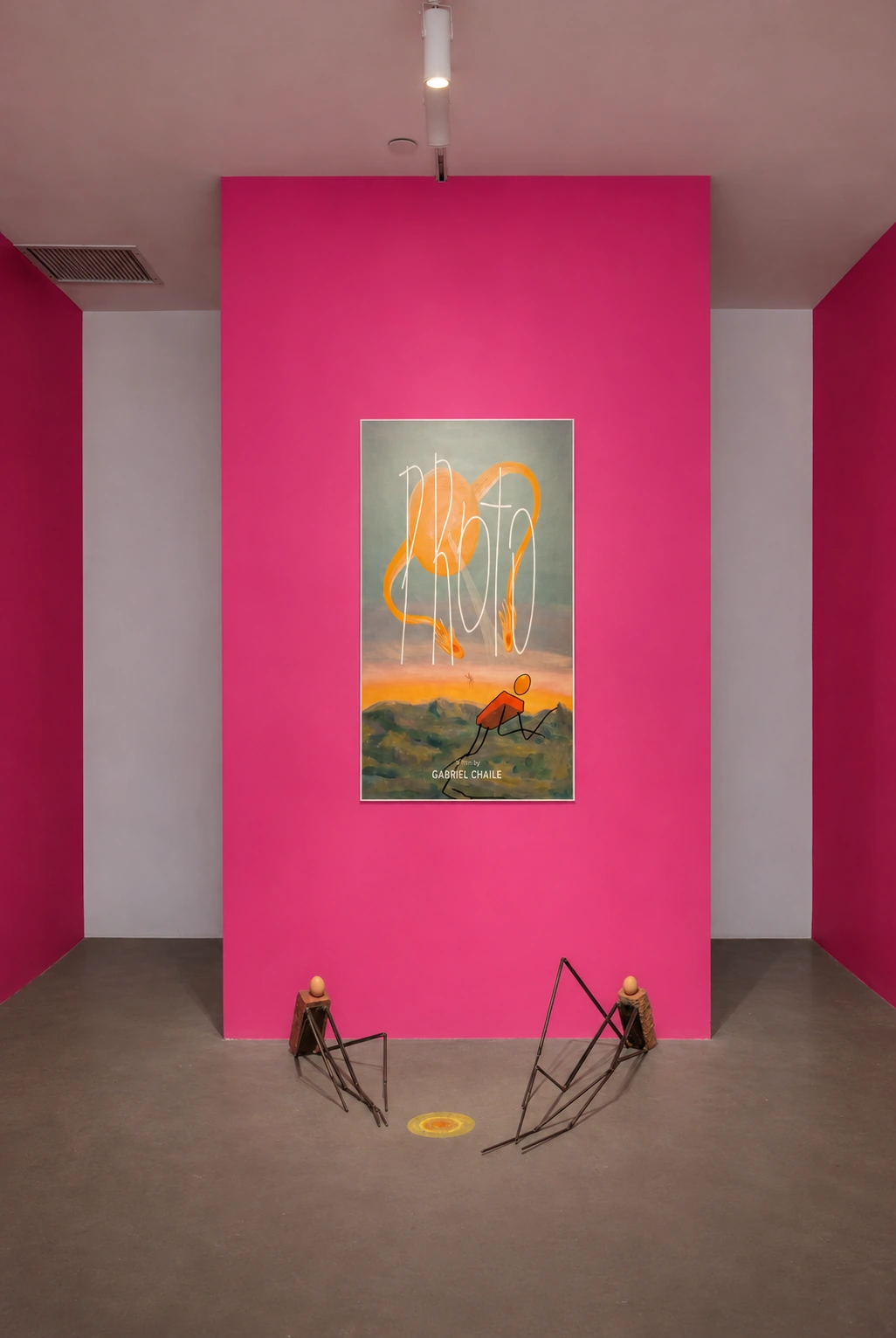
SK: Gabriel is not a historiographer nor an anthropologist, yet his unique approach to creating art has a historiographical and anthropological dimension. This venture into the topic of genesis and the origin of forms is fascinating. When we talk about “genesis,” it’s discussed not only from a religious perspective but also, as you pointed out, in terms of Gabriel’s aesthetic choices. As we discussed earlier, the materials he uses in his sculptures, like iron, which forms the underlying structure, are significant. On top of that foundation, he uses adobe to construct these monumental sculptures. The inclusion of eggs in his work, like in the massive sculpture at the New Museum featuring 300 eggs, seems to be a part of his cultural legacy. In my interpretation, if Mamá Luchona is seen as the “mother” of his sculptures, these 49 eggs in Salir del surco para labrar la tierra [Leaving the Furrow When Tilling the Soil: Delusions of Grandeur II] could symbolize the offspring of his cultural expression. The ingredients are evident in this work. Yet, in another room, those same materials take on the roles of characters from a non-existent movie. It’s as if you’re seeing a film made up of elements typical to movies, but there’s no actual film to watch. Instead, you visualize the movie based on the synopsis with the characters represented by sculptures, and drawings. When you close your eyes, you can reimagine and construct the film in your mind.
MN: The synopsis Gabriel crafted for this conceptual movie is amazing. One intriguing and humorous aspect is the narrative about an egg wanting to become pregnant—yes, the egg itself aspires for impregnation. In a twist, it is suggested that the egg might achieve this when bitten by a mosquito. However, it’s revealed to be just a bite, merely a fleeting encounter.
Gabriel has described Condhouasi ceramics as being “in between two states,” perpetually in a state of transformation—like a form yearning to evolve into another. One of the captivating elements about this particular piece, and indeed in many of his creations, is the sense of anticipation it evokes. There was a query earlier about whether the eggs used in the artwork were boiled or raw. Regardless of their state, there’s an implied promise of change—an impending event. The sense that something is about to occur is palpable, whether it’s the moss gradually creeping over the bricks, or the indeterminate role of the light within the room, reflecting on the bronze rods. Within many of his works there is an essence of unpredictability and transition, leaving viewers pondering potential outcomes.
SK: There’s an expectation of encountering an animal presence in the artwork, emphasizing themes of fragility and instability. There’s also an inherent adaptability in Gabriel’s approach. Even if you’ve seen this piece in a different setting, you’ll notice changes he made specifically for this context. For instance, he introduced moss to the piece, which wasn’t in the original design. This adaptation is compelling, especially when considering moss as one of the earliest forms of plant life. Roughly 485 million years ago, when oxygen began filling the atmosphere, mosses were among the first plants to colonize the land, paving the way for subsequent terrestrial life.
It alludes to the emergence of life and the genealogy of species, echoing how life claimed the Earth. And from here, it connects well with Darwin’s quote that accompanies the work ‘Leaving the Furrow When Tilling the Soil: Delusions of Grandeur II,’ which reads: “But if variations useful to any organic being do occur, assuredly individuals thus characterized will have the best chance of being preserved in the struggle for life; and from the strong principle of inheritance, they will tend to produce offspring similarly characterized. This principle of preservation, I have called, for the sake of brevity, Natural Selection.” Now, would you like to add something, or shall we proceed to the next room?
MN: We can continue in the next room.
SK: This piece is another argument that Gabriel presented in this show. This piece represents the poster of a movie, but the movie itself doesn’t exist. What we see here as sculptures and drawings represents the characters of Chaile’s narrative. These characters symbolize a connection between three distinct beings. Initially, there was an alien being with four legs. On one side, it was a brick, and on the other, an egg. These elements combined to create a new entity. As this being journeyed across the planet, it encountered the fourth character in the narrative, which was the mosquito. If you take a moment to read the synopsis you’ll find it’s a narrative about the beginning. Not in a traditional sense, but rather a reimagined origin or apocalypse. Essentially, it’s another take on Biblical Genesis.
Audience: There’s a frightening aspect to that story.
SK: What’s scary about it?
Audience: Well, there’s uncertainty around whether the egg was stung by the mosquito or impregnated. This introduces an element of fear. But then there’s also a sense of sadness when they realize the egg wasn’t impregnated at all. It’s just a misconception.
SK: Well, I believe it ties back to the idea we discussed earlier: which came first, the egg? But how can an egg become pregnant, right?
MN: Indeed, it does recall the proverbial chicken-and-egg conundrum. It’s hard to pinpoint the beginning, isn’t it? This notion is intriguing, especially when considering history. Conventionally, bricks signify the building blocks of human construction, often associated with the impact of humans on the environment. But here, the brick symbolizes a genesis. So, in a way, while there’s sadness in the thought that the egg won’t become pregnant and bring life, there’s also a notion of the brick heralding new beginnings. I don’t have all the answers. However, I do see a lot of absurdity at play.
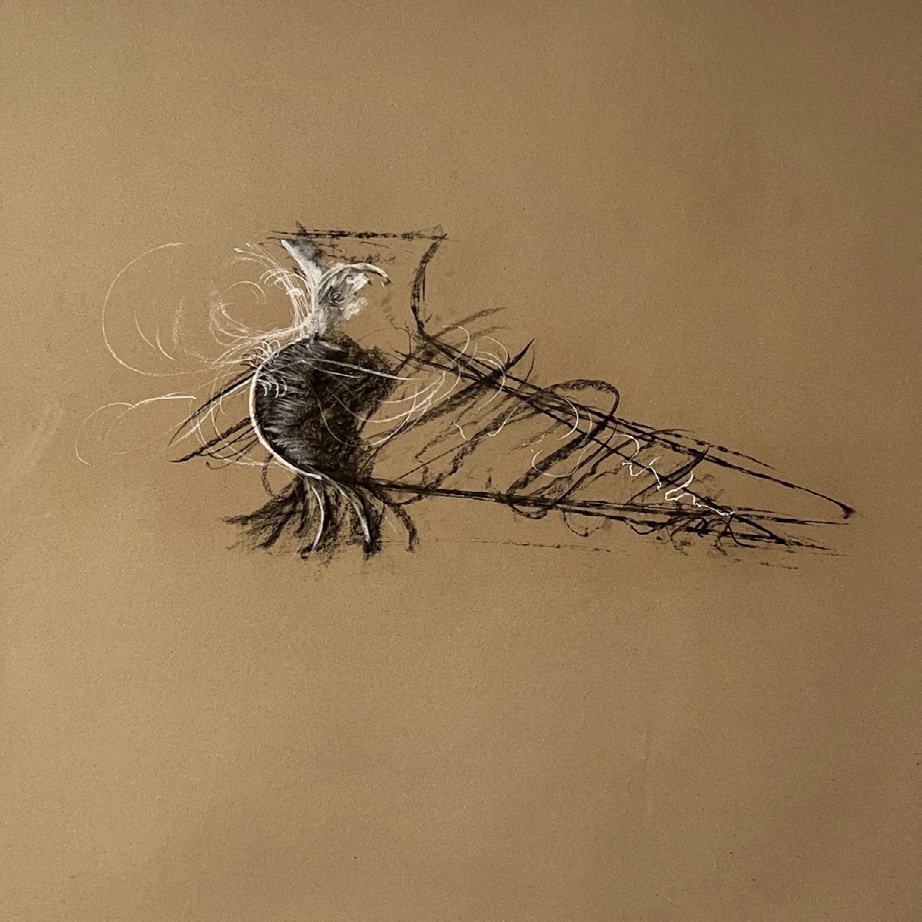
SK: You can see the absurdity in these drawings as well. They are part of the animated series for the movie, and it’s geared towards children. Yet, while children might easily understand it, adults might find it difficult to decipher. One of the characters, possibly the third one in the series, might be clearer outside. Let’s continue our journey.
Audience: For me, the brick symbolizes the foundational building block. It’s earth, clay shaped in a particular way. We don’t have to take it literally. It’s not about being precise but rather about understanding the essence. The brick stands for land, the foundational block. Additionally, when we consider the egg, historically, even before the advent of electricity, people would hold eggs up to a candle to check for fertilization. Seeing the light within this context alludes to the idea of checking for impregnation, as the light is used to determine if the egg is fertilized. My immediate thought upon seeing that was its reference to checking the egg’s fertility.
Audience: I also associated it with incubators, which have lights. This ties back to the concept of Genesis, suggesting an anticipation of birth or hinting that the egg might give rise to new life.
Audience: It could simultaneously hatch or be destroyed, right? Audience: It represents a transition; it will no longer be an egg at that point.
MN: Yes, it’s a form of destruction, isn’t it? It’s an action that fundamentally changes its state.
SK: Yes, they resemble incubators. I recall a conversation with Gabriel about this. We were observing the city, and it appeared like an intricate urban landscape installation from above. When you look at the city from the sky, you can discern this grid pattern of buildings. What’s fascinating is how some parts of the city have vegetation while others are just brick structures. Imagine observing New York from above; you’d see Central Park amidst a concrete jungle. This interplay between nature and the city suggests that perhaps it represents more than just human constructs. Based on Umberto Eco’s writings, art can be open to interpretation. Maybe the earth, or the planet, or even the surface of the egg can symbolize the city, but there’s always another layer of meaning.
MN: Like becoming whole again, or returning to the earth.
SK: I believe it references the Bible, where the first human was said to come from the earth, likely shaped from clay. Let’s take a look at the sculpture on the floor and behind the poster of the movie.
Audience: I feel like they have a spider-like quality. I genuinely believe they can walk. Had they not wanted movement, they would have been designed without hinges or joints. What I notice is the sun depicted on the floor.
Audience: What is this image?
SK: This is an image of the sun with hands, trying to grasp Proto, with the hands of Fatima.
Audience: Ah, I see. So it’s not the sun but a fire. I initially thought it was an embryo.
Audience: No, it’s definitely the sun. I adore this representation.
MN: In the other room, some of the eggs are centered, while others seem precarious, as if they might fall or break. The way they’re positioned on the bricks is quite intriguing.
SK: It references an ancient language, the foundational elements. The card for the exhibition provides one interpretation, suggesting a series of seven. Although presented abstractly, there isn’t a singular way to understand it; it’s more about the concept of that particular type of language. For example, “In the sacred echoes of ancestral texts, the numeral 7 dances with an ethereal weight, materializing over 700 times across the dual landscapes of the Old and New Testaments. As we traverse the intricate tapestry of biblical numerology, this number emerges not merely as a count but as an emblem of wholeness, a seal of the divine. The narrative unfurls, revealing a cosmos sculpted in six acts, with the Creator, in poetic reprieve, embracing rest on the seventh..”
Audience: Was it his decision, or was it a curatorial choice to position them as they are? Did he personally arrange them?
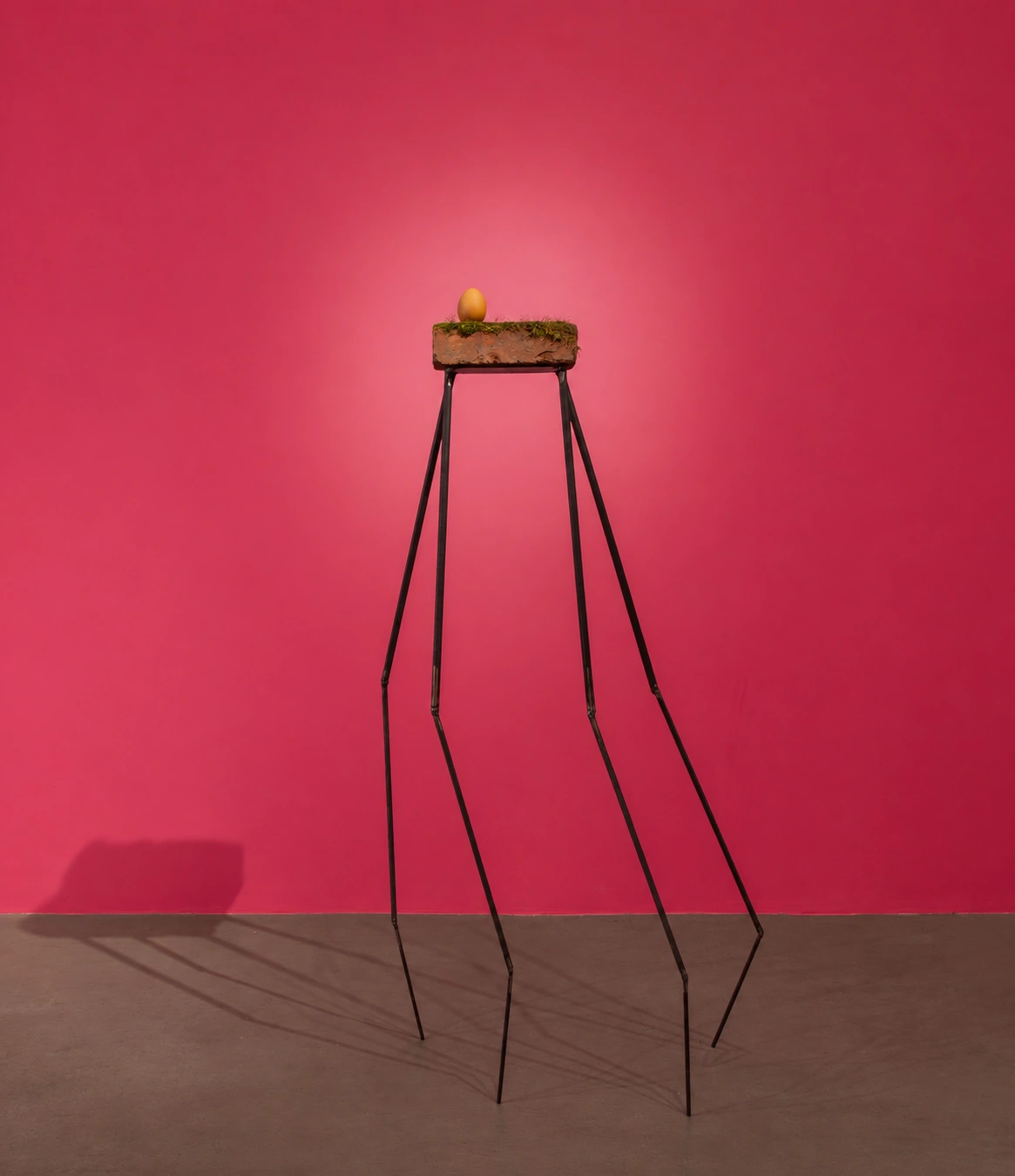
Audience: But it was constrained by physics. They can’t just be placed anywhere without considering stability. So there are limits. It has its own dictates.
MN: There are indentations in some bricks, which might dictate good placements for the eggs. However, reflecting on it further, sometimes the moss or any small imperfection in the bricks causes the egg to rest in a particular way. So their positions are influenced by what has already occurred.
SK: The eggs aren’t boiled; they’re whole raw eggs.
Audience: So, are you replacing them every two weeks?
SK: We’re replacing them. Would you like to talk about your upcoming project with Gabriel?
MN: Yes, something I admire so much about Gabriel is that he is always pushing the boundaries of his practice. I am excited to work with him on his first solo exhibition in the US, opening this December at Berkeley Art Museum and Pacific Film Archive (BAMPFA).
We are in the beginning stages of planning his exhibition, which is titled No hay nada que destruya el corazón como la pobreza (Nothing destroys the heart like poverty). For the exhibition Chaile is producing a newly commissioned, 15-foot-tall clay sculpture, which reflects on the social concerns of his community and connects to long histories of anti-colonial resistance. In particular, Chaile is looking at a historical turn in Tucumán’s history when the government closed key sugar mills in the late 1960s that had been the city’s central industry since the late nineteenth century. In 1968, a group of artists worked with journalists to expose the reality of the impoverished region, which culminated in a series of art events, known as Tucumán Arde (Tucumán is Burning), which has been heralded as one of Latin America’s most preeminent examples of art’s capacity to expose injustices and ignite change.
The new work Chaile and his team are creating for our exhibition, will reflect on how these histories reverberate in the present, and connect to ongoing social justice concerns. Chaile and his team will be creating this new sculpture alongside the students at UC Berkeley’s Art Practice Program in the MFA studios, and premiering the results of their collaborative process in our exhibition. I feel that the project will have particular resonance in Berkeley, given the activist history on campus and in the greater Bay Area community. It is also exciting to be involving the participation of the students in this way, allowing the project to go deeper and with more meaningful engagement than simply mounting an exhibition at the museum.
SK: Awesome, I am so looking forward to seeing the show. All right. I invite you to have more wine and cheese. Perfect.
About the participants
Biographical notes reproduced from the original publication. Institutional roles refer to the time of the conversation.
MARGOT NORTON is Chief Curator at the Berkeley Art Museum and Pacific Film Archive, where she leads the curatorial team and oversees the exhibition program. She was previously Allen and Lola Goldring Senior Curator at the New Museum, New York, where she recently co-curated the 2021 New Museum Triennial: Soft Water Hard Stone; Wangechi Mutu: Intertwined; and Pepón Osorio: My Beating Heart/ Mi corazón latiente. At the New Museum, she has also curated solo exhibitions with Carmen Argote, Diedrick Brackens, Pia Camil, Sarah Charlesworth, Lynn Hershman Leeson, Sarah Lucas, Goshka Macuga, Chris Ofili, Laure Prouvost, Pipilotti Rist, Mika Rottenberg, Kaari Upson and Bárbara Wagner and Benjamin de Burca, among others, and group exhibitions including The Keeper, Here and Elsewhere, and NYC 1993: Experimental Jet Set, Trash and No Star. In 2017, she curated the Eighth Sequences Real Time Art Festival in Reykjavik, Iceland, and the Georgian Pavilion at the 2019 Venice Biennale with artist Anna K.E. She also serves on the editorial committee of Museums Moving Forward (MMF), an intergenerational, cross-institutional coalition of art museum professionals committed to advancing equity across the museum field. Before joining the New Museum in 2011, Norton was a curatorial assistant at the Whitney Museum of American Art. She has contributed to and edited numerous publications and exhibition catalogs, and regularly lectures on contemporary art and curating. She holds an MA in Curatorial Studies from Columbia University, New York.
SYD KROCHMALNY is a multidisciplinary artist, writer, researcher, curator, musician, and Professor of Arts, Literature, and Sociology. He completed his Postdoctoral Studies at Columbia University in New York City, and holds a Ph.D. in Social Sciences, a master’s degree in Communication and Culture, and a bachelor’s degree in Sociology from the University of Buenos Aires. Krochmalny’s multimedia work has been exhibited at the Reina Sofia Museum, Harvard University, David Rockefeller Center, the MALBA, the Americas Society, Cultural Center of Memory Haroldo Conti, Remembrance Park, University of Oslo, Universidade Federal do Rio de Janeiro, MAC de Niteroi, Pinacoteca San Pablo, The University of Edinburgh, Museum of Contemporary Art in Buenos Aires, among others. Krochmalny has published several books, including “Journals of Hate” (2016), “Weak” (2017), “The Dreams” (2018), “The Size of My World” (2021), and “Ramona, Debates in the Art on the Edge of the Millennium” (2021). He has also written a prologue for “Crypto Currency and Sovereignty” (2022) and has been involved in magazine projects such as editor of Ramona, co-founder and editor of Jennifer Magazine, and co-founder and editor of the CIA magazine (Center for Artistic Research). Krochmalny has received a fellowships by the Argentinian Research Council CONICET, and has served as a Professor and Researcher at various institutions including the Gino Germani Institute and the Institute of the Theory and History of Art Julio Payró at the University of Buenos Aires, The Latin American Council of Social Sciences (CLACSO), and the University of Avellaneda. Krochmalny has delivered lectures at universities such as Harvard University, Columbia University, New York University, Rutgers University, University of Oslo, Edinburgh University, Stirling University, and the Americas Society. In Buenos Aires, Krochmalny has played a vital role in the art education culture as a contributor to the Center for Artistic Research (CIA), nurturing many of Argentina’s most prominent artists.