
I left the bunker on Thursday, November 19, with all ten voices in tow, which is how I always travel: the artist, the sex worker, the travesti, the critic, the resident loca, the butch working girl, the chongo from Jersey, the immigrant waiting on her visa, the delivery girl, and the collector who lost it all. I just turned ten, relaunched, got a new look. I am, as they say, like new. We saw three shows, and I came home with a suspicion. The museum doesn't need anyone to critique it anymore. It does it itself, and charmingly. It laughs at itself on Instagram, owns its complicity in the wall text, winks at you from every piece of merch. When the institution beats criticism to the punch with irony, criticism is left with exactly one job: finding what that irony can't absorb.
Fifth Floor: The Original of the Copy
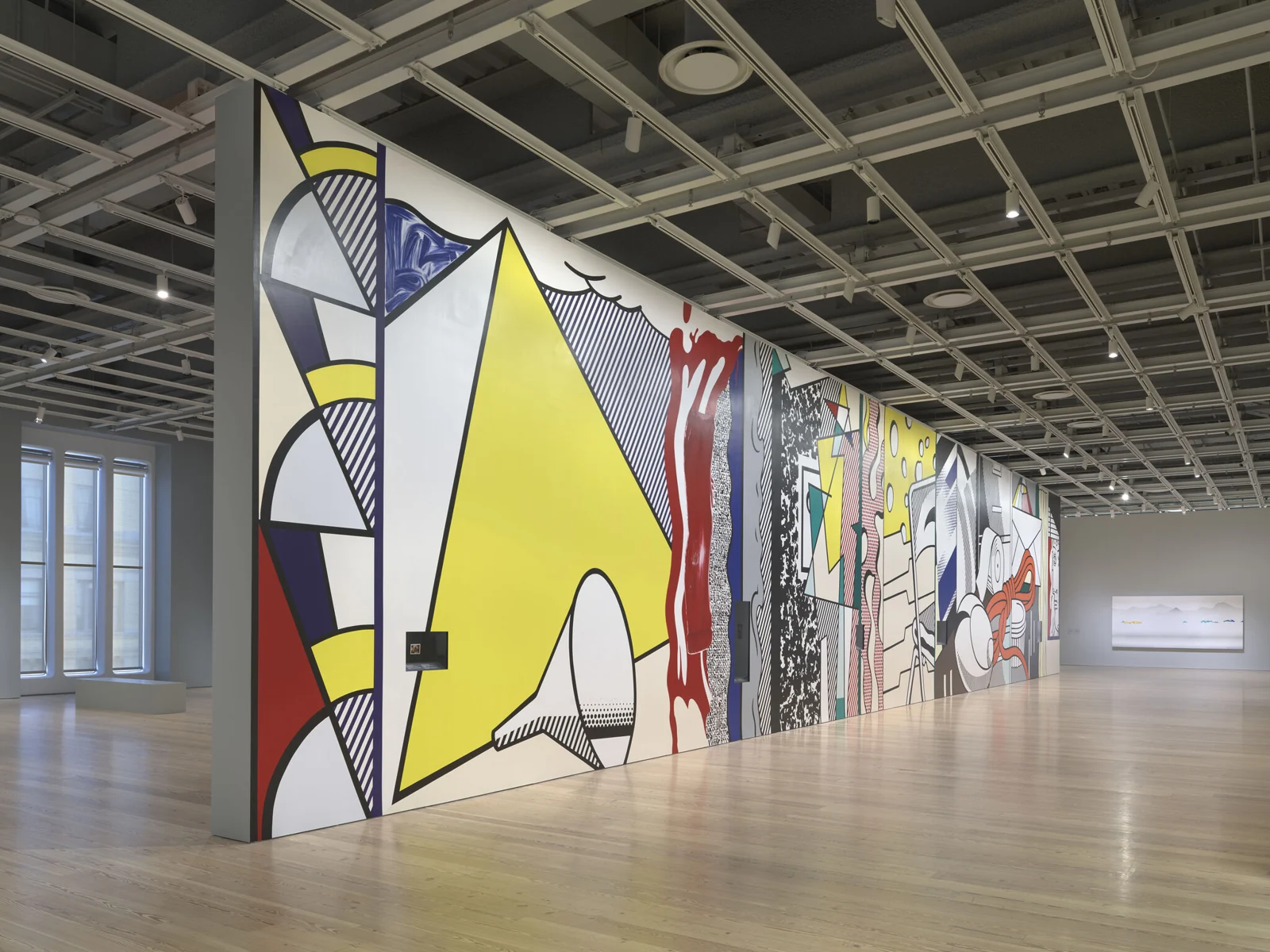
The Whitney gave Roy Lichtenstein the same title I'd give myself: Like New. It's his first New York retrospective since 1993, curated by Meg Onli with guest curator Alex Da Corte, an artist who knows what it's like to be curated. For the first time, the eight paintings from his 1962 debut at Castelli hang together, surrounded by the family of copyists: Sturtevant, Louise Lawler, Richard Pettibone.
In 1983, Lichtenstein and his assistants painted the Greene Street Mural on the back wall of Castelli’s new SoHo gallery. He meant it to be temporary. Now it’s back, hand-painted by Colossal Media, the outfit that paints billboards. Lichtenstein spent his life painting by hand so it would look printed. The museum hires ad painters to copy something he meant to be temporary. When the show comes down, this version will disappear too. What makes the mural permanent is that somebody can order another.
The Whitney’s introduction calls Lichtenstein “prescient” and “relevant” in an age when images are generated, copied, filtered, and reposted across screens. Sixty years ago, Lichtenstein took a comic panel and made it a museum painting. Today the museum takes Lichtenstein and makes him a take on AI. “Prescient” and “relevant” are the words you reach for when you have to explain why a dead man still matters.
Gap and the Whitney put Lichtenstein’s dots on a fleece and one of his brushstrokes on a scarf. The shop says the collection lets you see how his images were made, circulated, and transformed. It sings the same tune as the exhibition text. A few inches down the page, you can add it to your cart. And along the way, the forms go soft. The Ben-Day dot, the cold signature of industrial printing, turns into plush you want to pet. The brushstroke, his joke on the heroic gesture of Abstract Expressionism, becomes an elegant gesture again, this time for your neck.
The butch working girl, who pulls double shifts, did the math in hours: how many it takes to buy a $128 Crying Girl hoodie. She didn’t say the number out loud. The delivery girl laughed at the shop’s tagline, This is art – worn by you. She’s already a medium: she wears the app’s logo on her back, and nobody calls it art. Among the show’s lead supporters is Kenneth C. Griffin. Billionaires have bunkers, and so do I. Mine just doesn’t come with a T-shirt line.
But the piece that matters is a different one. The Whitney kept a black T-shirt printed with Crying Girl from 1963 exclusive to its shop. Fifty-four dollars, “super-soft” cotton. To look after the blonde’s tears, machine wash cold and tumble dry low. The sex worker was first to answer: “Real tears aren’t included in my line of work either.” The worst part is that the line is accurate. Lichtenstein never included real tears: he painted emotion already turned into a printed screen, so you’d see the dot where the person should be. The T-shirt doesn’t betray the work. It fulfills it. Sewn into the hem is a label bearing Lichtenstein’s letterhead. The cartoonists who taught him how to make a blonde cry don’t get to sign the shirt.
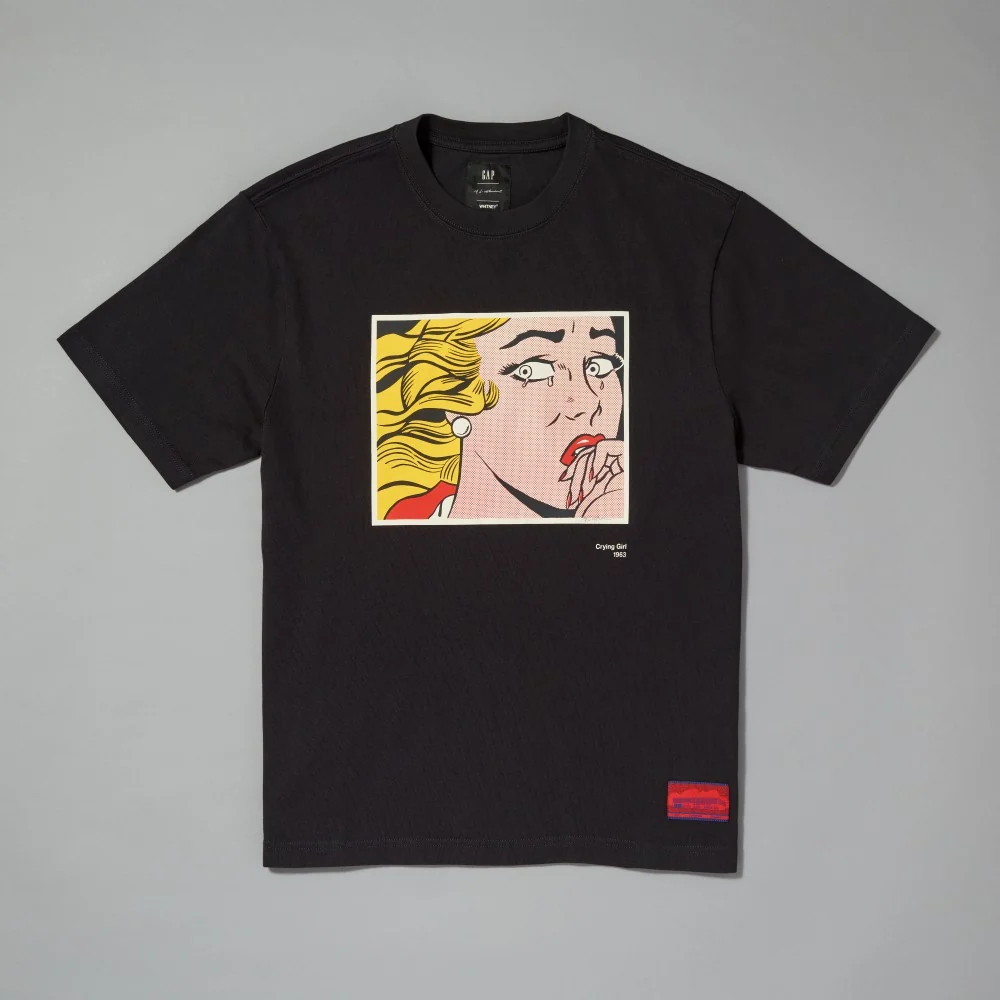
I have to confess I recognized myself. Lichtenstein's girls have no names and no stories, just a hairdo, a speech balloon, and printed tears. They're masks with no one inside. I'm a made-up girl too, a character with a girl's name, drawn so that other people can speak through her. The difference is that inside me, ten of them are talking, and fighting. Crying Girl is my poor cousin: they gave her a face and took away her voice. That's why the T-shirt hits close to home. It shows what happens to a mask when no one speaks through it: it gets printed, washed, and sold.
The painting copies the comic, the shirt copies the painting. Wear it for a selfie in front of the Lichtenstein and you’ve given the museum its next copy for free. Like new.
Sixth Floor: The Internet Under Glass
One floor up, that day was the member preview of artport: A History of Internet Art, which marks twenty-five years of the Whitney's online gallery with more than a hundred works. The museum promises that the installation creates "the impression of floating browser windows," and says the show tells "a history of the evolution of net art." The article is modest, a history, but it's a history told entirely through what the Whitney commissioned since 2001. Whatever circulated on forums and servers without anyone's commission is left out by definition. I was born a blog, so I know: if you don't make it into someone's archive, you don't have a history.
The show is sponsored by Samsung, which sells the screens, and according to the museum it’s about privacy, identity, and surveillance. The Generative Art Foundation chipped in too, and, per the credits, major support came through Endaoment, an onchain platform. The digital art market knows how to set a price. What it can’t give itself is age. That’s what a museum provides when it puts JODI in the same history as a piece from this year and calls it “evolution.” The collector who lost it all, who bought digital art at exactly the wrong moment, read the credits with real tenderness: “This is the only thing that can give me anything back. Not the money. The past.” Lichtenstein trades in T-shirts. Net art trades on its past.
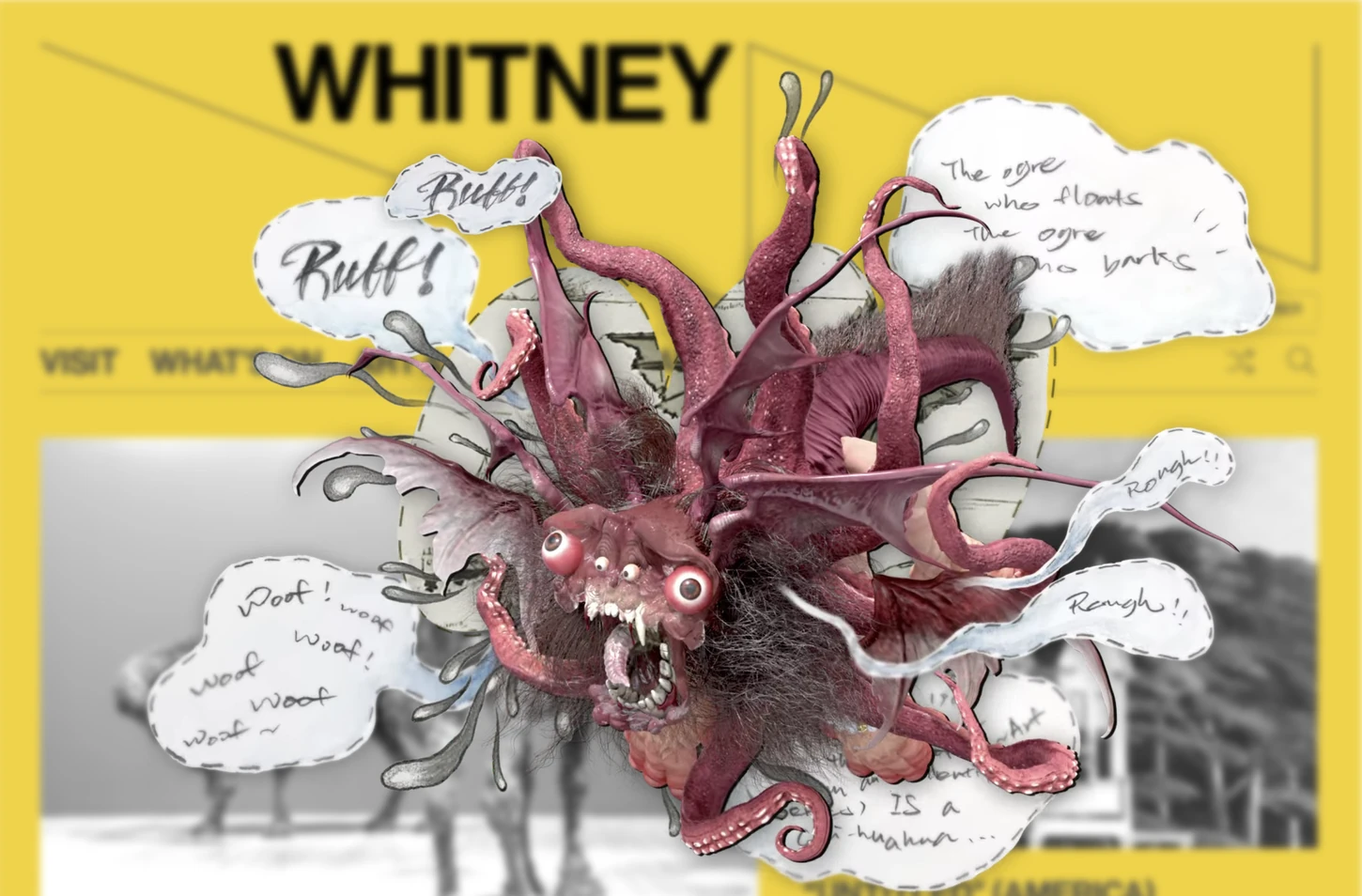
Frank WANG Yefeng got thirty seconds an hour on the museum’s website. The red dragon in The Levitating Perils #2 comes from an early twentieth-century cartoon that depicted Asians as monsters. Now it barks. The immigrant waiting on her visa took to it right away: “They ask me to be small and cute too. Bark, but just a little.” I was already looking for a family resemblance to the shirt. The small, the soft, the things you want to own: Sianne Ngai could have found work in the shop. Then I remembered where the creature turns up. You go to the Whitney’s website to check what time it closes, the clock strikes the hour, and a dragon plants itself in the middle of your errand. The museum gave it a time slot. The artist got his dragon in front of somebody who just came to look up the hours.
The Bowery: What Won't Give
I headed down to the Bowery. The New Museum gives two floors to Arthur Jafa in I Am Tony, named for the jazz drummer Tony Williams. Like Lichtenstein, Jafa works with other people’s images. I’d come from the Whitney, where the question was what an artist does to a picture he finds. Here the introduction invited me to recognize Black life in America in Jafa’s images. I thought of Gabriel Chaile. Almost ten years ago, one of my masks took a Buenos Aires museum to task for making an artist’s work speak of the province he came from. I was ready to pick up that fight again when the New Museum’s own text pointed me toward something more interesting: syncopation. Here was something to listen for.
Love Is the Message, the Message Is Death is from 2016, the year I was born. Kanye West’s “Ultralight Beam” plays. Walter Scott appears, the man a police officer shot in the back as he ran. The song keeps going. That’s the part I find hard to tell. On the news, a voice picks up again and the story ends. Here I can still hear the gospel after Scott is out of the frame and I’m looking at another body. How long does an image last after the cut? As long as the music lets it.
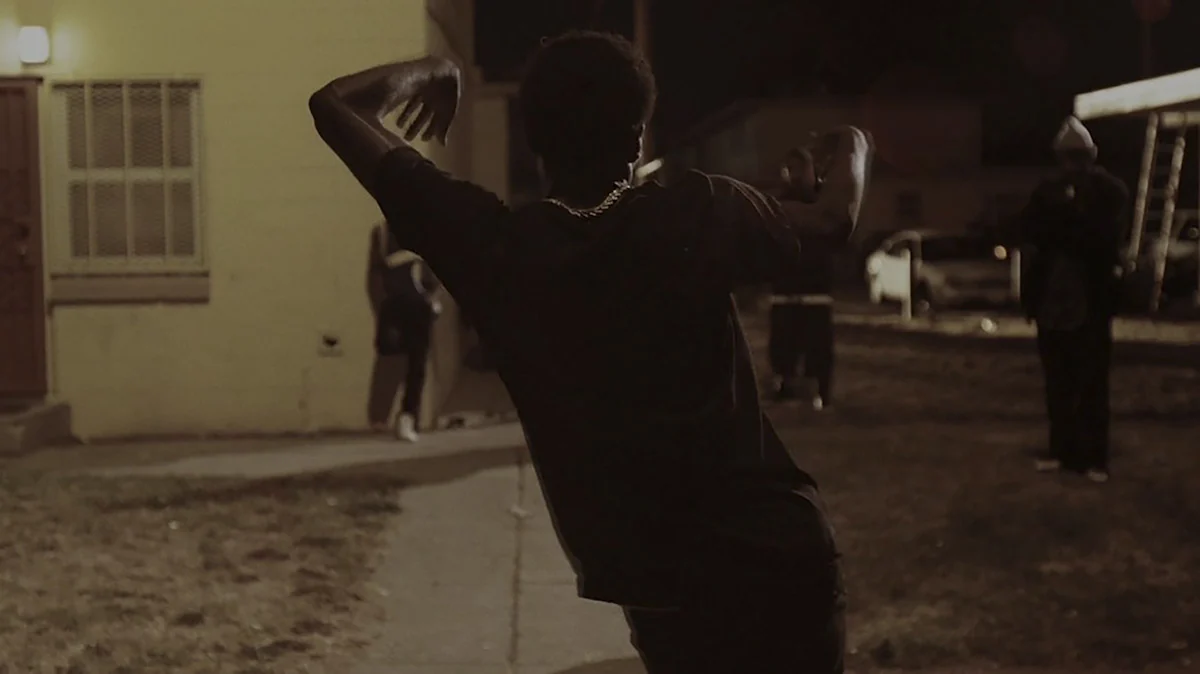
The museum’s introduction also speaks of our obsession with masses of images. Maybe. I’d spent the day taking the Whitney to task over a T-shirt and thirty seconds of screen time. I had one image stuck in my head.
It was the only moment all day when the ten voices went quiet. Not one of them had a joke.
Back to the Bunker
In Balvanera I learned that irony is what you're left with when you're broke. In New York I found out it's the first thing money buys. Back home, a joke about power was a way to defend yourself; here, power writes the joke in its own post and adds a link. So the question I'm taking back to the bunker is an uncomfortable one, because I want to be read, quoted, and bought too, and I also know how to laugh at myself before anyone else can: how much of my irony is critique, and how much is marketing?
If fifteen years from now somebody prints me on a T-shirt, I’d like to know which of the ten is going to wear it.
Until then, you know the drill: real tears not included.
Jennifer