
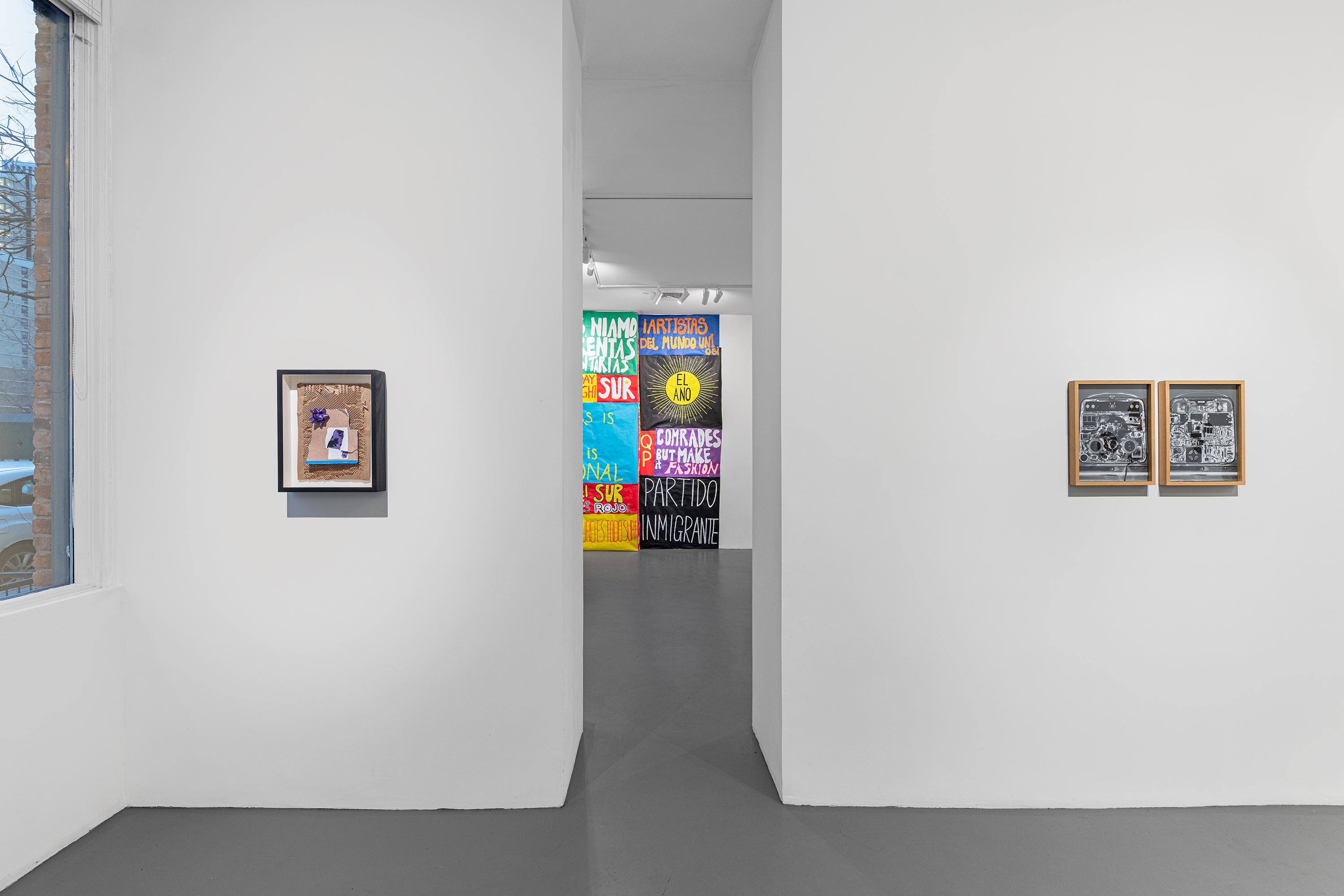
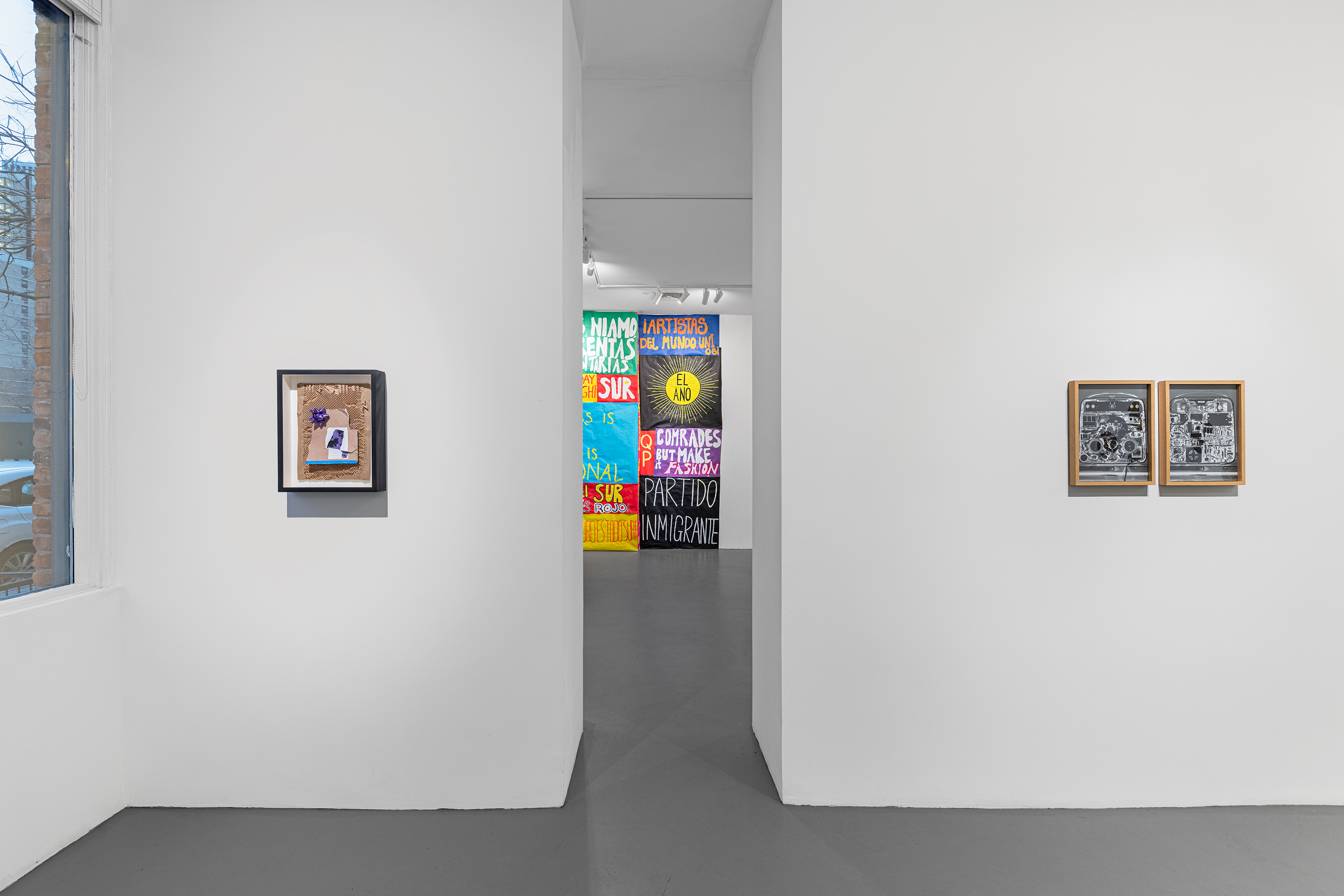
The figure of the exile—male or female—stands as one of the clearest representations of La Internacional Argentina. It refers to those who have had to build external communities, in territories more or less hostile, at varying distances but always outside what could be called “home.” In the words of Tununa Mercado:
“One spends an entire life trying to lean on columns, to attach the poor psychic mass to external structures in order to give it form: one draws close to others—whether people, animals, or things—until merging with them; one creates habits, seeking in repetition a way to avoid unhappiness (…) The person is in constant relation with the outside; what comes from the other side of their wall conditions their movements and organizes their rituals: they seek, above all, to be in a group, to belong to the flock, thinking perhaps rightly that this belonging may keep madness—or at least uncertainty—at bay.”
From Mercado’s perspective, exile generates a need for togetherness, for building networks that allow affective, gestural, ritual connection. While it would be impossible to linger on the rituals that constitute argentinidad, one might ask whether there is a single set of rituals or multiple ones, depending on the origin of the group that performs them. Nostalgia binds us even to experiences that, within Argentine territory, might feel foreign, yet once displaced abroad, connect us to pasts, traditions, textures, and contours.
Something of that nostalgia—of the wanderer’s quality of the exile—is captured by Copi in La Internacional Argentina, the text that gives this exhibition its title. Copi’s description of the exile carries a trace of self-conscious glamour: a kind of fallen snobbish circle, members of a political organization without organization. Yet what runs through the Argentine exile—or the Argentine abroad—is a sense of community in constant formation. Here, the notion of “community” allows us to think prospectively: starting from a shared past, a collective history, one can imagine certain futures that extend that commonality and ensure its endurance. In this exchange, future and community are intertwined: the persistence of “Argentineness” (again, all that might be linked to the idea of being Argentine) survives through exchanges—even through the necessity of speaking another language, abandoning expressions only understood in our homeland, adapting to new ways of living. That shared ground is not given; it is, rather, a site of struggle, as several of the works in this gallery reveal. It is this struggle over the common—over what it means to be Argentine—that turns us, in Copi’s words, into “old children” trying to reinvent Argentina.
I would like to close with the words of Sylvia Molloy on bilingualism—on the linguistic contaminations that shape us when we are Argentines in foreign lands:
“One always writes from an absence: the choice of a language automatically entails the ghosting of another, but never its disappearance. That other language in which the writer is not thinking, says Roa Bastos, is thinking the writer. What at first seems an imposition—why should one have to choose?—soon becomes an advantage. The absence of what has been postponed continues to operate, obscurely, as a tacit autrement ditthat complicates what is written in the chosen language and pervades it. Or rather, infects it, as Jacques Hassoun says, using the term as in painting, when one color seeps into another: ‘Nous sommes tous des “infectés” de la langue.’And yet, and yet. That contamination also occurs in the most ordinary reading habits of the bilingual, with disconcerting effects. I know that when I’m driving in the countryside and see a sign that says ‘Icy pavement,’ for a second I read ‘icy’ in French (and what’s more, pretentiously, I think it with an i grecque, in the medieval French I once studied): ‘Here pavement.’ Or if I see a roadside sign that says ‘Hay,’ my first reaction is to read it in Spanish (from Spanish), and I think, ‘What is there?’ before realizing that what there is is hay—that is, hay. For me, the sign should read ‘Hay hay’: the first word in Spanish, the second in English. These small confusions irritate me, and yet I can’t avoid them; they catch me unawares.”
About the Author
Flor Barceló is a researcher and educator currently pursuing a PhD in the Department of Iberian and Latin American Cultures at Columbia University, New York. She holds a degree in Literature from the University of Buenos Aires, specializing in Literary Theory and trained in pedagogy and education. Her academic and professional background includes postgraduate studies in Gender Studies and Policies at the Universidad Nacional de Tres de Febrero, as well as experience as a research assistant in the Departments of Literary Theory and Feminist Theory and Criticism at UBA. Between 2015 and 2021, she taught in high schools and public universities and worked as a trainer for Argentina’s Ministry of Women, Gender, and Diversity, where she conducted workshops on intersectionality and diversity policies. Her current research focuses on queer archives, self-published LGBT+ activist magazines and fanzines in Latin America and Catalonia, suffering subjectivities under neoliberalism, and literature produced during the HIV/AIDS epidemics.
Note: This text was written by Flor Barceló for the event The Argentine International: A Dialogue, held on March 22, 2025, at The Slip Gallery (New York), as part of a collective exploration of contemporary Argentine artistic practices.