
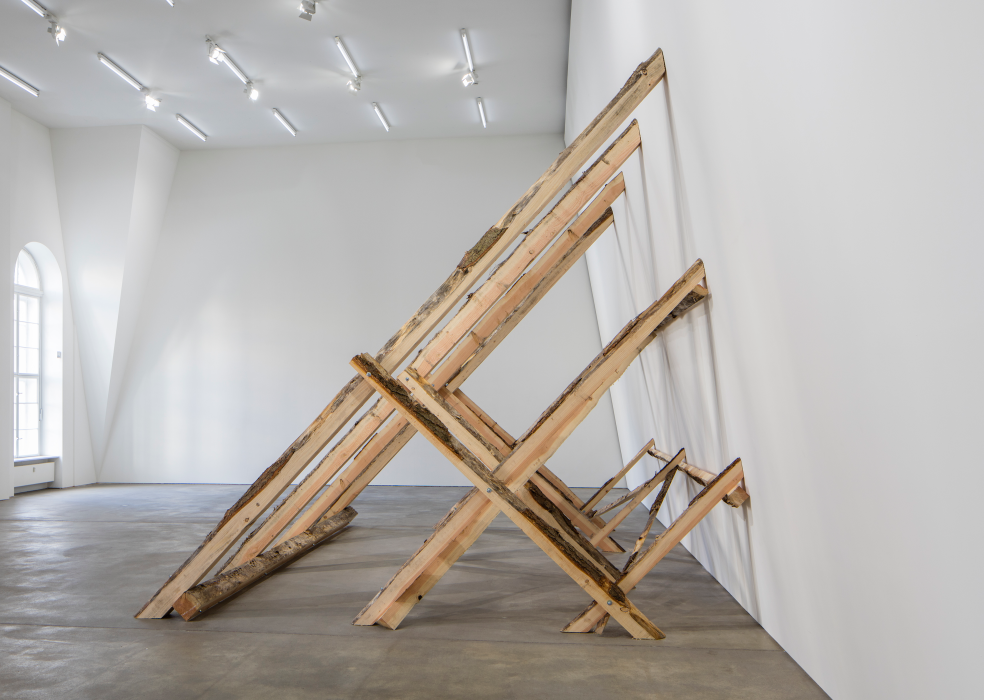
In The Machine, David Lamelas's exhibition at Dia Chelsea, several works have two dates. Untitled (Falling Wall) is dated 1993/2026; Piel rosa, 1965/2026. The slash seems to separate an invention from its return. But what happened between those years deserves more than a conservation note. A retrospective also decides what can be made again, and on what grounds it can keep the same name.
The checklist identifies Piel rosa as an exhibition copy. The leaning wall of Falling Wall, meanwhile, is built again to sustain a fall that never quite happens. They share a second date, although they act differently in the present. The copy allows an earlier form to be exhibited; the wall requires the material problem of keeping it out of position to be solved again. The slash groups together operations worth distinguishing.
The most revealing case, however, lacks that second date. Office of Information About the Vietnam War at Three Levels: The Visual Image, Text and Audio remains dated 1968. At Dia, its front glass partition is removed, and the office is visible from the street through the building's window. A consequential spatial change does not require a new year alongside the title.
From the sidewalk, the gallery's glass becomes the office's frame. The distance between those watching and those administering information takes on another scale: the building participates in a separation previously organized by the work's display structure. The shift matters because these distances are precisely what the work operates on. Its identity persists while the position from which it can be observed changes. The date preserves an origin; the installation redistributes positions.
This complicates a familiar temptation when looking at conceptual art: to imagine an idea pure enough to pass intact through any realization. Lamelas allows variations. The critical task is to establish what those variations do, even when artist and institution agree that this is still the same work. Authorization settles a question of identity; it leaves the question of effects open.
In 2016, Daniel Quiles discussed the difference between reconstructing these works as historical archives and treating them as situations open to updating. A further difficulty belongs in that discussion. In his conversation with Neus Miró that same year, Lamelas defended the decision to reuse the original Vietnam news at MoMA: temporal distance had allowed him to perceive a human dimension he had previously missed. Preservation can also change an experience. Substituting a current war for Vietnam would not, in itself, guarantee a more incisive reading.
Here the second date acquires substance: it prompts us to ask what is preserved to produce a difference, and what is changed to sustain continuity. An apparatus can remain identical and address us differently. It can also receive new materials and repeat an entirely familiar relation. The amount of technical novelty tells us little about the force of its intervention.
Situación de tiempo II, dated 2025, introduces another possibility: a new commission with seventeen monitors and a color-bar generator. Its relationship to Situación de tiempo, from 1967, is part of how it operates. Repetition enters the present here with the status of a new work. Lamelas is still working on his past; the retrospective gives him the means to produce within the history it is organizing.
It is therefore insufficient to describe this exhibition as the rescue of a forgotten precursor. The research for Life as Activity, presented at Hunter in 2021, was supported by ISLAA, which also participates in The Machine. There is a concrete institutional continuity. Dia adds a scale of production and assembly that allows historical objects, copies, new realizations, and recent commissions to coexist. That coexistence is one of the exhibition's achievements.
It also calls for a reading that distinguishes its terms. The coherence of a career can become too comfortable when every difference in status seems to confirm that the artist always had the same great idea. The office without its partition, the declared copy, and the new television situation allow a less settled account: they offer different ways of negotiating what still belongs to a work.
The strength of The Machine lies in that negotiation. A retrospective can present an artist as someone whose importance is already established while providing conditions for him to keep altering what we will recognize as his work. In Lamelas, the two operations brush against each other without quite coinciding. The second date gives us a way to begin reading that discrepancy. Then we have to look for it where it has not been written down.
David Lamelas: The Machine. Dia Chelsea, 537 West 22nd Street, New York. Through January 16, 2027.
Daniel Quiles, “Mediate Media: Buenos Aires Conceptualism”, post / MoMA, 2016.
Neus Miró, “Artists at Work: David Lamelas”, Afterall, 2016.