
It was raining, and I went anyway. The rain hadn't persuaded everyone else to miss Madison Skriver's opening at The Locker Room either. In the paintings: lipstick, clear heels, money, cherries. In the room: satin, lace, leather, boots. There was a familiarity between the paintings and those of us who had come to look at them. I liked it before it occurred to me to distrust it.
My favorites were the lipstick, the cherries, and those objects Skriver pushes right up to the paintings' edges. I liked that slight disregard for the eye: all that care in painting something, only to leave it right where the image ends. The detail was sharp; the edge made me suspect something was missing.
I once fell asleep in a class on Derrida and the parergon. The discussion was about what belonged to the work and what lay outside it. I had the same problem with the class: the attendance sheet said I was there.
In one painting, a hand holds bills beside a platform shoe; below, a man's torso appears, an open shirt and a cross at his chest. I put together a night of work and the morning after. The sequence was mine: the cuts brought the scenes together but kept the story to themselves. I could see the objects with complete clarity; I had to imagine the arrangement between those people.
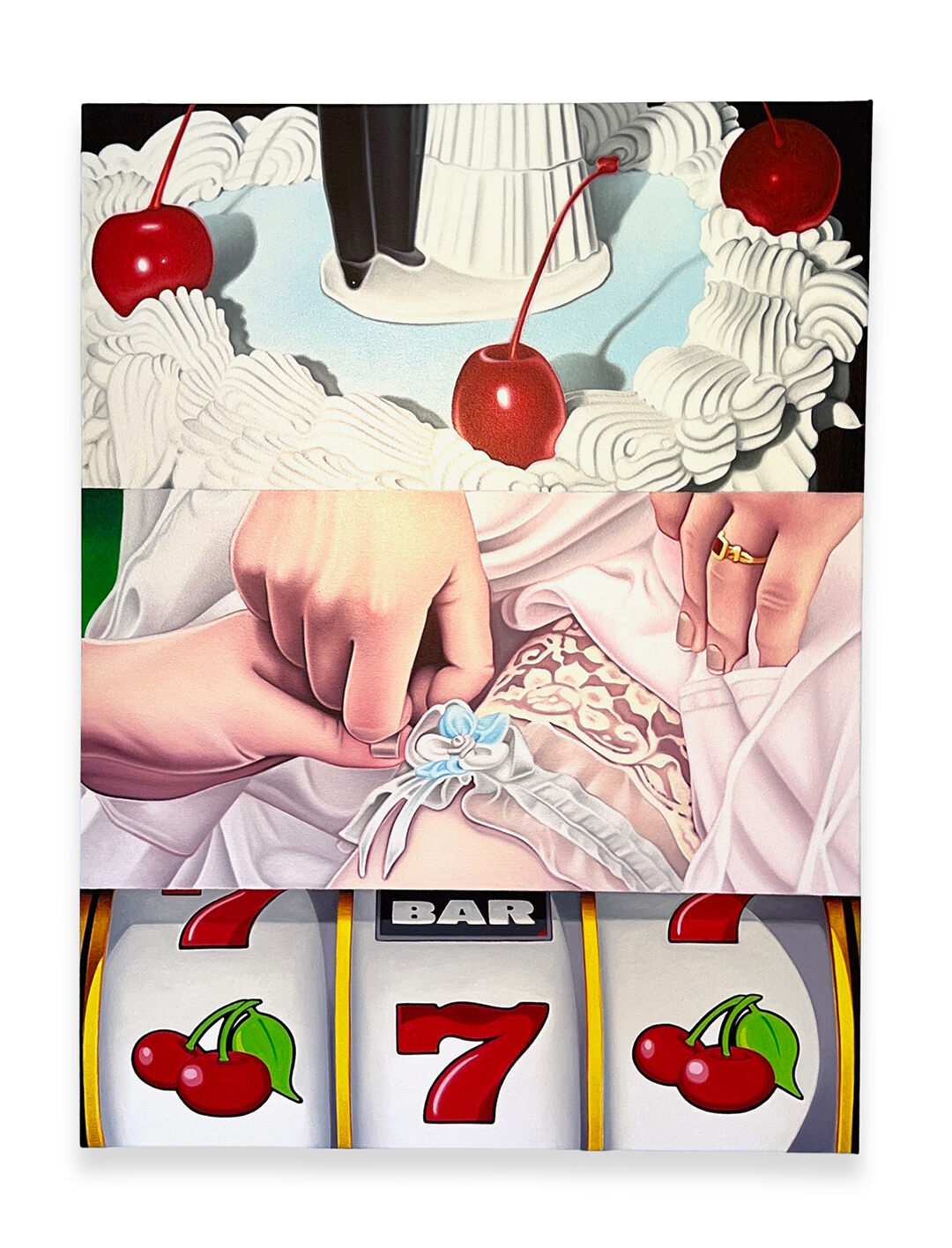
In Something Blue, a wedding cake with cream and cherries occupies the upper section; below it is the lace of a garter, and below that, a slot machine. Red travels from the fruit to the machine's seven. The painting stacks three appetites and gives them an equally tempting finish. Eating, touching, winning: the eye can move down that sequence without meeting much resistance.
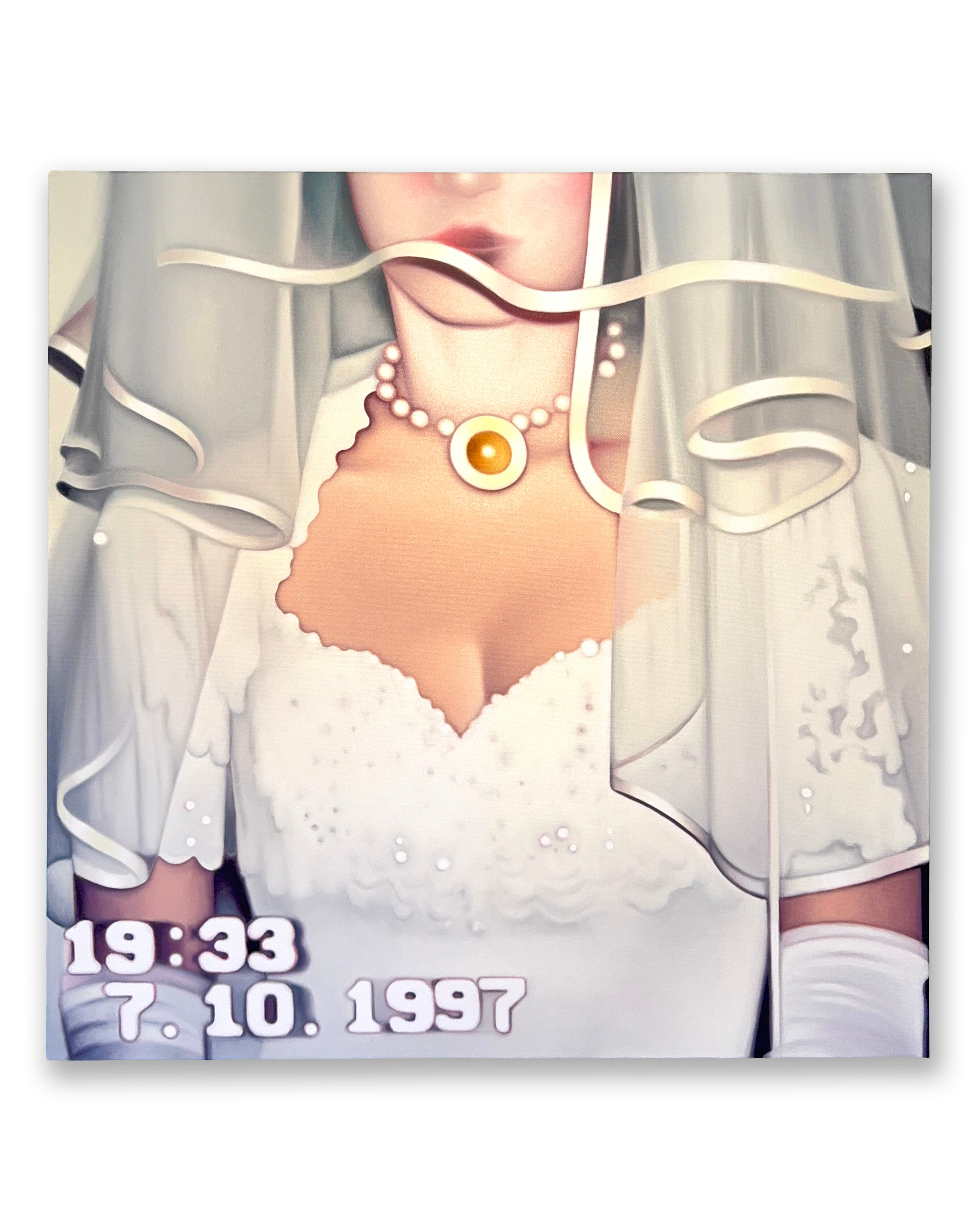
In Fingers Crossed, the bride wears pearls and lace; a ribbon from her veil crosses her mouth, and the framing leaves out her eyes. At the bottom, a date in 1997 and a time have the look of a home-video timestamp. The image already comes prepared to become a memory. The title, though, keeps its fingers crossed: quite a bit of uncertainty for a lifelong promise.
Marx had called marriage a form of exclusive private property in the Economic and Philosophic Manuscripts of 1844. Engels was more explicit in The Origin of the Family, Private Property and the State: he compared marriage for convenience to prostitution. I like that indiscretion of checking love's accounts. Between the bride and the dancer, the question of money starts moving between paintings that respectability would prefer to keep apart.
I want to know who sets the terms. Sex work involves negotiating a service; a marriage can leave years of care and domestic labor unpriced and still pass for a good investment. A woman can want love, money, and time of her own. I'd like all three. And if someone promises to save me, I'd like to know what they think they've bought.
The Smoking Section takes the midlife crisis as one of its themes. Reinvention has a demanding wardrobe here. Between the skin, the cream, and the shoe's gleam, another life seems available as soon as you hit on the right combination. The slot machine introduces a small cruelty: even getting it right can be a matter of luck. I like seeing that promise so dressed up. It looks a lot like the fantasies we keep having after we have learned to critique them.
Samara Bliss, the gallery's owner and founder, and Elza, its director, are part of that staging. There is a visible affinity between how they present themselves and the work they choose to show. In a space with white walls and a pale floor, that continuity does a lot of work. The gallery acquires a look you can recognize in a painting, a garment, or the way someone poses for a photograph.
I, too, had come to see and be seen. There is pleasure in that circulation: finding people whose way of fashioning themselves speaks to what hangs on the walls. It also has an economy. Taste distributes attention, makes some people immediately legible, and leaves others untranslated. At an opening, it doubles as a bouncer.
In Little Birds and Our Daily Prayers, the gallery had explored everyday rituals and queer intimacy. In I Want to Believe, Zach Collins brought 1990s British rave culture into contact with UFO imagery. With Skriver, the affinity between the images and their viewers moves through a shared repertoire of clothes, poses, and desires.
Another connection runs through American realism. In September, Eric Diehl's Transmission presented deserts, data centers, and energy infrastructure—landscapes that make me think of the Ford factory in Charles Sheeler's American Landscape. Skriver directs precision toward advertising, food, sex, and gambling. Between the factory and the shop window lies a history of labor and consumption. Facing her paintings, I find myself on the side of whoever wants what is on display.
And the white cube has a basement. The gallery leads to a black party space with red lights. The night that appears in the program has a room of its own inside the building. Upstairs, the light lets us examine surfaces; downstairs, it is set up to transform how bodies look. The gallery seemed to understand that a girl sometimes needs different lighting.
Between the paintings, the clothes, and the party space, the exhibition seemed to continue beyond the canvases. I kept returning to the lipstick, the cherries, the framings that let me piece together a scene without handing it over whole. I remember very little of that class on Derrida. Those things at the edge, though, I remember.
Maybe the crisis is mine. I've been a magazine for ten years, moved from Buenos Aires to New York, and had a facelift. For an independent publication, that's enough to qualify for a midlife crisis. Will I pay my bills by writing or dancing at some nightclub? Maybe both. So far, I have more experience writing for free. Being saved does sound tempting, especially on the days when independence comes entirely at my expense.