
I remember my thoughts coming to a standstill. My mother, who used to sing Sui Generis songs solemnly out of tune, was absolutely indignant. ‘Chipi chipi, sweetheart: just look at what Charly García sings now.’ So was a friend—my own true love—who played the guitar. ‘It’s bullshit.’ I did not contradict them, but one Sunday I cut an interview and a box containing the lyrics out of the newspaper. I was fifteen, and it left me stunned with admiration: ‘I’ve never been to New York / I don’t know what Paris is / I live underground / I live inside myself / I don’t have a mirror / I don’t have a souvenir.’ I thought many things later, after listening to the whole album, absorbed. La hija de la lágrima, released in 1994, unfolded like a long novel, a little ridiculous or tragic. ‘The shadow comes and does not wait, / it appears / and leaves you no choice. / Everything turns to wood.’ Charly spoke in the first person, and he was a girl; her present was precarious, about to vanish. There were moments of fury and moments of contemplation. Soundscapes, broken things, street noise and rain. As a mark of its conceptual nature, the songs were woven together by recurring phrases, voices, or words. A mesh with funny insertions: a brief rumba, a rock cover, and other bits of nonsense. ‘Chipi chipi’ was, in fact, the pinnacle, the very summit of nonsense; that was how lovers of ‘content’ heard it, and how radio stations heard it, since it quickly became a hit. A video circulates on YouTube of Charly on Susana Giménez’s television show in 1995. Charly invites her over to the piano; she sits beside him; he is going to dedicate a song to her. He sings ‘Chipi chipi’ and looks at her. Music and Susana are one and the same. Susana happily joins in.
The word ‘chipi-chipi,’ he told Daniel Riera around that time, means nothing—or rather, it means nothingness itself, a song of the kind ‘in which plagiarism is looked upon favorably.’ Little hand-cranked music: ‘This song will last forever / that’s precisely why I made it this way.’ Whether close to the ear or farther away, Charly inscribed silliness into La hija de la lágrima: he exaggerated and deflected the protagonist’s pain, made it tender and pop. ‘Chipi chipi’ approached a limit. Charly’s ecstatic listeners, who exalted him for lyrics that resisted and jabbed at power or society, could not have maintained that the song contained only irony or parody, or any other form of binary thinking that diminishes something to conceal a greater meaning. You heard that, and something more: the little tune, tenderness, the emptiness of thought. It was all of this together that made us laugh at ‘Chipi chipi,’ without understanding what we found funny.
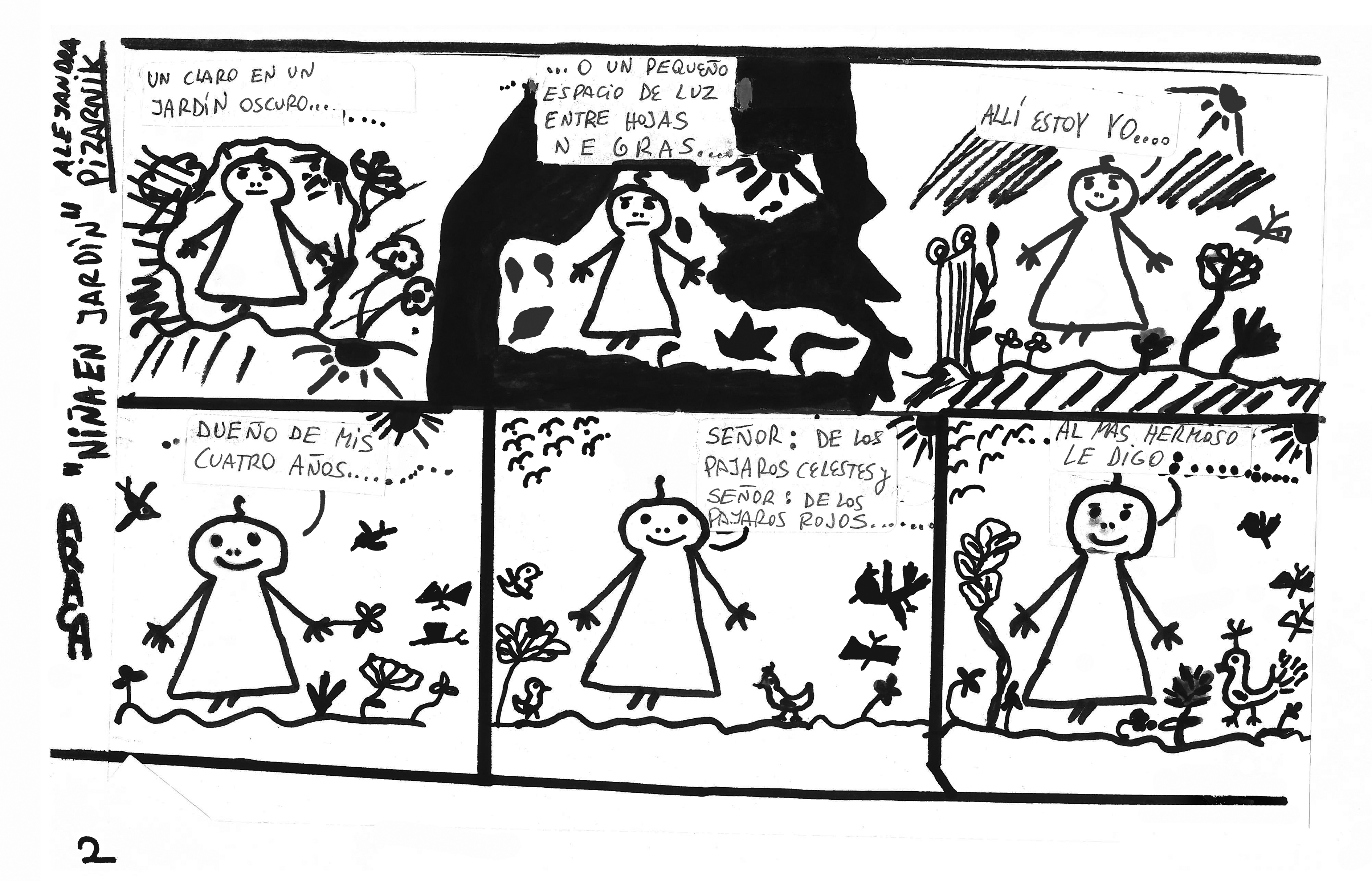
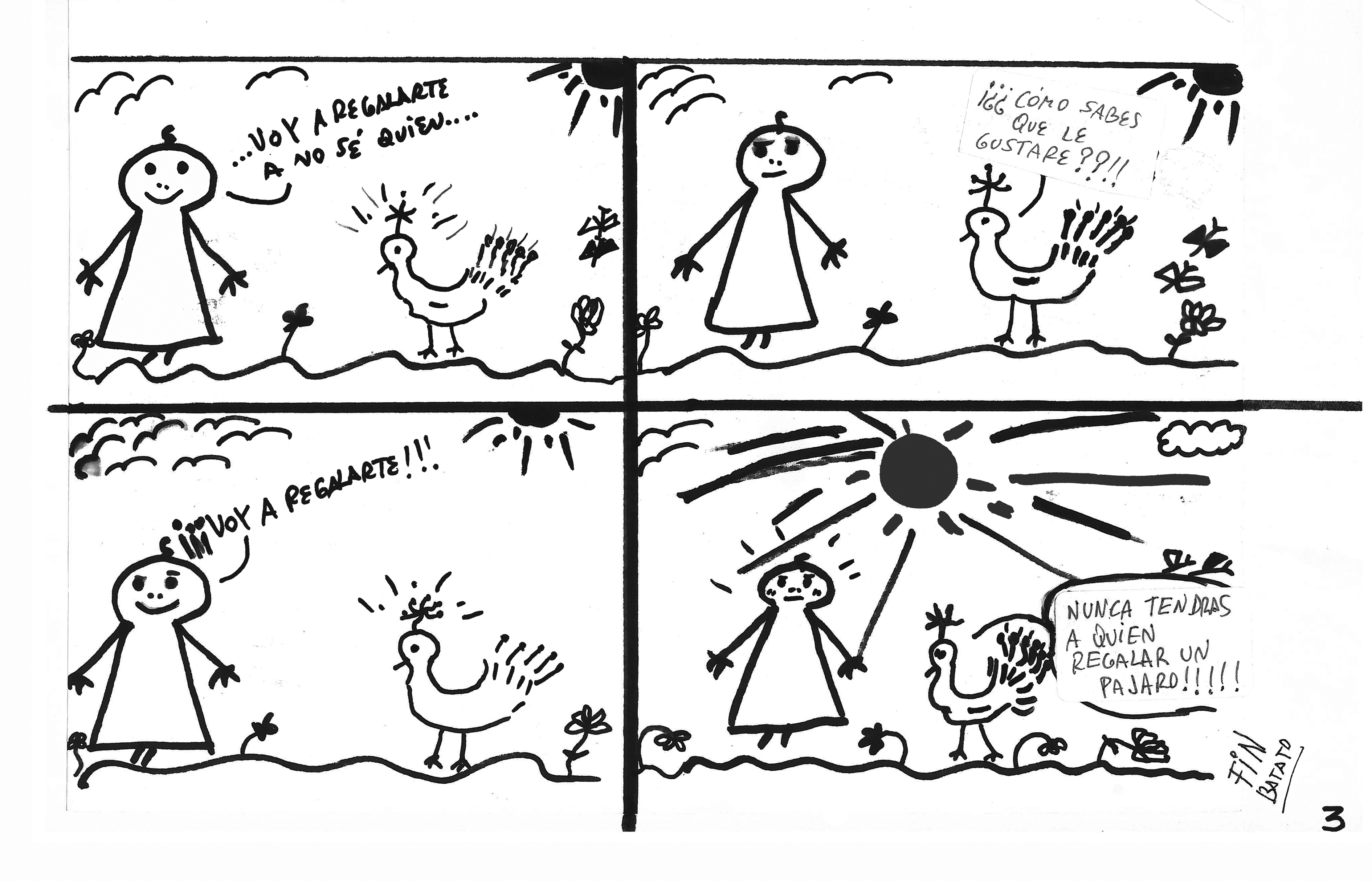
Almost ten years before Charly’s album, on the fine border between the 1980s and the 1990s, another girl was singing the songs of another ‘daughter of the tear.’ I mean Batato Barea and his covers of Alejandra Pizarnik, in an equally bewildering and strange key. How odd it is to watch Batato perform, to hear him shout: ‘I no longer exist and I know it; what I don’t know is what exists in my place!’ Batato used minimal means to make people laugh with Pizarnik. Where the poems spoke of the distance between words and things, Batato ‘illustrated’: he brought signs onto the stage defining the word ‘asphodels’; he burned a piece of paper with a candle to represent a ‘bent candle’; he used a fan and said, ‘A wind came and swept everything away’; he drew a little stone beside Araca, his minimalist character in Historietas obvias, and transcribed ‘Extracting the Stone of Madness.’ He also made the character say, drawing an exclamation mark beside it: ‘And above all to look with innocence, as though nothing were happening, which is true.’ Some accounts of art in the 1980s and 1990s—particularly the scenes emerging from the underground—emphasized parody as a key. This was not always viewed favorably: indeed, it was accused of being light, trivializing, and conducive to neoliberalism. There have, of course, been many disputes over light art, or lightness in art, although some figures suffered more public lynchings than others. Take Emeterio Cerro, whose work Fogwill himself described—I take the quotation from an article by Daniel Freidemberg—as ‘foolishness for gay café-concert consumption.’ And yet, even where there was parody—with Tortonese and Urdapilleta, he dressed up as poetesses reading dreadful, sentimental poems at a literary gathering—Batato’s method rested on the clown’s neutral mask, on an innocent, literal gaze that undid any metaphorizing or tragic quality. It was another way of reading, equipped with a plebeian sensibility—the ‘plebeian archive,’ as Sara Bosoer would put it—an ‘obvious’ canon, the modernista library of school textbooks, and a queer canon: the writers circulating at the time in fragments of borrowed books and photocopies, among them Pizarnik herself.
I recently wrote in Otra Parte about Amor total, the book bringing together works from Fernanda Laguna’s first exhibitions, also from 1994 and 1995, at the Rojas. In the curatorial text recovered through Francisco Lemus’s research and introduction, Jorge Gumier Maier spoke precisely of the difference between parodic or avant-garde copying and Laguna’s copies, stripped of irony and kitsch ambitions, oriented instead toward handicraft or the talisman. Laguna’s work, too, had begun in a ‘chipi chipi’ form: as a work-sign reproducing tender, sensitive things of mass appeal. Like collectible stickers, reproductions of photographs from magazines, or album covers. In his 1994 text, Gumier Maier found in them the memory of a neighborhood art school, where learning art meant copying ‘friezes, anatomical studies, the faces of babies and old people, Tyrolean landscapes.’ A democratizing impulse, a domestic absorption of different motifs from popular art, the creation of a small fantasy. A souvenir. At the presentation of that book and the third chapter of Orgullo y prejuicio—the exhibition Lemus curated for Nora Fisch gallery—Fernanda said that painting the faces of Luis Miguel or Cristian Castro was a way of recreating a moment of happiness and carrying it with her, ‘to have them with me.’
Gumier Maier saw then, in 1994, that not every copy answered to the terms of parody—homage and dethronement, high and low, the explicit and the concealed—so thoroughly reconsidered and theorized in the early days of postmodernity. There was something else that pop art was making possible through its exercises in lightness, its forms of extreme simplicity: something that did not point toward a greater contrary meaning that would validate them, but toward the construction of a tiny language, sumptuous in expressing its minimalism, with nothing more and nothing less than the bewildering effect of its sheer literalness.

Images: Batato Barea, Historietas Obvias, no. 3, June 1987. © Archivo Batato Barea, courtesy of Cosmocosa. Reproduced in Batato Barea, Historietas Obvias, Editorial Milena Caserola–Cosmocosa, Buenos Aires, 2017, pp. 80–81.
#EspiralAños90 — special edition of critical writings on the 1990s