
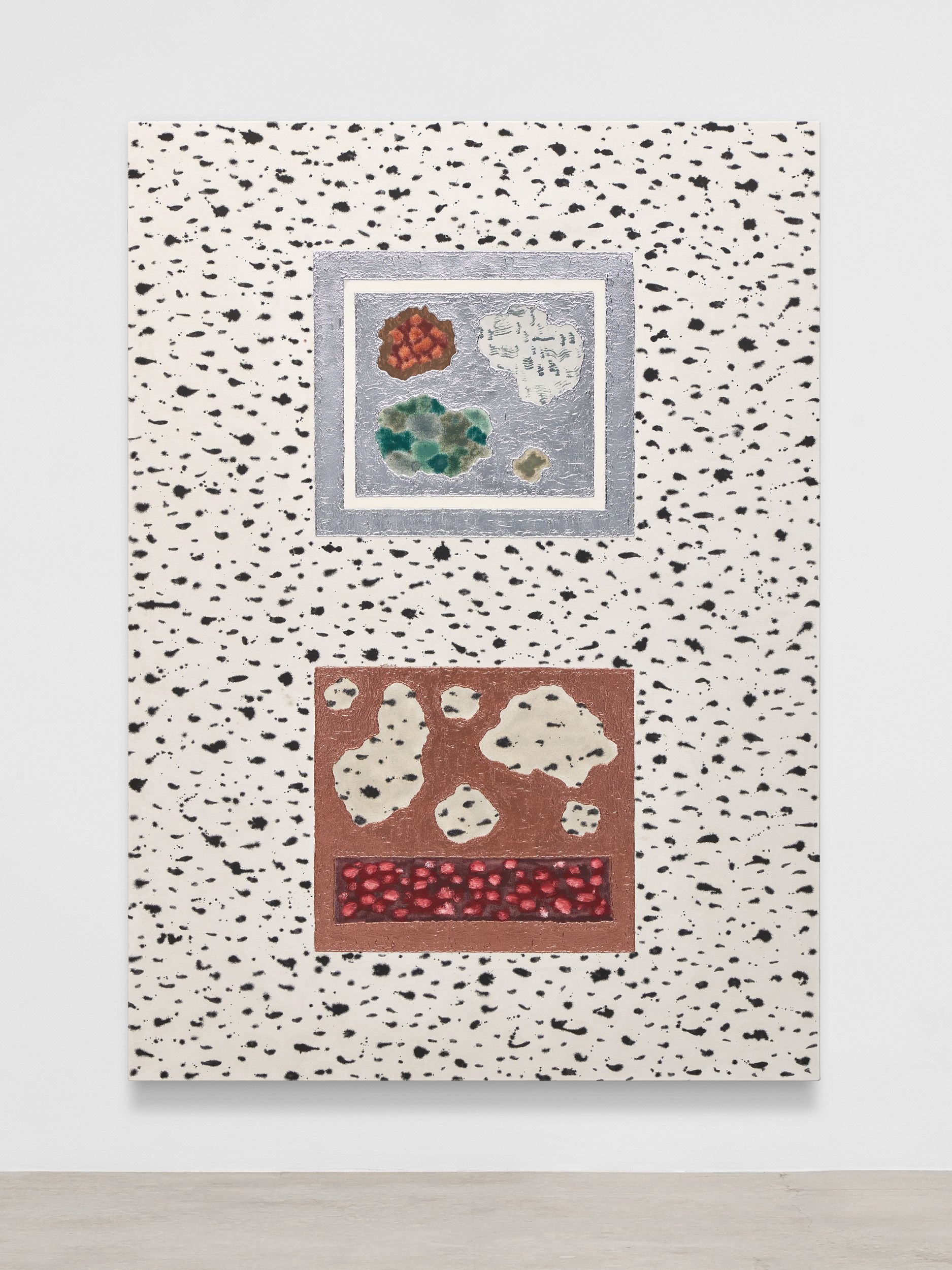
In Rebecca Morris's Untitled (#16-26), black speckles spread across a white field. Farther down, inside a copper-colored rectangle, they reappear in small, isolated shapes. The same motif that serves as a ground outside receives a place of honor inside. Between the two, painting has manufactured a difference in rank.
That promotion interests me in #35, her exhibition at Bortolami. Interior frames, borders, and metallic-looking surfaces distribute attention among marks that could pass for patterns, color tests, or residue. The painting shows how much a presentation can do for what it presents. A mark gets its own setting and suddenly seems to have deserved one all along.
The upper rectangle in #16-26 takes this operation quite far. A silver border contains another silver field, separated by a white band. Inside are a few colored motifs. The painting equips itself with the apparatus of an exhibition: frame, interval, ground, selected objects. But there is something unstable about its solemnity. In the lower rectangle, the speckles retain an unmistakable kinship with what has been left outside. The hierarchy is being constructed in plain sight.
Shine helps, and it would be a mistake to treat it as an embarrassing concession. Morris uses paint to produce the appearance of metal: the gallery describes thick oil lines coated with spray paint. There is representation inside this abstraction. Paint imitates a material we associate with settings, ornament, and soldering. It can suggest value or assembly without depicting a jewel or a machine.
In Untitled (#15-26), against a pink field, fragments receive gold, silver, and copper-colored surrounds. Some motifs recall those in the previous painting: black marks on white, small grids, reddish clusters. Their new positions change their character. The painting resembles a collection of costume jewelry, with one consequential difference: the settings are as irregular and specific as what they surround. They want attention too.
Shine thus becomes more than a finish applied to an already resolved composition. It produces relationships. A surface can support a detail, surround it, compete with it, or become the principal figure. Abstraction becomes quite worldly: it knows the power of an accessory. And it lets us see how much of that importance is manufactured, without requiring us to stop enjoying it.
The discussion of taste has specific precedents. In her conversation with Molly Zuckerman-Hartung in BOMB, Morris connected decisions about surface to gender and described her interest in appearances whose prestige had expired. She also distinguished her process from her interlocutor's: she has procedures for bringing a painting to completion. Reading these paintings as celebrations of accident or endless revision misses that decision.
What remains open, once the work is finished, is our distribution of importance. Painted metal can seem precious, vulgar, domestic, or excessive. Each judgment carries an idea of what a painting that expects to be taken seriously ought to look like. Morris makes us exercise that judgment on a surface whose rules change within a single canvas. A ground can acquire a setting; a frame can become another mark.
The differences between the works help establish the reach of this operation. In #15-26, the abundance of small centers of attention sometimes threatens to settle into a repertoire: a halo for every fragment. In Untitled (#14-26), two silver paths traverse a turquoise field and are cut off by the canvas's edges. There are fewer elements, but the lines do not resolve into a frame either. They leave broad areas of color whose extent the eye has to negotiate.
#16-26 strikes me as the most incisive painting in this group because it lets us test the difference each enclosure makes. The speckles inside and outside the rectangle offer an almost experimental comparison. Its strength lies in keeping recognizable what has changed rank. We can see the promotion without having to believe that the promoted material has become something else.
Morris does not need every irregularity to be an act of resistance. A composition can manage its oddities as efficiently as its symmetries. What makes these paintings interesting is the possibility of catching ourselves conferring prestige: a border, an interval, a little imitation silver can be enough. The mark is still there. Our willingness to take it seriously has already shifted.
Rebecca Morris: #35. Bortolami, 39 Walker Street, New York. Through December 19, 2026.