
The history of art in Buenos Aires can be interpreted through two vectors: scale and style. It expands and contracts between two vast limbos where time and space are lost, either dissolving into a drawer of the past devoid of history or abandoning life to become eternal in a mental fiction. At least, that's how it has been told until now, as if it were something that took place between the 19th and 21st centuries, between the bazaars of downtown Buenos Aires and some forgotten industrial warehouse.
However, in this year's arteBA art fair, it seems difficult to find anything resembling a story. In the jumble of artworks and people bumping into drywall panels and wandering among a thousand light bulbs that don't quite know where they're supposed to shine, the spatiotemporal coordinates don't function in the way we're used to; scale is lost and style never emerges.
The fairest thing would be to treat this as a parallel reality, with its own limbo. If we don't know much more about that limbo, it's because we haven't yet met anyone who has been able to escape it to communicate with us. That parallel reality is perhaps something similar to what happens inside a Tupperware container. Only the leftovers know what happens when they get together, only a breaded cutlet knows what it feels like to be in there for a couple of days. The closest thing to a story I found at the fair was the confession of a friend I hadn't seen in a few years who revealed he was thinking about getting a hair transplant. But what I want to talk about here isn't so much the weariness, but rather the work of Mimi Laquidara, which is on display at Espacio Andreani, at the entrance to the fair.
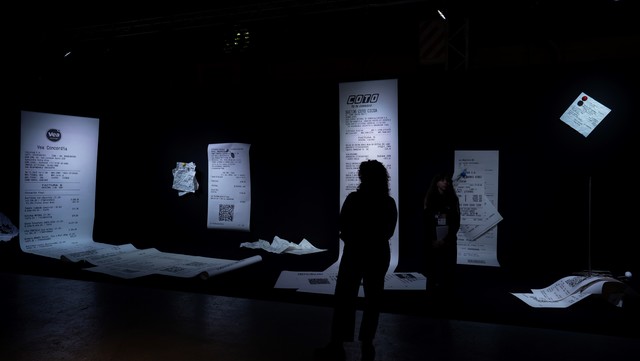
After a couple of days of intense work, limbo, and nights of partying, Mimi Laquidara looks a bit tired. Meanwhile, she tries to stay alert to warn people not to stand with muddy feet on her artwork, to take selfies with something they may not even recognize as a drawing.
The drawings feel large in scale, while their style is imperceptible. Enlarged copies of shopping receipts from Coto, Vea, and Res, executed by hand, meticulously following the precepts of John Ruskin. The sacrifice inherent in the effort required to create a great work, the truth expressed in the fidelity to the nature of the materials, the power of monumentality, the Platonic beauty with which the imitated model is scaled, the memory projected as a faithful witness to the sentiment of this era, and the obedience to the artist's original criteria.
“Breaded chicken breast cutlets” and “yerba mate” are some of the words depicted in these drawings that document her purchases over the past few days. The work emerges as something akin to a commission, something that comes with a budget for assistants and materials offered as if they were a guarantee of successfully fulfilling the demand. In this way, a premise is drawn, both literally and theatrically: for a contemporary art market to exist in Buenos Aires, one must spend money.
Although there's no history in limbo, something emerges here that we must remember. The contemporary art market in Buenos Aires may have been born as a delirious Keynesian fantasy. In a troubled context, where success seemed highly improbable, someone came up with a way to definitively escape poverty, a path that initially seems counterintuitive: spending.
While inflation falls due to the recession, Mimi's drawings—very timely—remind us that we are somewhat lost, that we don't know how the story will continue, and that we have to spend, even though spending is not a plan that can last forever.
On Papeles by Mimi Laquidara at Espacio Andreani, arteBA 2024.
Photo: Xinhua/Martín Zabala