
If we could always look at images without thinking about their history, we would naturally focus first on the forms, the contrast of the colors, the path of the lines, and then on the memories they evoke. Santiago Paredes' paintings are innocent in that sense: they hide nothing, they resist interpretation. Perhaps that's also why they don't carry the solemnity of something that defines itself before entering the scene. In them lies the play of enchantments that only leisure, or better yet, boredom, can offer. The softness of some surfaces, the time that carefully wears things down, the entire universe we see when we close our eyes while a song plays. In his studio, Santiago says something I like: that as the world hardens, he softens. And softening is less about losing structure than gaining dispersion, in the best sense.
Melancholy and the Future confronts us with something akin to a lyricism of the everyday, in which the spaces, objects, and beings of our closest intimacy intertwine, forming a single, tightly embraced, indissoluble whole. But it also leaves suspended in the air the loose threads of the dreamlike realm that this everyday life ceaselessly prepares every minute.
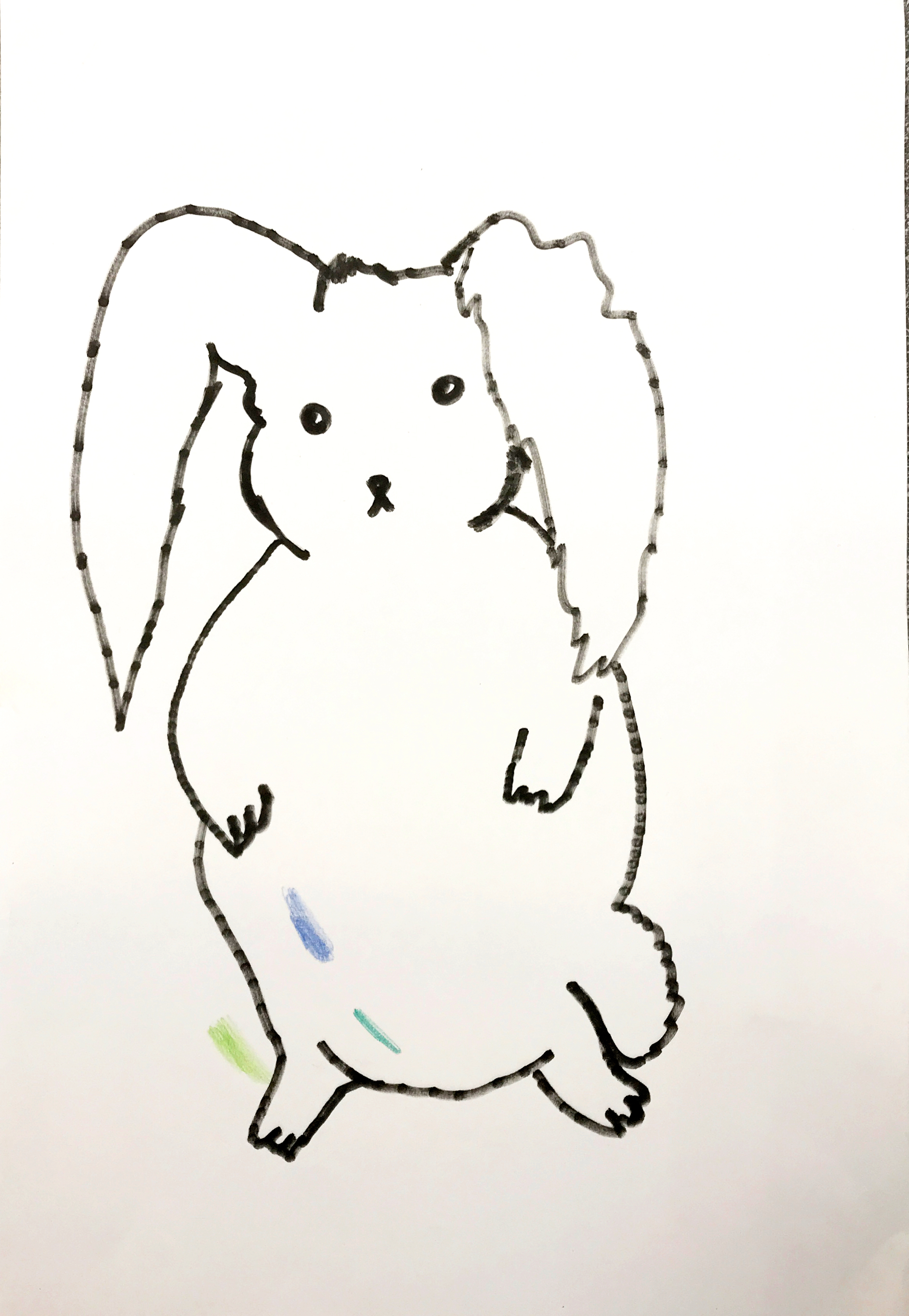
Like a method, the translations maneuver insistently not to arrive at an ever-improving result (more complete, more finished, with fewer gaps), but to disrupt a machine that is constantly on the verge of breaking down. A first translation, from drawing to painting: it begins with a doodle that, as an exercise to ward off boredom, ends up hanging on the wall like a trophy and, as the days go by, transforms into a painting of enormous dimensions. But the drawing is not discarded; it remains there as a discovery and emblem of some kind of personal mythology. And then it is repeated, changes form, and reappears in the paintings, leaping among the furniture and rooms of a house.
Another translation serves as a corridor between the two worlds that, to put it simply and without rehashing old questions, share weight and substance in our hearts: the virtual and the real. As if the two offered each other refuge, as if their respective logics could be transposed without any regard for the consequences. The screen glitch spills onto the canvas, and the distortion doubles, while backgrounds and figures repel each other, leaving a millimeter-sized empty space where the head rests. The mouse spirit wanders through the works with the urge of an addict, ignoring their materiality, wanting to move the vases, threatening to erase everything.
If we understand these translations as recombinations of elements, a free transition from one state to another that doesn't imply a final or definitive destination, what resonates most is the bad joke of adulthood. Against all odds, maturing is becoming more tender and sweet. Softening while everything else hardens is also escaping the world's rapid pace, slowing down the attention we pay to things. These experiences bring back something of childhood, not as a distant memory, but as the first practical application of taste.
An artist who softens is more prone to impurity and becomes less self-referential (something to be celebrated). In Santiago Paredes's fantasy, teenage girls and animals curl up in their little beds, giving way to the potent dream of a neon future.
On "Melancholy and the Future" by Santiago Paredes at Espacio Acoyte.