
An Avant-Garde Before It Scattered
We tend to return to the Di Tella for its works, its archives and the stories of those who were there. The Instituto Torcuato Di Tella, created in 1958 at the initiative of the sons of the industrialist whose name it bears, was the center of the Buenos Aires avant-garde in the sixties: its Centro de Artes Visuales, directed by Jorge Romero Brest, organized prizes and exhibitions, and its Centro de Experimentación Audiovisual brought together theater, dance and happenings. The Centro de Artes Visuales and the Calle Florida site closed in 1970. In the paper we present here, Marta R. F. de Slemenson and Germán Kratochwill did something unusual: they interviewed the artists, studied the people who disseminated their work and surveyed the audience while that avant-garde was still active. They asked what the artists lived on, where their works circulated and who went to see them. Essays and archives allow us to reconstruct much of what happened. But unless those questions are asked at different moments, it is hard to know what changed from one period to the next.
The research was carried out in 1966 and 1967 at the Di Tella's Centro de Investigaciones Sociales, and it belongs to the empirical sociology that took shape at the University of Buenos Aires around Gino Germani in the late fifties: questionnaires, samples, counts and Germani's own model of social stratification, applied to a world that until then had been narrated through anecdotes and manifestos. In 1966 the authors had already published “Sociología del pop” in Primera Plana, and in July 1967 they presented the study at the Symposium on the Sociology of Intellectuals organized by the Instituto Torcuato Di Tella. We publish the 1967 paper, titled Un movimiento plástico de vanguardia en Buenos Aires. Sus creadores, sus difusores y su público. Materiales para un estudio sociológico de la vida artística e intelectual. Un arte de difusores (An Art of Disseminators) is the title of the later version, published in 1970 in El intelectual latinoamericano.
I chose to return to the 1967 paper because its tables allow the research to be followed closely: how old those artists were, what households they came from and what they lived on. It also shows how the group was put together. The authors started from a classification by Oscar Masotta, added contacts through an artist and through the La Ruche gallery, and completed the list with names the interviewees themselves supplied. The disseminators are thus present from the start: before the study asks how an avant-garde is recognized, they have already shaped the way it was delimited.
Being able to ask those questions again was one of the reasons I wanted to take up the study in my doctoral dissertation. The other had to do with what was happening at the time. In 2009, the Art Department of the Universidad Torcuato Di Tella, directed by Inés Katzenstein, launched its Artists' Program, and the following year it hosted the fifth edition of the Beca Kuitca. Around the same years, Roberto Jacoby, one of the artists of that sixties avant-garde, founded the Centro de Investigaciones Artísticas together with Graciela Hasper and Judi Werthein. Spaces for training and exhibition were multiplying, and the Argentine art market was growing. Returning to the questions of the sixties made it possible to examine what that expansion meant for those who were beginning to train, to show their work and to make a living as artists.
In De la utopía al mercado I compared the social origins, trajectories and practices of the Di Tella artists with those of thirty artists I interviewed in 2011, during the progressive period. Among the twenty artists in the study, only three lived exclusively from their production. In 2011, eleven of the thirty lived from art, sixteen lived from it in part and three supported themselves with work outside it. The figures measure different things: living from art, in 2011, could mean combining sales, grants, prizes, teaching, writing, curating and management. But the door had narrowed. The Di Tella artists came largely from lower-class families moving up into the middle class, the children and grandchildren of immigrants; most of the 2011 artists came from households with a prior accumulation of educational, cultural and social capital. In the two samples studied, the artists linked to the Di Tella came, as a whole, from households of lower social position than those of 2011. The shift was not from precarity to professionalization, but between two different regimes of access, recognition and risk.
I also set the Di Tella's 1966 audience survey alongside the one I conducted in 2012 in three galleries and at arteBA, which I later published as “La cofradía estética” (The Aesthetic Brotherhood). Within a larger sample, the authors had selected 92 people who said they had attended both other Di Tella events and other events characterized as Pop art. The audiences surveyed were not equivalent, but taking up some of the same questions and cross-checking the answers against interviews and observation in galleries and fairs allowed me to examine the distance between the people who actually went to see the works and the audience the artists imagined. In my sample, the 2012 audience was more educated and more likely to hold paid jobs; it learned about exhibitions mostly through friends and acquaintances and hardly ever through newspapers; and many of its members also produced, curated, edited or collected. And when asked what artists were after, it spoke of art and the market; the 1966 audience spoke of creation, scandal and fun.
What interests me most about the study is that it detects, in a group still working as a group, the tensions that allow one to anticipate its dispersal. Slemenson and Kratochwill saw that a weak market could sharpen competition among them, and that the grants almost all of them had just received would add geographic dispersal. In the progressive period I found a paradox that I develop in my forthcoming book and that I call the crisis of success. Between 2003 and 2007, the arrangements that collectives had created to share risks, tasks and resources had to distribute benefits that cannot be collectivized in the same way: an exhibition, a grant, a sale, a trip or an international invitation is organized under proper names and calls for representatives, signatures, recipients. Scarcity can turn against each other those who started out together. Expansion can give them reasons to go their separate ways. But the collective did not disappear: it stopped coinciding with the group that produces in common and was redistributed among spaces, publications, archives, programs and galleries born of self-organization.
Republishing this study in Jennifer is somewhat uncomfortable, because a magazine is also a disseminator. It chooses whom to name, whom to argue with and whom to leave out. In the sequence Slemenson and Kratochwill describe (the gallery exhibits, the critics endorse, the prize consecrates, the grant sends the artist abroad), a magazine occupies the second step: that of the people who make a work visible to those who will later award it. That step has changed too. In the sixties, artists felt critics were distant: Romero Brest helped them, but “he doesn't know how we live.” In 2011 they felt critics were close, in a relationship that bordered on friendship and rested on generational proximity; even so, twenty of the thirty believed their work had not been correctly interpreted. The distance shrank and the dissatisfaction remained. When the critic is a friend, criticism runs the risk of becoming validation.
Jennifer was born in Balvanera to write from inside that circuit, and it now writes from Tribeca, in the city the study used as a point of contrast. In The Vanguard Artist: Portrait and Self-Portrait (1965), Bernard Rosenberg and Norris Fliegel had interviewed twenty-nine established painters and sculptors, none of them young, financially comfortable and prior to Pop. Their careers rested on New York's primacy in the world art market, with interested collectors and buyers around them. Slemenson and Kratochwill found there the same conflictual relationship with society, but also a difference: in New York the bonds among artists were stronger, while in Buenos Aires the dismal conditions of the market pushed competition to the point of dissolving the groups. From Tribeca, the question of 1967 is ours to answer. If those artists needed “to be selected by the most influential disseminators,” whom does Jennifer select, and whom does that selection serve? Masotta was reproached for “saying not what we do but what he thinks we do.” A magazine should be able to level that reproach at itself before others do.
References
Krochmalny, Syd. De la utopía al mercado. Los artistas de la postcrisis (Buenos Aires, 2001–2011). Doctoral dissertation in Social Sciences, Facultad de Ciencias Sociales, Universidad de Buenos Aires, 2012, vol. I.
Krochmalny, Syd. “La cofradía estética: el público de arte contemporáneo en Buenos Aires” (The Aesthetic Brotherhood: The Spectators of Contemporary Art in Buenos Aires). Prácticas de oficio, vol. 2, no. 18, December 2016–June 2017.
Rosenberg, Bernard, and Norris Fliegel. The Vanguard Artist: Portrait and Self-Portrait. Chicago: Quadrangle Books, 1965.
Slemenson, Marta R. F. de, and Germán Kratochwill. Un movimiento plástico de vanguardia en Buenos Aires. Sus creadores, sus difusores y su público. Materiales para un estudio sociológico de la vida artística e intelectual. Paper, Symposium on the Sociology of Intellectuals, Buenos Aires, July 3–5, 1967.
Editor's Note
The cover of the 1967 paper gives “Germán Kratochwill,” with a double l. The 1970 edition prints “Germán Kratochwil.” In each reference we keep the spelling of the edition cited.
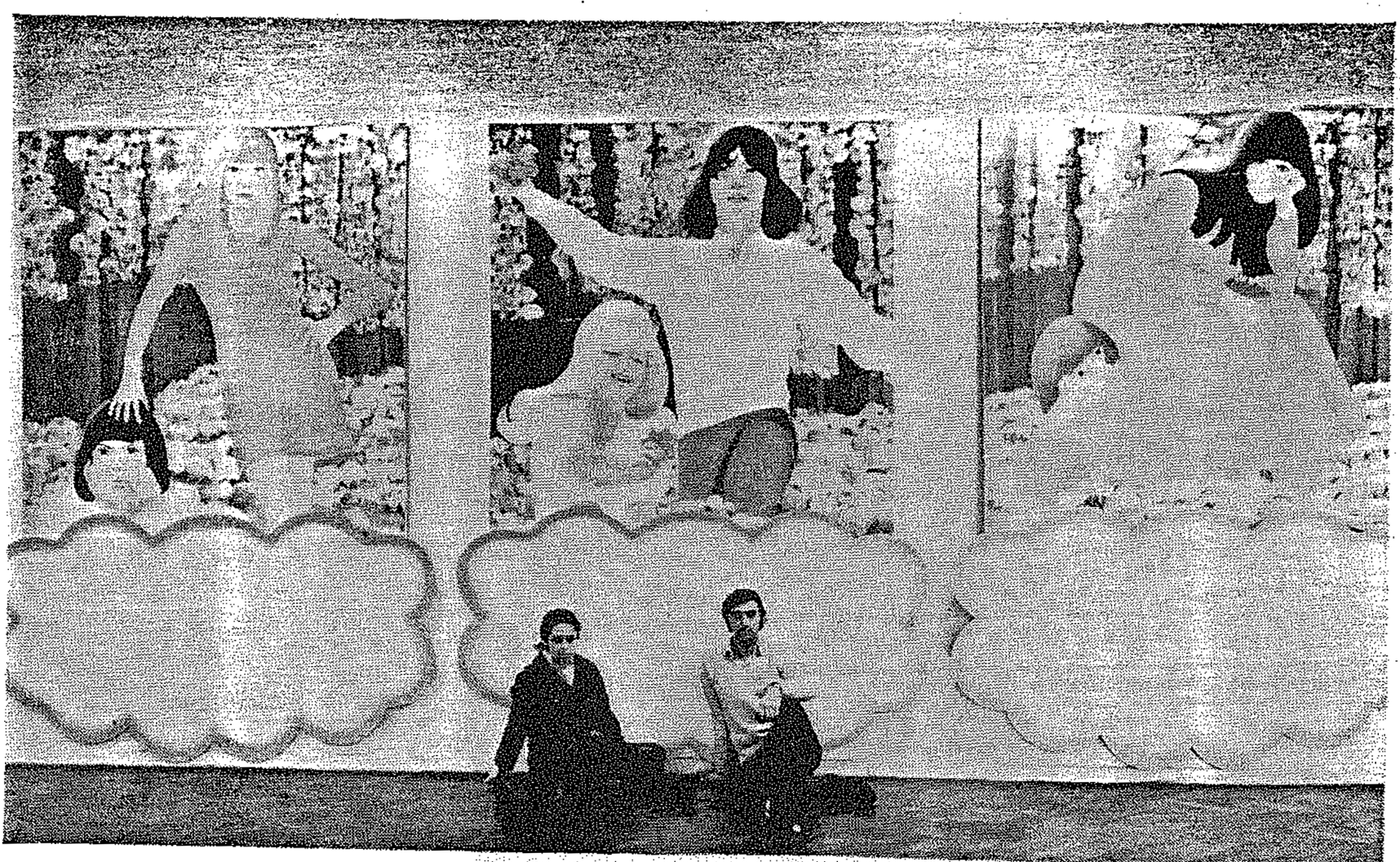
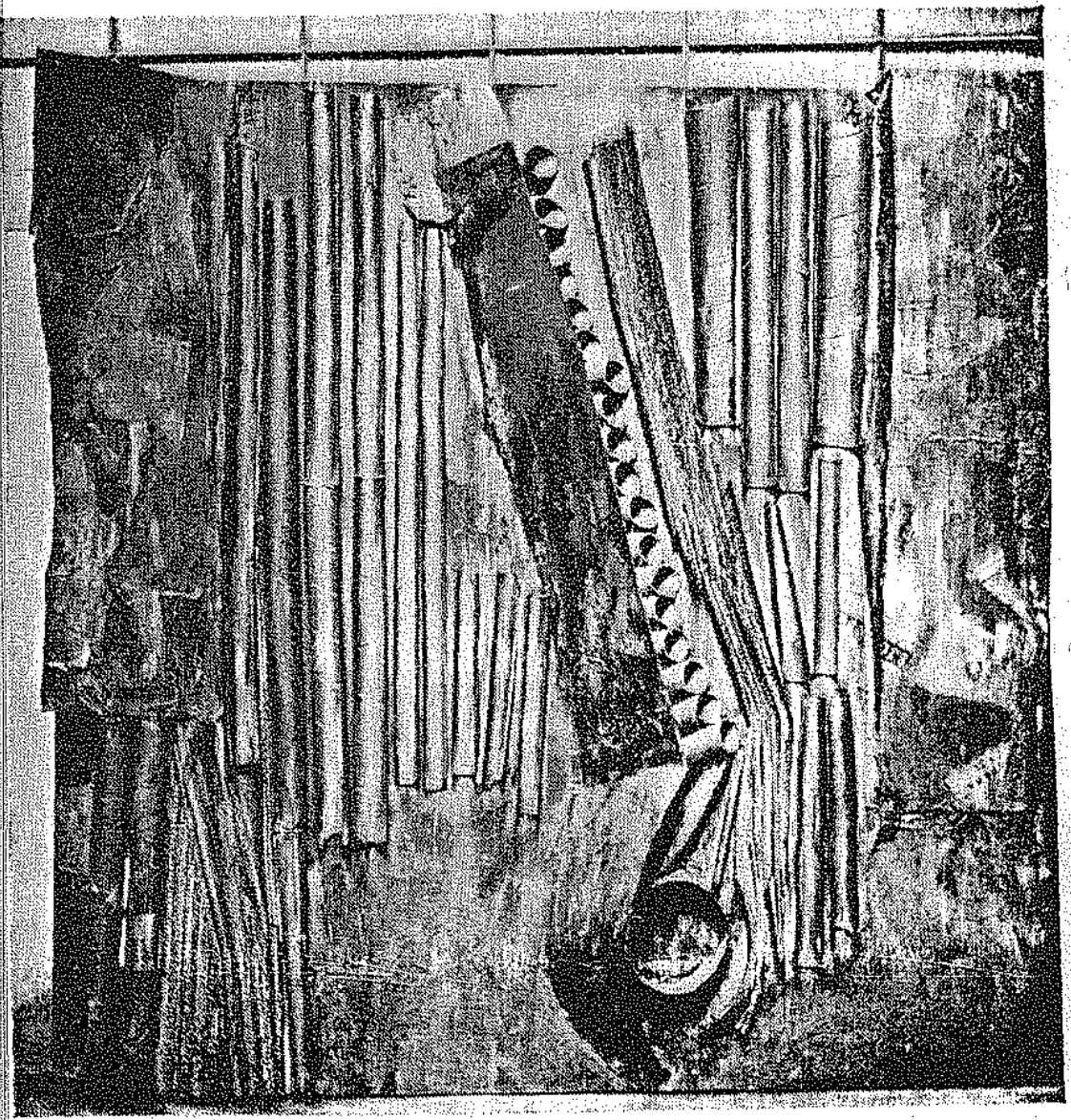
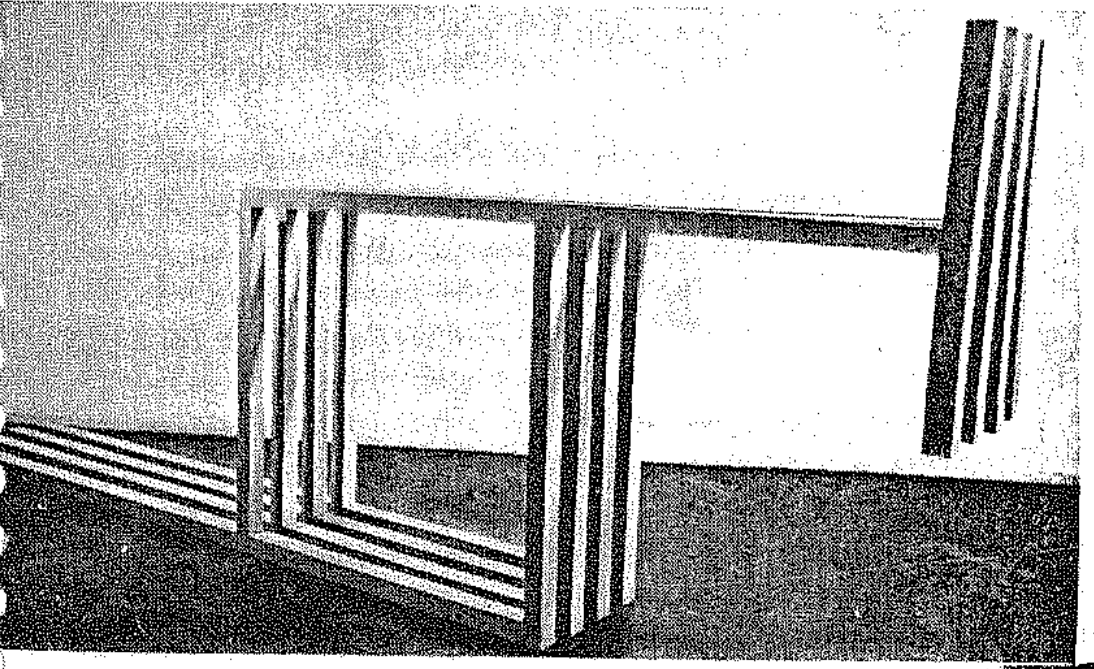
Note on the images. The 1967 paper included tables and diagrams, but no photographs. For this edition, Jennifer added period documentation and the five plates from Un arte de difusores, the version published in 1970. Captions identify each image’s source. None of these photographs appears in the 1967 facsimile.
The Original Paper
The architect Rosa K. de Koenisberg and Mrs. Silvia Karp de Kratochwil took part in the audience survey. The data from the “audience questionnaire” were processed by Susana Cristal, Dora González and Mirta Parnés de De la Vega, all holders of the licenciatura degree. Our thanks to all of them, and to the people interviewed and the institutions visited.
I. SOME METHODOLOGICAL REMARKS
1. The Origin of the Study and Its General Aims
The initial purpose of this study was a sociological approach to avant-garde visual art in Buenos Aires (excluding any aim of aesthetic evaluation). Our interest centered on the relations between the artist, as an individual immersed in a developing sociocultural context, and the social structures with which he comes into contact.
We lacked not only an organized body of theory but also factual material drawn from similar research in our country. It was obvious that we had to limit our objectives to preliminary formulations of an exploratory nature and to the pretesting of instruments to be used in future research with more clearly defined characteristics.
2. Three Basic Questions
Our first question was: What does it mean to speak of “avant-garde visual art” in Buenos Aires? We took as our starting point Noé's view that “the tendency toward the abstract object, together with the new figuration, makes up that reality in our country” (1). (We believe that at this moment it is also necessary to take into account the tendency that Prof. J. Romero Brest summed up in a recent exhibition as the new geometry). Accepting Noé's delimitation meant getting in touch with several movements. We decided to work on them in the manner of a mosaic: determining the components of each one and then entering the others through the members who served as links between one and another.
Does this kind of sampling correspond to reality? We believe it does, and Romero Brest supports us when he says: “…One then realizes that there is not one situation, but as many situations as there are groups of creators and beholders, each of which has, moreover, its own collectors, its own press, its own magazines and its own museums…” (2). This means that each part of our mosaic would include not only a group of artists connected with one another, but also those (individuals, groups, institutions) who take part in the production, dissemination and consumption of avant-garde creations. Reaching this point raised new questions:
a) Which artistic movement should we choose first, and why?
b) How should we delimit its three components: creators, disseminators and audience?
c) How should we establish the connections between one movement and the others?
a) To answer the first question we had to isolate our first sample. The decision arose somewhat by chance. We attended a lecture given by the essayist Oscar Masotta at the Museo de Arte Moderno de Buenos Aires. In the course of it he sketched a classification of the groups of artists who at the time made up the manifestations of the experimental avant-garde in the visual arts in Buenos Aires. This gave us the possibility of isolating a movement on the basis of the opinion of a specialist in the field.
b) To delimit it correctly we used several sources:
- The lecture by O. Masotta mentioned above;
- One of the artists present, whom we knew, gave us some names and telephone numbers;
- An art gallery, “La Ruche,” added new addresses;
- We completed the list using the so-called “snowball” technique, by which the interviewees themselves completed it, giving the names of the works each of them considered closest to his or her own artistic work and providing information about disseminators and audience;
- In other interviews, with the disseminators, the delimitation of the movement was completed.
c) We assumed that some of the individuals on our list would serve as connections: 1) with other movements to which they had been linked at some point in their artistic development; 2) with other movements they were about to join. This hypothesis was confirmed in practice.
3. Sample “A”: The Artists
Using the technique described, 21 names were listed, including artists from the Capital, Greater Buenos Aires and one from La Plata. We believe this list corresponds to our explicit aim: to group artists working in convergent visual modes, representatives of a specific sector, seen as distinct by themselves and by members of other movements, and linked to a single set of disseminators (3).
3.a. The Data-Collection Instrument
We determined the following topics on which we wanted to obtain information:
1) Routine census data;
2) Present occupational situation (from an economic and professional point of view);
3) Artistic development;
4) Present work (intended and actual aspects);
5) Connections with other artistic ideas and movements;
6) Connections with the other members of the group;
7) Connections with society at large;
8) Connections with the individuals, groups and institutions that disseminate art;
9) Connections with the art audience.
The 31 items, developed into 74 questions, should not be interpreted as a questionnaire of open-ended questions in the usual sense of that technique. We anticipated that the particular manner of most of our subjects would make it difficult to administer a questionnaire, and we handled it by applying “in-depth interview” techniques.
3.b. The Interviewers' Tasks Up to the Interview Situation and the Administration of the Questionnaire
The visual artists were interviewed between June and August 1966 (with the exception of one, who was interviewed in April 1967). The subjects were contacted by telephone, with the interviewee who had provided the name and number given as a reference. We tried to visit the artists at their place of work (home or studio), not only to become acquainted with the works they were making at the time, but also to create a friendly and informal atmosphere for the interview.
This aim was generally achieved. In only one case was it impossible to arrange an appointment, and in another the interviewee expressed his refusal because “I don't think sociology can get into these things.” Even so, in this case 50 percent of the planned answers were obtained.
The general attitude was cooperative. Some artists expressed themselves with great fluency and richness of content. The main difficulty lay in fulfilling our aim of keeping them from experiencing a situation structured within overly rigid limits or with overly obvious inquisitive purposes.
Wherever possible we began with a conversation about the works in the studio. When the interview took place in other places they frequented (the bar of the Instituto Torcuato Di Tella, the Bar Moderno), they brought slides and photographs of their work.
No tape recorder was used. Notes were taken at the time and completed afterward with the interviewer's observations.
The interviews lasted between forty minutes and two hours, depending on the number of works to be seen and the talkativeness of each interviewee. The artists discussed among themselves the fact that this study was being done, and some who had not yet been interviewed expressed their wish to be.
On the occasions when we saw the artists again, relations were cordial. The appearance of a first report on this part of the work in the magazine Primera Plana (4) caused some discomfort among some of them. We tried to clear up their doubts in person and believe we succeeded.
For a little over three months we went around studios and repeatedly walked one area of Buenos Aires: the area bounded by M. T. de Alvear, Lavalle, Carlos Pellegrini and Reconquista. This area has acquired characteristics that would make it worthy of a study like those carried out on Greenwich Village or Montparnasse. The experience was certainly enriching for us and dispelled any possible doubt about the likelihood of being rejected as “scientists” by a group made up of artists. We would use the same method if we were able to continue our work.
4. Sample “B”: The Disseminators
We selected only those disseminators who stand out in handling the products of the artists included in the previous sample.
We applied the same technique of unstructured questionnaires that had produced good results in the survey of the group of artists. As in those, the interviews were held at the place of work whenever possible. To complete the information on the disseminators we also used printed material containing references to the selected disseminators (magazines, catalogues and books).
5. Sample “C”: The Audience
We decided to sample the audience of the Instituto Torcuato Di Tella, which at the time was the center of Pop art activities in the Capital. When, a little later, a very successful show appeared at the “La Recova” theater, we added a small sample from it to our earlier data.
The sample was drawn by taking one in every three people attending the last two performances given by the dancer Graciela Martínez (Instituto T. Di Tella: “Juguemos en la bañadera”); one in every two people at three performances of the theater piece “Drácula” (Instituto T. Di Tella); and one in every two people at one performance of the theater piece “Help, Valentino!!” (La Recova). The audiences of these shows were chosen because the shows were directly linked to the selected movement, a link detected during the interviews with the artists.
Five minutes before each performance began, an announcement was made over the microphone explaining the content and aims of the survey, which had been handed out as the audience entered the hall. People were asked to answer everything except the last section before the show began, and to leave that last part until after it had ended. The questionnaires were collected at the exit, where any questions that came up were also answered.
The audience showed interest and asked frequent questions. Some spectators were offended at not having received a questionnaire. But there was also a considerable number of questionnaires returned blank or partly answered. Most of the difficulties arose in the sections of open-ended questions. This was especially evident in the section to be answered after the show.
5.a. The Questionnaire
At first we thought of adopting the questionnaire used by R. Gibaja (5), limiting our work to the comparative aspects. But almost immediately the need arose to introduce changes based on: 1) the excessive length of the original questionnaire; 2) our interest in looking more deeply into the communication between audience and creators.
To solve 1), the questionnaire was reduced from 71 to 49 items, divided into five fields. Four corresponded to the original questionnaire: 1. personal data: age, sex, nationality, place of residence, marital status, education, ideology and class identification, occupation and socioeconomic status; 2. attitudes toward and evaluation of the exhibitions and shows of the Instituto T. Di Tella. Here, however, some modifications were introduced: instead of covering only the years 1960 and 1961, the Institute's exhibitions “in general” were considered. In addition, this set of questions was repeated to measure attitudes and evaluation “toward other Pop shows”; 3. cultural behavior and patterns of mass communication; 4. attitudes toward culture, art and mass communications.
To solve 2), a fifth field was added, covering attitudes toward and evaluation of the show just seen. Two fields of the standard survey were removed: one on “patterns of leisure and free-time activities” and the other on “effects of advertising.”
The data analyzed in this paper do not represent the whole of the audience sample obtained. We have tried to isolate a group closely linked to avant-garde manifestations in the visual arts. For this reason we selected 92 subjects who say they have attended both other events of the Instituto T. Di Tella and other events characterized as Pop art.
II. THE ARTISTS
1. Description of the Population
The small number of individuals in the sample rules out a quantitative analysis of the variables. Nevertheless, we would like to summarize some of its census features with the sole aim of outlining its components more clearly.
C.1 Sex and Age
| Age | Male | Female | Totals |
|---|---|---|---|
| under 20 | – | – | – |
| 21 to 25 | 7 | 4 | 11 |
| 26 to 30 | 2 | – | 2 |
| 31 to 35 | 3 | 1 | 4 |
| 36 to 40 | – | – | – |
| 41 to 45 | 2 | – | 2 |
| 46 or over | 1 | – | 1 |
| Totals | 15 | 5 | 20 |
The group consists of five women and fifteen men. We see that 11 subjects are between 21 and 25 years old. Among them are those seen as the core of the movement. Extending the age range to 35 years, we take in 15 subjects.
In the group aged 35 and over we find the individuals we have called “backward links,” that is, those who through their artistic development served as connections with other groups that are regarded as precursors “surpassed” by the younger ones.
In the young group, on the other hand, “forward links” can already be distinguished, that is, possible members who are about to break away from the group and move toward new tendencies. It is, then, a group with very unstable boundaries.
C.2 Sex and Marital Status
| Marital status | M | F | Totals |
|---|---|---|---|
| Single | 7 | – | 7 |
| Married | 7 | 4 | 11 |
| Separated | 1 | 1 | 2 |
| Totals | 15 | 5 | 20 |
Of the 11 married artists, six are married to each other. This professional affinity becomes more marked when we ask about the spouse's profession in the other cases: two are married to artists (dancers) within an avant-garde current, and a third to a photographer with whom he shares this profession in order to make a living. Only two married subjects (a man and a woman) are married to people whose professional activity lies outside art.
C.3 Marriage and Professional Affinity
| Married to artists | Married to people in related professions | Married to people with no professional affinity | Sex |
|---|---|---|---|
| 3 | 3 | 1 | M |
| 3 | – | 1 | F |
| 6 | 3 | 2 | Totals |
All the artists in the group are Argentine and only two come from the provinces. The great majority are descended from the great waves of immigration of the end of the last century and the beginning of this one. Of the forty maternal and paternal grandparents, 28 are of foreign origin, and of these 18 are of Spanish and Italian origin.
C.4 Country of Origin of Family Ancestors
| Relative | Arg. | Ger. | Arm. | Span. | U.S. | Fr. | Eng. | Ital. | Pol. | Rus. |
|---|---|---|---|---|---|---|---|---|---|---|
| Father | 13 | 1 | 1 | 2 | – | – | 1 | 2 | – | – |
| Mother | 16 | – | 1 | 2 | – | – | – | – | 1 | – |
| Paternal grandfather | 6 | 1 | 1 | 5 | 1 | 1 | 1 | 2 | – | 1 |
| Maternal grandfather | 6 | 1 | 1 | 7 | – | – | – | 3 | 1 | – |
| Totals | 41 | 3 | 4 | 16 | 1 | 1 | 2 | 8 | 2 | 1 |
(Data missing for one maternal grandparent.) [Editor's note: the total printed in the Italy column is 8; the visible figures in that column add up to 7.]
C.5 Generation of Argentines They Represent, by Paternal and Maternal Ancestry
| Ancestry | Third generation | Second generation | First generation | Total |
|---|---|---|---|---|
| Maternal | 7 | 9 | 4 | 20 |
| Paternal | 6 | 7 | 7 | 20 |
In keeping with the usual features of this turn-of-the-century immigration, we find a high percentage of lower-class families rising to the lower middle and middle middle class in the following generation.
C.6 Occupation and Origin of Family Ancestors
| Occupation | Pat. gp. Arg. | Pat. gp. for. | Mat. gp. Arg. | Mat. gp. for. | Father Arg. | Father for. | Mother Arg. | Mother for. | Total |
|---|---|---|---|---|---|---|---|---|---|
| Farmer | – | 3 | – | 2 | – | – | – | – | 5 |
| Craftsman | – | 5 | – | 2 | – | 3 | – | – | 10 |
| Worker | – | – | – | – | 2 | – | – | – | 2 |
| Office worker | – | 1 | – | – | 3 | 1 | 4 (1) | – | 9 |
| Small shopkeeper | 1 | 2 | 2 | 8 | 1 | 2 | – | – | 16 |
| Small manufacturer | 1 | – | – | – | 1 | 1 | – | – | 3 |
| Professional | 1 | 2 | – | – | 6 | – | – | – | 9 |
| Other (housewives) | – | – | – | – | – | – | 12 | 4 | 16 |
| Doesn't know | 3 | 1 | 5 | 1 | – | – | – | – | 10 |
The immigrants tend to settle through marriage to native-born daughters (16 Argentine mothers). They form traditional households in which only in very few cases do women hold a professional occupation, through the classic career of schoolteacher (1).
The traditional attitude toward the education of daughters still appears in our population: although this is a group with a high educational level, that level is much higher among the men than among the women. Five of the men have undertaken university studies and three have completed a university degree, while no woman has gone beyond secondary studies (we place art schools at this level).
C.7 Education by Sex
| Education | M | F | Totals |
|---|---|---|---|
| Primary completed | 1 | – | 1 |
| Secondary incomplete | 1 | – | 1 |
| Secondary completed | 2 | 2 | 4 |
| Academy incomplete | 2 | 1 | 3 |
| Academy completed | 1 | 2 | 3 |
| University incomplete | 5 | – | 5 |
| University completed | 3 | – | 3 |
| Totals | 15 | 5 | 20 |
This means that 75 percent of the sample has completed secondary and/or university studies. Fifty percent have also undertaken specialized studies in painting studios (generally for short periods and often in several studios), and 70 percent have studied, whether to completion or not, at the Academia de Bellas Artes or in art studios.
We would like to end this description of the population of artists by saying something about their economic and professional situation. We will limit ourselves here to their real level of income, the source of that income and their economic aspirations.
C.8 Economic Reality Compared with Economic Aspirations
| Pesos m$n | Income M | Income F | Income total | Aspirations M | Aspirations F | Aspirations total |
|---|---|---|---|---|---|---|
| 10,000 to 20,000 | 3 | 2 | 5 | – | – | – |
| 21,000 to 30,000 | 7 | – | 7 | – | – | – |
| 31,000 to 40,000 | 2 | 1 | 3 | 1 | – | – |
| 41,000 to 50,000 | – | 2 | 2 | 5 | – | 5 |
| 51,000 to 100,000 | 2 | – | 2 | 7 | 4 | 10 |
| Over 100,000 | – | – | – | 1 | 1 | 2 |
| Doesn't know | 1 | – | 1 | 1 | – | 1 |
[Editor's note: the figures and totals are kept as they appear in the printed original.]
Seven of the twenty subjects earn between 21,000 and 30,000 pesos a month, fifteen between 10,000 and 40,000 pesos a month, and 90 percent aspire to earn more than that ceiling. Fifty percent would like to earn between 51,000 and 100,000 pesos a month.
This is, then, a group frankly dissatisfied with its income. There is only one case in which the interviewee says that his actual income roughly matches his economic aspirations, but he is among those who earn more than 51,000 pesos.
1.a. Source of Income and Professionalization
The economic and professional situation is even more serious than Table 8 suggests. Thirteen of the artists admit that they do not live from their artistic production, four say “more or less,” and only three answer yes. Of these, one explains that this has been so only for the past year, and another that only now, owing to an important prize he has just won, have his economic prospects changed.
Both belong to the group of those over 41.
What, then, do they live on? Eight practice professions entirely unrelated to their art (office worker, teacher, commercial photographer, lawyer, etc.). Six say they are supported partly or wholly by their families (three men and three women). Three practice technical professions in which they apply their knowledge (advertising), and six live wholly or partly from minor forms of art (ceramics, designs for fashion items, etc.).
It is worth stressing that, although roughly half support themselves with work that is in some way related to art, they do not regard it as their main activity and retain, in this respect too, a rejection of a traditional kind (which is why we have kept the term “minor forms,” as they appear in art histories, without this implying any evaluation on our part). This is doubly curious, because much of the renown the artists of the movement enjoy rests precisely on those ceramics, tapestries, earrings, small pieces of furniture, mirrors, shop decorations, etc., which are often seen in the area of the Capital we have delimited.
We also wish to stress that, although all the interviewees define themselves as “artists,” they cannot be considered “professionalized” in the usual sense of the term. That is, they are not individuals who make their modus vivendi from the craft, technique or profession in which they are specializing.
How can this phenomenon be explained? Could it be because they regard their economic and professional situation as temporary? We asked them: What possibilities does a visual artist in Argentina have of living from his art? Only one subject answered flatly that such possibilities exist, against ten equally emphatic “they don't exist,” and nine reticent answers (“few, perhaps in the long run, practically none,” etc.).
They agree that the possibility of living from the visual arts exists only for those artists who, because of their position in the market, are regarded as an investment by the buying public, and that this happens, in their view, at the moment when the artist “has stagnated, become conformist, given the best of himself,” etc.
What are their possible economic solutions? Above all they speak of knowing how to do something else, of “getting by however one can.” Yet we believe they evade the problem, perhaps because it is too fraught with conflict. It serves them to create what we take to be a defensive barrier: that atmosphere with “the common note of cosmopolitanism, joy and leisure as driving forces” to which Romero Brest refers. The point is not to deny the truth of these features, but to suppose that there is a less evident, less conscious background interwoven with them. We have asked ourselves whether they do not refer above all to patterns that correspond more to an image sought by the disseminating circles and the audience than to the creators. The wish to escape daily routine by mingling with the “golden youth” and the apparent freedom of the artist. One artist says: “Lots of people come close to us so as not to seem old. It's a way of joining youth.”
We have seen more tenacity and sustained work than leisure, more youthful enthusiasm than joy, more intuition and curiosity than true cosmopolitanism. And at the same time we have found symptoms of insecurity, ambiguity and frustration. Is it joy that makes a woman artist, asked what possible solution she sees to her economic situation, answer “marry a millionaire”? Is it idle behavior when another artist tells us that he is not working and has time to study because he has sold his camera (he supports himself with photography) to buy the materials with which he is preparing for two prizes?
What possibilities do these twenty artists have of obtaining some economic benefit directly from their art? The answer is almost obvious: grants and prizes. At present almost the entire group surveyed holds grants abroad, and ten have won prizes in 1966 and 1967. This fact gives us some clues for understanding aspects that appear, at first sight, to be the fruit of an “irresponsible bohemianism.” Namely: what they do with their works and their working hours.
1.b. What Becomes of the Works
This aspect is particularly significant for understanding what has been set out above. Let us recall first that seven of our artists have never sold their works, and of the rest only two sell with relative regularity. What, then, happens to their works? The answer is surprising: five of them would like to destroy them, and almost all work with perishable materials; that is, in many cases these are works that “self-destruct.”
What is the reason for this attitude? Most work with an exhibition or a prize in view. The works are conceived for a particular exhibition hall. The intention is to compete for a prize, to show what has been done. No one believes the work might be sold. Why, then, give up large works that are assembled in the exhibition hall and taken apart when they are removed? Why refuse to use perishable materials, costly or not, such as papier-mâché, cardboard, rags, plaster, polyester? Whether the work disappears because it is taken apart at the end of an exhibition, or because it loses its shape or its color, comes in the end to the same thing. It is impossible to fill studios or one's own room with them.
Are these facts proof of indifference toward one's own work? Certainly not; they mean, as Margaret Mead puts it, seeking creativity along different lines. In a culture in which self-realization appears dysfunctional, in which art in its original singularity loses its freshness through the serial reproductions with which the mass media flood us, a new solution may arise for those who detect creativity: “Granted that an object has been the result of a single artist's wish to make something new and fresh, it matters little what will happen to it later. Perhaps it will soon be destroyed (…) In these cases, part of its characteristic freshness will come from each spectator's awareness of the short life it will have (…) The next day, all this will be dismantled, withered and even devoured. Only those who were present on the day of the celebration will have seen it; afterward it will persist among the nostalgic memories of those who made it, and will nourish new creations or new applications among those who were able to see and enjoy it” (6).
In an industrialized age like ours, it is not surprising that memory should be supplemented by the slides and photographs the authors keep. And if M. Mead's Balinese had creators who devoted all their efforts to works used in a single celebration, why be surprised that our artists also give their destruction a spectacular turn? The works are set on fire, sunk in the river, dismantled. One artist suggested a new poetic idea to be put into practice: “I'd like my works to disappear over the horizon, carried off by big balloons.”
2. Working Hours
Even while working at something else, the artists find the time they need to devote themselves to their work. “I take it,” “I manage,” etc. But that time is not regular. It is almost always planned around the dates of exhibitions or prizes. At those moments they work intensely for short periods. “Up to ten hours when an exhibition is coming up,” “…at those times we work flat out and hardly sleep,” etc.
3. Where They Work
Summing up the information obtained on working conditions, we can say:
- 6 have a home without a studio;
- 5 have nothing but the studio and live in it;
- 4 share a studio with someone else and live in separate housing;
- 5 have a studio of their own.
As can be seen, eleven artists have not solved the problem of their professional premises. Six have no studio (several of them live with their families and have set up their workplace in their bedrooms) and five have a studio of their own.
Six artists expressed, with some urgency, their need to solve the problem of their professional premises. Some complained that the level of rents makes it much harder to find suitable premises for a visual artist, and two pointed out that in this respect things are easier in the United States and in Europe.
4. Artistic Development and the Character of Current Works
All the artists interviewed have gone through different stages in their artistic development. We have constructed a scale made up of six items that correspond to the successive stages to be expected in this development.
The scale is based on the idea that in modern visual art, after exhausting the various possibilities of painting in the traditional manner on a flat surface, and after passing through mixed forms in which three-dimensional objects are joined to the surface, artists turn to building three-dimensional objects, to which they may or may not apply all the techniques they applied to the flat surface. These objects in turn may be (as in painting) figurative or abstract.
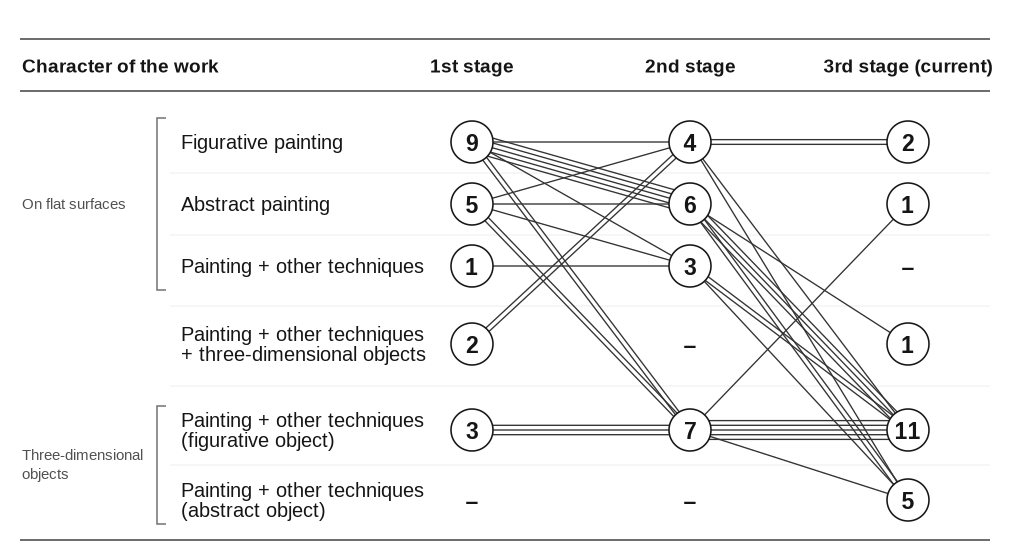
Redrawn by Jennifer from the 1967 paper, p. 14. View the original diagram.
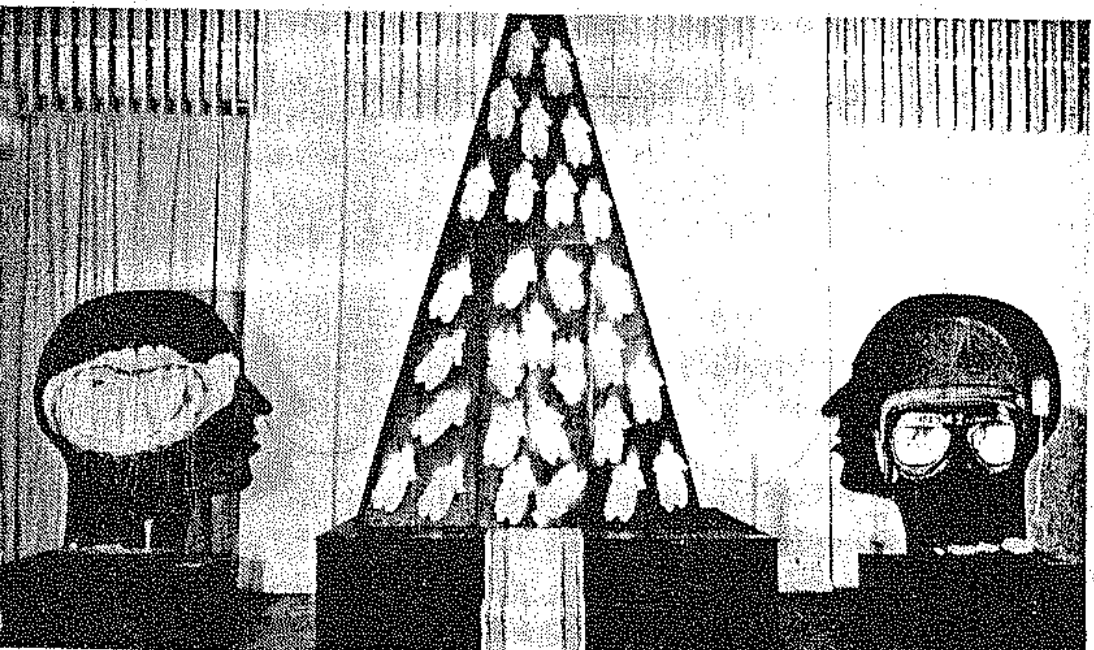
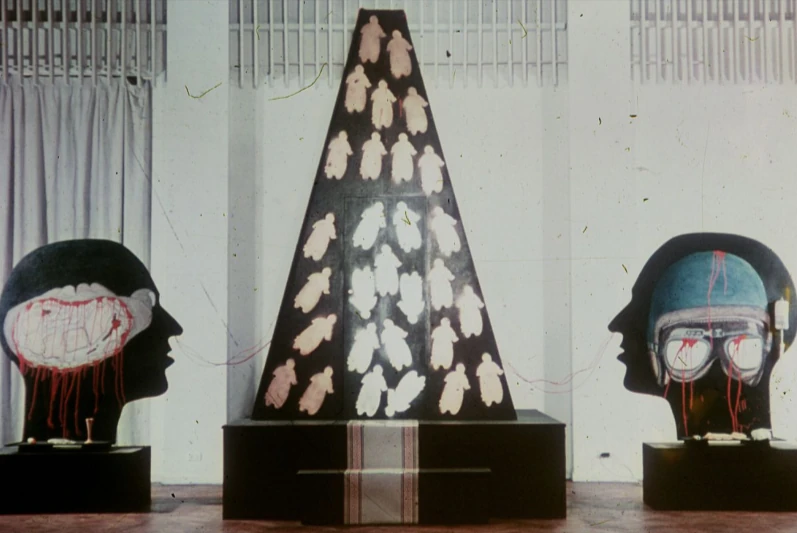
The diagram gives a rough idea of what happened in the creative stages of the artists interviewed. The so-called “intermediate stage” is in fact made up of several sub-stages; some developments are marked by a real zigzag between styles. In turn, the first stage depends on the fashion or the school the young artist attends and is characterized by a general restlessness with the traditional flat surface. During the second or intermediate stage, seven artists venture into making objects and only one gives up this work again. Of the 14 artists who in the first stage of their artistic development can be called painters in the traditional sense of the word, only three are painters in the current stage. Of these, only one began within the traditional technique. The lines show the process each went through: each corresponds to an artistic curriculum. It is interesting to note the case of three artists who begin their work with three-dimensional objects and do not abandon this practice. They are, moreover, three artists who live together and share a studio.
In the third stage a twofold problem arises:
1) The problem of the image: a choice must be made between making something figurative and creating abstract objects.
2) The problem of materials: a decision must be made about which materials are selected for making the objects. The form and expression achieved will often depend on this. One of the “object makers” comments: “Maybe colored polyester is better, because it's less of a pretext for painting on than wood.” All show a growing interest in new materials. Roland Barthes foresaw this fascination: “In extreme cases, objects will be invented for the pleasure of using plastic” (7). And Barthes says that the fashion for plastic marks a development in the myth of imitation. That myth was something typically bourgeois and wanted to be noble. But in the case of plastic, for the first time imitation, the artificial, tends toward the common and not toward the exquisite.
Sometimes the artists adopt short-lived materials that suit very well the idea of the work's limited duration. Other reasons that brought about changes in their techniques and styles are:
1) The effect on them of other artists “who were already into something else.”
2) The influence of fashion, which cannot be avoided.
3) Loss of interest in a particular technique and form, and curiosity about others.
4) Deep changes of personal origin that call for another expression.
The current works of the artists interviewed include objects and paintings with the following characteristics:
Figurative Painting
Large canvases. Monotonous colors (dark gray, light gray, sepia, etc.). Themes from the modern world: jazz singer, astronaut. Use of industrial enamels.
Abstract Painting
Large, rhomboid canvases. Strong colors, distributed in neatly bounded fields. “Themes”: lines, undulations, irregular polygons.
Figurative Three-Dimensional Objects
Giant polyester flowers; life-size human figures in papier-mâché painted with Poxi-Mix or covered in tinfoil; a polyester flag; a polyester staircase. Landscapes: trees, waterfalls, in plastic material. (We recall Barthes when he says: The hierarchy of substances is destroyed, a single one replaces them all: the whole world can be plasticized, and even life itself…) (8). Silk tents with pillows, big plaster corsets lined with printed fabrics, two meters high.
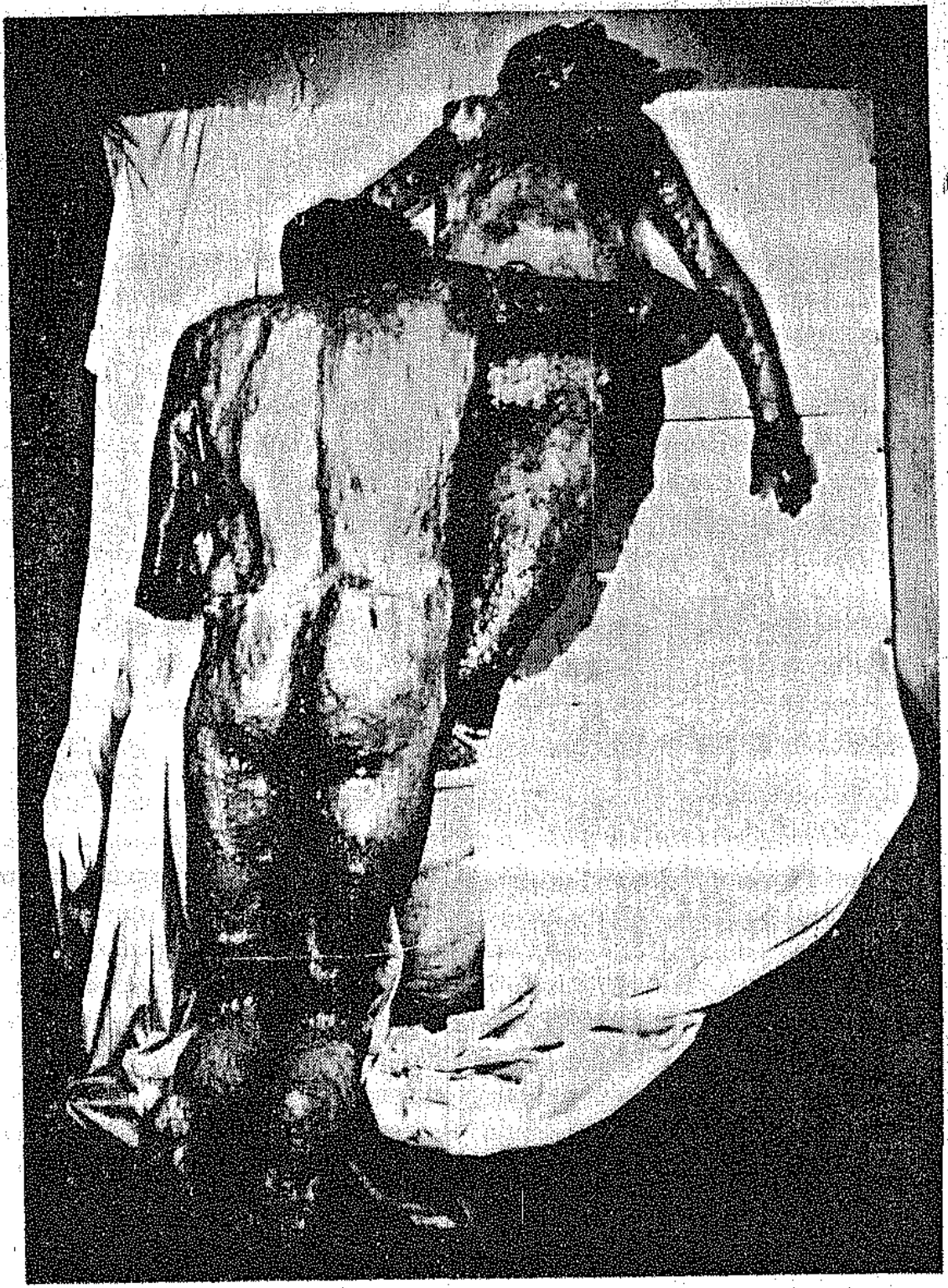
Abstract Three-Dimensional Objects
Objects of varied geometry, painted or monochrome, in wood, polyester, cardboard, metal sheets, chromed acrylics, etc.
Both types of object often carry some lighting installation. Some have been fitted with a motor that gives movement to part of the object.
5. Participation in Other Artistic Activities
Participation in other artistic activities can have several origins: a) it can be the expression of another talent or interest of the individual; b) it can be a necessary consequence of the experimental tendency the individual has given to his visual work; c) it can be related to some private circumstance that links the artist with other forms of expression (for example: marriage, friendship, work, etc.).
The following table gives information on other artistic activities carried out by the subjects interviewed.
C.9 Participation in Other Artistic Activities
| Activity | No. of cases |
|---|---|
| Performing arts, shows (happenings, micro-events, ballet sets and costumes), film | 9 |
| Literary arts (poetry, essay) | 4 |
| Other (minor arts: photography, advertising, fashion, pottery) | 8 |
| No other artistic activity | 2 |
Note: some interviewees have carried out more than one activity.
Most of the stage works were made possible by the availability of the facilities of the Centro de Experimentación Audiovisual of the Instituto T. Di Tella. In the case of the “minor arts,” as we have already noted, the need to obtain additional income plays a part. In only one case does the complementary activity become the main one (advertising), with artistic activity appearing as secondary. Some interviewees said openly that they are not sure they “really belong” to the visual arts, and that their future interests point just as easily to other arts: theater, film, television. Given the artists' open readiness for other forms of art, the decision to change seems to depend above all on an opportunity arising. Some interviewees said they wished that offers of some form of collaboration in other artistic activities would materialize.
6. Relations Within and Between Groups
Very few of our respondents admit influences on the making of their work. Only three accept being classified within a particular group (a “Pop” artist, an “object maker” and a “geometric” artist). One describes himself as among those who “seek the transfer of languages through communication theory.” When they accept influences, they refer them to early stages of their development and mention them as received from artists who at this moment “are into something else.”
They prefer instead to speak of certain affinities that do not commit them as part of a movement: “I've got something of the new-style Futurists, I take up things they didn't do”; “I don't think I belong to Pop, my style is more naive”; “I'm with the people who are doing something new.” In other cases the acceptance of affinities is even vaguer: “We influence each other in a way because we're products of the milieu”; “I get on with some people more than with others”; “there's a certain coincidence with some.”
They accept that there is a bond with certain people and make it explicit through three functions: a) making possible friendships among those who are “into the same thing” (many see each other daily); b) providing information about what is going on “in the scene”; c) providing entertainment.
We would suggest a fourth function, that of “artistic evaluation,” inferred from some comments. For example: “We don't need the judgment of posterity to know whether we're good or bad. There are so few of us and we know each other so well that our own colleagues take it upon themselves to tell you you're no good and to tear you to pieces as if they were wolves.”
Although they unanimously deny that the group fulfills a theorizing function and base it solely on friendship, in some cases living together in one place is expressed through technical similarities that are rejected by that specific subgroup but accepted by the other members.
In short: We have a sample of twenty individuals who at some point were characterized as a group: a) from outside, by criticism and by invitations from galleries and museums to exhibit together; b) from inside, by professional affinities and emotional ties born of constant contact and/or sharing studios.
But our impression is that this union is badly cracked and that the group as such is about to collapse. We base this assumption on the following:
- There is no longer a subject or group of subjects (members of the group) capable of drawing the others together.
- Unity is affected by a heavy load of anxiety arising from internal rivalries.
- The artistic affinity that held most of the relationships together tends to disappear.
- It can be foreseen that the grants they have recently obtained will bring about not only a geographic separation but also the disintegration of the remaining ties.
- The experience of two subjects, precursors within the group and fundamental to its formation, who have lived abroad for a time, seems to point to this pattern. They were received with “cordial curiosity,” but not taken back into its fold.
- The existing ties of friendship do not seem strong enough to get around this situation.
- It can be foreseen that most of the subjects will go on to join new groups of professional affinity. They would constitute what we have called “forward links.”
7. Connections with Society at Large
We have studied the artists' ties with society through their professional role, through their class self-affiliation and through their image of an ideal society.
7.a. Connections with Society at Large Seen Through the Professional Role
We summarize them in four questions:
Do you believe there is any relationship between the economic, political and social reality of a society and the type of art it produces?
Do you believe art has any function in society?
What are you trying to express with your work?
Does being an artist affect your relationship with others?
Although thirteen of the twenty artists believe there is a relationship between the economic, political and social reality of a society and the art produced in it, the nature of that relationship is not specified: “It's a relationship that's hard to define”; “there may be one… but I don't know what it is”; “there has to be a relationship, but it's very subtle.”
Insofar as the relationship is accepted, it is expressed as factors of the milieu acting on the individual: “The artist needs a favorable breeding ground”; “it's important because if a country lives in the twentieth century the artist feels supported, reinforced.”
The elements drawn from the social surroundings to enrich that “favorable breeding ground” vary according to individual needs. They may be:
- political identification: “Frondizi's presidency gave me hope, his fall hurt me too”;
- economic stability: “without a reasonable economic level there's no possibility of making art”;
- the impact of social change on the artist: “as society changes, the ways of creating and expressing oneself change”; “specifically: an artist may be unable to express himself for lack of materials, and, conversely, he may at a given moment express things that arise from the materials his society provides and that he makes use of.”
In every case the opinion rests on some personal experience, but it is neither a specific ideology nor a scientifically elaborated idea, in the sense of knowing what the artist should ask of society. If, as we have seen, society can lend the artist the elements needed for his flourishing, the artist will return what he has received through a refined, enriched, illuminating vision of the world. The artist's ability to act as “intermediary and supplier, perceiving a reality that others do not see and passing it on to other people” rests on a professionally sharpened sensibility. “I do what others can't do for lack of imagination. It's a division of labor.”
This quality can unfold on three temporal levels:
- Permanent aspects: The function of art will be “to teach people to see many things in everyday reality… it's important because it can wake up the masses by making them notice the things around them and giving those things a value”; “we make the art of things; we seek the integration of everyday objects. We carry out a rediscovery of what surrounds us”; “we talk about what's outside and yet we want to teach people something: to use their senses and nothing more.”
- Changing aspects: The possibility of seeing what the non-artist cannot perceive allows the creator to “point out change” more quickly and to “make the image of the world more dynamic.”
- Future aspects: The artist will be able to reach an almost prophetic experience by presenting an early image of the immediate future: “The artist is something of a lookout for future structures, in the sense of anticipation”; “we show what can be seen by looking ahead.”
Where perhaps the newest elements emerge is in relation to the content of the work. The two dominant notes are: a constant search for the new and experimental, and a search for immediate contact with the spectator.
It could be said that trying out new techniques, or the need to make contact with the audience, are far from new in art. What is different is the emphasis given to each of these searches. The pursuit of the new ceases to be a means of achieving, for example, greater perfection in artistic execution and becomes an end in itself: “I'm with the people who are doing something new. It's a different spirit, like an international philosophy”; “our common values are hard to define. Perhaps the most similar thing is that we consider everything provisional and want permanent experimentation.”
The search for contact with the spectator also takes on different characteristics. It is not a matter of communicating a message, which sometimes does not exist (“I simply want to provoke reactions of taste or pleasure”), but of making the spectator a “participant observer” in the situation: “we wanted to set aside our own emotional, personal charge and offer an inexpressive situation in which the other would be an accomplice… to overcome the act of mere contemplation.”
Achieving this means breaking old patterns, overcoming the division between the observing subject and the contemplated work, a total and active participation with the work and even with its creator. Hence it is often necessary “to shock in order to produce a liberating effect.” Achieving it means making “art stop being something solemn and mysterious” and turning it into “a reality accessible to all.”
To sum up: The answers to our first three questions seemed to indicate that the connections with society at large, seen through the professional role, are satisfactory enough. The artists believe that they receive from society, even though the nature of the relationship is not explicit. And, more clearly, they perceive that they can give that same society valuable elements.
But that image begins to crack as soon as contacts with other, nonprofessional groups in society at large are mentioned. When asked about the effect of the professional role on social interaction, all our interviewees but one (who says his is “a profession like any other”) admit that it creates difficulties for them.
They do not seem to have asked themselves much about why these difficulties arise, and they limit themselves to noting that: “They see me as different, there are people who react negatively to that”; “there are few people who understand someone devoting himself to art.”
Two artists went further into the problem. One stressed the economic factor, in the sense that art does not appear serious or worthy of respect because it is not a permanent source of income. “They tend to take you for an odd creature, someone who stakes everything on gratuitous things”; “now (he has just won an important prize) they respect me more because I made money.” The other artist shows that his professional role completely invades other areas of his social and emotional life: “Yes, sometimes it makes relationships harder. At first I had to break off attachments. I thought I should only associate with artists, but when you spend a lot of time with them you start to feel great contempt for everyday things. Now I have relationships with non-artists again because contempt for everyday things seems wrong to me.” In this case the loss of contact with others was not due to a rejection caused by being “different,” but to the concentration of interests on aims removed from everyday and more common ones, isolation in a reality “of the artist's own.”
7.b. Connections with Society at Large Seen Through Class Self-Affiliation
The group's description of Argentine social stratification has no special features. Nine subjects adhere to the neutral hierarchical image (9) (upper, middle and lower class). Of the rest, four had never thought about it and one does not answer; four use a more ideological image (e.g., “two aristocracies, proletariat and middle class”), one uses a socioeconomic image (“the powerful and those who have nothing”), and one uses an image in terms of personal qualities (“the intelligent and the stupid”).
Perhaps the most striking aspect lies precisely in the political apathy that appears in most of the interviews. When the artists are asked to place themselves within the classes they mention, new elements emerge: the number of “not interested” rises slightly (six); the remaining fourteen show features of “social marginality.”
Marginality takes three forms:
1) The feeling of being a “group apart”: this can be felt as a pseudo-privilege. “I get on fine with everybody. I eat with the banker and chat with the newspaper vendor just as comfortably”; “we're outside the schemes: we're the powerful ones with nothing.” Or it can be experienced as ambiguity: “We're with the upper class but we live with the lower”; “the upper class takes us in, but out of snobbery.”
2) The feeling of rejection: “In general we come from the middle class, but it doesn't accept our way of life”; “we're well and truly outside, although what we'd like is to be well and truly inside”; “we're a bit everybody's jesters, we're an amusement.”
3) An attitude of rejection: aggression is displaced onto groups experienced as traditional in their worldview, which are generally identified with sectors of the middle class. “The middle class is dangerous because it doesn't want the new.”
7.c. Connections with Society at Large Seen Through Their Image of an Ideal Society
Given the existence of social conflict, and given that these are individuals endowed with creative imagination, we presumed we would find abundant and rich utopias. Reality was different.
Five artists declare that they “agree” with existing society. “I'm satisfied with this society. In a different society I wouldn't make sense. I am what I am because society is this way.” Another five do not answer or had not thought about it. Among the remaining ten artists we can distinguish three types of utopia:
1. The economic utopia: “A communist society”; “a society with better-distributed wealth and greater dynamism” (two cases).
2. The utopia of the perfect world: “A society with no hunger, cruelty or ignorance”; “completely different from the present one, something like a world out of the Thousand and One Nights” (two cases).
3. The utopia of acceptance: “A society that guarantees everyone's personality to the utmost”; “where people respect others and don't look at us as if we were odd creatures” (six cases).
The need for acceptance is so great that one would even agree to stop being what one is in order to be fully included: “A society in which there were no artists because everyone would paint the picture they wanted in an age of love for one's neighbor, without money.”
It clearly emerges that the imagined nonconformity gives way to two opposite but complementary attitudes:
1. The experience of belonging to a marginalized group.
2. The wish to be integrated into society, just as one is.
8. Conclusions
We believe the most important thing is to highlight the status incongruence that emerges from the analysis of the four classic indicators of social class (applied here even though this is not a quantitative analysis).
If we summarize our data on “housing” (in this case professional premises), “income,” “education” and “occupation,” we find that:
a. Housing (professional): they work in their own homes or use humble studios, which in several cases they share. They complain of the difficulty of solving this problem because of the high cost of rents, which exceeds their income. More than half need to resolve this inadequacy with some urgency.
b. Income: Although they earn incomes within the range earned in our country by individuals of the lower and lower middle class, to which most of them belong, almost all assume they would need to earn roughly twice their actual income to live in keeping with their aspirations.
c. Education: It is high, and they have generally undertaken complementary studies within their profession.
d. Occupation: The limits of the concept appear extremely blurred. All include themselves under the common name of “artists,” but they show a certain reluctance toward the traditional role of the artist and prefer to imagine themselves as “explorers” in response to the demands for novelty set by the milieu. Only three can be considered “professionals,” and only very recently. Somewhat less than half of the sample supplements its income with activities related directly or indirectly to the profession to which they adhere. But only one of them has a professional self-image that allows him to include within it the work he does.
To sum up: We have a group that we can define as having:
a. a high educational level, clearly above its class origin;
b. an income level roughly corresponding to its class origin but experienced as frankly unsatisfactory for its present needs and aspirations;
c. an occupational level that corresponds to a cultural model with blurred limits, clearly in a state of change;
d. a level of housing inadequate to its present needs.
When this analysis is combined with the more subjective criterion of class self-affiliation, the features of incongruence remain. We have said that, although most of them acknowledge the visibility of social stratification in society at large, the class images they present are scattered and roughly half adhere to neutral class images. This sense of apathy takes sharper shape when we add the individuals who have never thought about the problem (five) and when we inquire into their class self-perception.
The only way to find a unifying element of identification is to use the criterion of “association through common activities” (in the manner of Warner) (10). If we echo the criticisms that have been made of this type of classification, namely that it does not delimit social classes but strata of the population defined by association, we must conclude that:
1. the members of this group have an incongruent social status that makes their class self-affiliation difficult;
2. they identify themselves as a group with professional strata.
On the other hand, the answers show that for most of the artists the reference groups are made up of middle-class and upper-middle-class circles, to which the art disseminators usually belong and which the artists frequent. The following paradoxical situation would thus arise:
1. The artists come, for the most part, from the lower and lower middle class.
2. They acquire a level of education above that of their class.
3. The role they play has certain features of prestige that allow them informal contact with the circle of art disseminators. The educational level they have acquired facilitates an apparent symbolic community in that contact.
4. At the same time, the role lacks an up-to-date institutional pattern that would allow its limits to be drawn clearly.
5. The subjects identify with the consumption patterns of the group of disseminators.
6. As part of their social activity, they form relationships with peers to whom they appear bound by the double play of professional affinity and of the social consensus radiating from the disseminating circles. This favors the creation of the “professional stratum defined by common activities.” Gradually these ties form a true membership group, reinforced by bonds of sympathy based on living together (and in many cases sexual attraction) and by defensive notes toward society at large, which is usually perceived as hostile, different or distant. This is the moment when the group acts at once as an insulating barrier and as emotional support.
7. But before long the membership group weakens (and, we believe, dissolves for good) under the impact of strong pressures. Among them:
a) An apparently very rapid social rise, which nonetheless seems to be experienced as highly ambiguous. The subjects feel that acceptance by the disseminators is unstable and that keeping it requires continuous innovation.
b) This need to innovate drives them into an artistic development in which they burn through the various stages of avant-garde visual art, greatly accelerated not only by their creative impulses but also by the need not to fall behind. A moment comes when all that is left to them is experimentation with their eyes on the novelties of the more developed countries.
c) The recently acquired consumption patterns create situations of economic frustration for them, heightened by the poverty of the art market in the Capital.
d) Although the group is quite small, its members begin to feel, with some urgency, the need to be selected by the most influential disseminators (who, as we will see in the next section of this paper, are not only very few but are also their only opportunity for economic and professional advancement).
e) Competitive situations arise within the group that weaken the internal ties of what had until then been the membership group, and dilute the only clear image of self-identification the subjects had.
8. The paradox completes its cycle when the reference group and the membership group accentuate the status incongruence that until then they had shored up.
III. THE DISSEMINATORS
In this third part we will deal with the individuals, groups and institutions that act as a point of contact between artists and audience. They are the art critics, the “marchands,” the owners and directors of galleries, the professional “adapters” (who integrate artworks into other forms of creation: architects, decorators, fashion designers, jewelers, etc.), collectors, museums and galleries, periodicals, and the institutions that award prizes for the visual arts.
We selected only those disseminators who have played a prominent role in relation to the products of the artists included in our survey. They were identified as indicated in the methodological introduction.
The idea of dissemination implies spreading information and distributing some product. It also includes “mediation,” understood in a restricted sense as “that which is the proper action of the medium of dissemination.”
Dissemination carried out by individuals translates sociologically into the performance of roles. As such, it responds to certain expectations of the other actors and is socially controlled and sanctioned at the following levels: a) by the other disseminators; b) by the producers (artists); c) by the consumers (audience); d) by other sectors of society (involved through unforeseen circumstances).
Dissemination carried out by institutions translates into specific functions: a) in the sphere of other cultural institutions; b) in relation to the expectations of artists and audience; c) in relation to individual disseminators.
In approaching the study of the disseminators we sought answers to the following questions:
1. Who are the disseminators of the group of artists studied?
2. How do the disseminators carry out their aims, and how do they respond to the expectations placed on them?
3. How do the disseminators interpret the production they disseminate, and what value do they assign to it?
4. What is the relationship between the influence exerted by the process of dissemination and the production of this artistic movement?
1. Who Are the Disseminators of the Group of Artists Studied?
1.a. Traditional Disseminators and Unexpected Disseminators
We introduce a distinction between the disseminators who traditionally handle mediation between artists and audience and who, as such, devote special attention to the group studied; and the disseminators who perform this function in an unexpected and temporary way, while also performing other functions related neither to artistic creation nor to the group studied.
We will call the former traditional disseminators and the latter unexpected disseminators.
The distinction becomes especially important if we relate the type of disseminator to the expectations created, the control exercised, the social sanctions applied and the values assigned to artistic production. For example: it is clear that the role of a museum is quite different from that of an association of textile factories temporarily linked to a group of artists.
In an intermediate disseminating position are magazines and other nonspecialized publications. They generally have a section devoted to the visual arts and can therefore be included among the traditional disseminators.
1.b. Traditional Disseminators
Critics: According to the answers of the artists interviewed, there are very few critics who interpret their work adequately and can be considered true mediators for the group. During the emergence of the movement, Rafael Squirru stood out (at that time, 1961, Director of the Museo de Arte Moderno), especially in relation to the rise of Marta Minujín and Delia Puzzovio. In Argentina, others who stood out were Jorge Romero Brest (Director of the Centro de Artes Visuales of the Instituto Torcuato Di Tella, which we will refer to by the abbreviation C.A.V.), Samuel Paz Pearson (Deputy Director of the C.A.V.), Oscar Masotta (of the Centro de Estudios Superiores de Arte of the University of Buenos Aires), Fermín Febre (critic for “El Cronista Comercial”), and Germaine Derbecq (columnist for “Le Quotidien”).
Acting as disseminators abroad at various times were Lawrence Alloway (Curator of the Guggenheim Museum in New York in the period 1962–1966), Thomas Messer (Director of the Guggenheim Museum in N.Y.), Michel Ragon (Vice President of the French art critics' union and architecture critic for the magazine Planète), and Pierre Restany (critic for the same magazine).
The Argentine group has no common denominator, nor can it be considered a group in the sociological sense of the word. Its only points of contact are its more or less close ties with the artists of our study and its direct or indirect ties with the Instituto T. Di Tella.
The foreign critics share with them this tie to the institution, and they also have something in common: they all belong to the generation born between 1920 and 1930.
Magazines and other publications: Most of the important newspapers and magazines have dealt with them at some point, but in no case does the aim seem to have been to act as disseminators of this art.
The weekly “Primera Plana” occupies a place of its own: for long periods it devoted a paragraph each week to commenting on aspects of the artists of the group. This magazine organized, in its sales rooms in Mar del Plata, the first exhibition of Pop crafts in the country. In one of its issues it devoted to them a cover, a critical essay and a sociological essay (11).
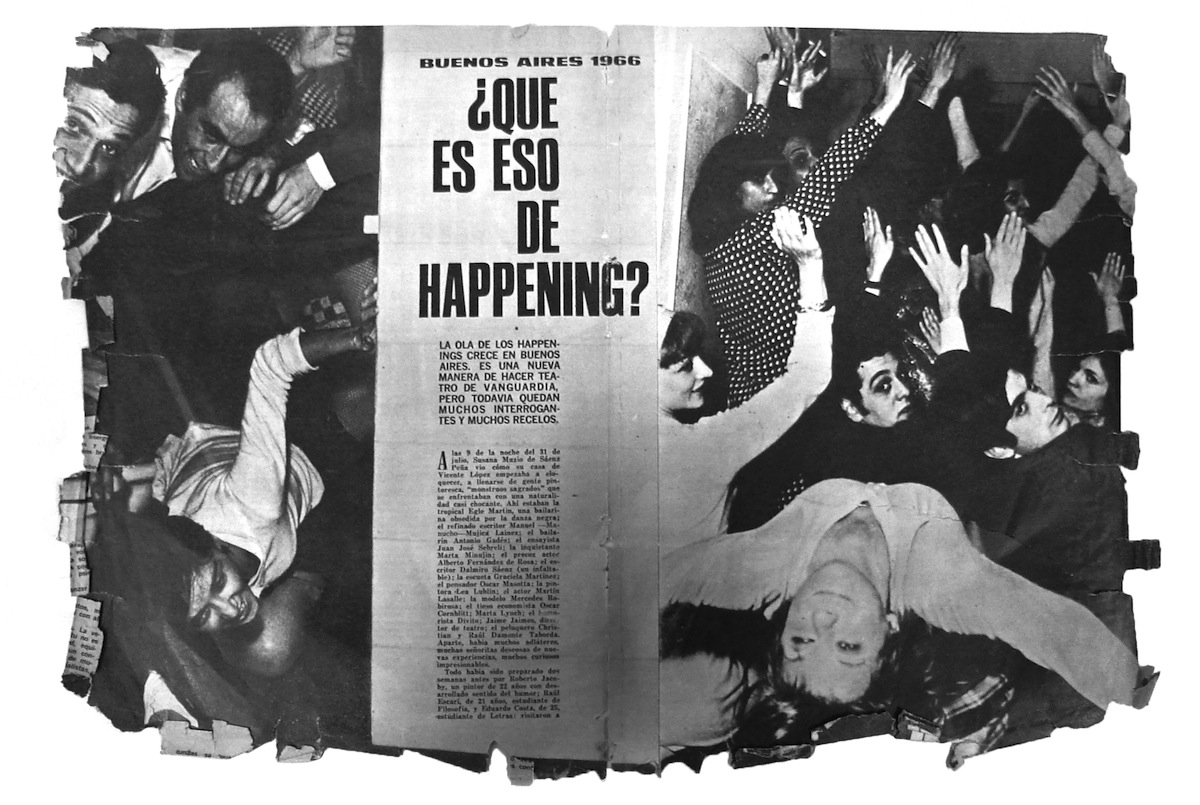
Articles on their production have appeared in magazines in other countries of the Americas and in Europe. The relations that Samuel Paz and J. R. Brest maintain with foreign critics played a part in this (the latter contributes regularly, under contract, to Art International).
Marchands and collectors: No important figures emerge in this sector. There are some occasional buyers, generally linked to the artists by friendship. The person who comes closest to the role is the architect O. Ghieso, whom we prefer to discuss in his capacity as a professional adapter in a later section.
Galleries: Of the fluctuating hundred or so small and large galleries in Buenos Aires, about ten have shown works by our artists. Among them the following stand out:
- Lirolay: between 1960 and 1965, 15 artists exhibited
- R. Lambert: in 1966, 11 artists exhibited
- Guernica: between 1964 and 1965, 7 artists exhibited
- Vignes: between 1965 and 1966, 4 artists exhibited
Other galleries where artists of the group have exhibited are: El Sol, Galatea, Bonino, Pizarro, Kala and Van Riel.
As the data above show, the Lirolay gallery (whose owners have been friends of Romero Brest for many years) was the first to present the artists of the avant-garde studied.
When the Ronald Lambert gallery opened, R. Brest was already directing the C.A.V. and expressed his wish that the new gallery should centralize the artists promoted by this Center. The plan did not bear fruit because the gallery did not want to identify itself with the visual lines or styles determined by the institution. Romero Brest told us that although he continued his search for a gallery to disseminate this movement, he was unable to achieve his aim.
Prizes: Three prizes stand out in promoting the group: 1) the “Ver y Estimar” prize, which has invited most of the group since 1962; 2) the “Braque” prize, in which several artists have taken part since 1965; 3) the “Nacional T. Di Tella” prize, which has invited them since 1964. In all of them, they have not only been singled out by the invitation but have also won mentions, ribbons of honor and the highest distinctions.
Outside the Capital, the first prize won by César Paternostro at the Third Córdoba Biennial stands out. All these prizes are among the most important a visual artist can win in Argentina.
Other institutions: The three arts centers of the Instituto T. Di Tella stand out: the C.A.V.; the Centro de Experimentación Audiovisual (which has played an important part in carrying the visual work of the artists studied over into theater and ballet), and the Centro de Altos Estudios Musicales. All our artists have had a greater or lesser relationship with the C.A.V., although we were struck by the fact that this did not come up spontaneously during the interviews.
1.c. Unexpected Disseminators
In September 1966, the Cámara Argentina de la Industria Plástica (Argentine Chamber of the Plastics Industry) organized an exhibition, “Plástica con Plásticos,” at the Museo Nacional de Bellas Artes, to which several artists of the group were invited. The graphic design and printing of the catalogue were done by the same people who do them for the Instituto T. Di Tella.
The INTI (Instituto Nacional de Tecnología Industrial) plans to hold a similar exhibition with the following materials: steel, nonferrous metals, glass, textiles, synthetic fibers, cement, marble, paint, paper, leather, wood and electronic devices.
A professional adapter, the architect Osvaldo Ghieso, opens his projects to the inventiveness of the artists and in this way makes the style known in other products.
We must also mention some small shops and boutiques that perform a disseminating function in a secondary way. Notable among them are “La Oveja Boba” and “La mordedura tierna” (Pop crafts), the “Picacobres” (Pop decorations and trinkets), and “Dé-Dé” (a fashion boutique linked to the “Paraphernalia” boutique in New York).
Another disseminating effect will materialize if Ignacio Pirovano (former director of the Museo Nacional de Arte Decorativo) carries out his plan to obtain municipal permission for the artists of the group to paint and decorate the vast Italpark amusement park.
Over a limited sector of the upper class extends the disseminating activity of a fashionable hairdresser, “Christian,” which took the form of a modern “patronage” through invitations to his private home and the sale of the artists' products in his salon.
1.d. Conclusions
This overview of the disseminators of the group studied allows the following answers to our first question:
a) A set of people and institutions, limited in number but carrying weight in the country's cultural life, act as disseminators.
b) There are contacts with disseminators abroad, especially in New York and Paris.
c) There are no marchands or art collectors who deal exclusively with the group.
d) There are no galleries or publications especially devoted to disseminating the production of the artists studied.
e) The artists have had access to, and won distinctions in, the country's main visual arts prizes.
f) The Director of the C.A.V., Jorge Romero Brest, and the columnist G. Derbecq stand out as promoters.
g) Attempts at promotion were made through unexpected mediators such as industrial companies, a technological institute, shops, craft workshops and architects.
h) Among the disseminating publications, the weekly magazine Primera Plana stands out.
2. How Do the Disseminators Carry Out Their Aims, and How Do They Respond to the Expectations Placed on Them?
2.a. The Action of the Traditional Disseminators
Critics: The interviews with the artists showed that the critics do not meet the expectations of the artistic group because: a) they consider their theoretical training insufficient; b) there are no theoretical critics capable of interpreting them; c) they deplore the fact that the critics are far from the artist's life and therefore fail to understand him (“Masotta doesn't say what we do, but what he thinks we do”; “Romero Brest helps us, but he's far from us, he doesn't know how we live”).
Germaine Derbecq is admired for her participation in the circles of the young. This Frenchwoman in her sixties came to Argentina in 1951 as the wife of the sculptor Curatella Manes. She considered art criticism in the country inadequate and arranged to work as a critic for “Le Quotidien.” This newspaper of the French community has a small circulation but is read by members of a minority linked to artistic life. As a friend of the Fano family, she took part in the opening of the Lirolay gallery and served as its first artistic director. From there, between 1962 and 1964, she offered the group of avant-garde artists the most spectacular opportunities to submit themselves to the judgment of the public. She also made selections for other galleries, in which she included artists of our group. She now expects them “to move on their own” and is no longer so interested in them. Even so, the artists still turn to her because they respect her, she has many connections in the visual arts world and she sits on the juries of important prizes.
O. Masotta has given several lectures and seminars in which he offered his interpretation of the new artistic phenomena. His theories influence some artists of the group. He is the only Argentine theorist of the movement, although he relies above all on French and American data and theories (12).
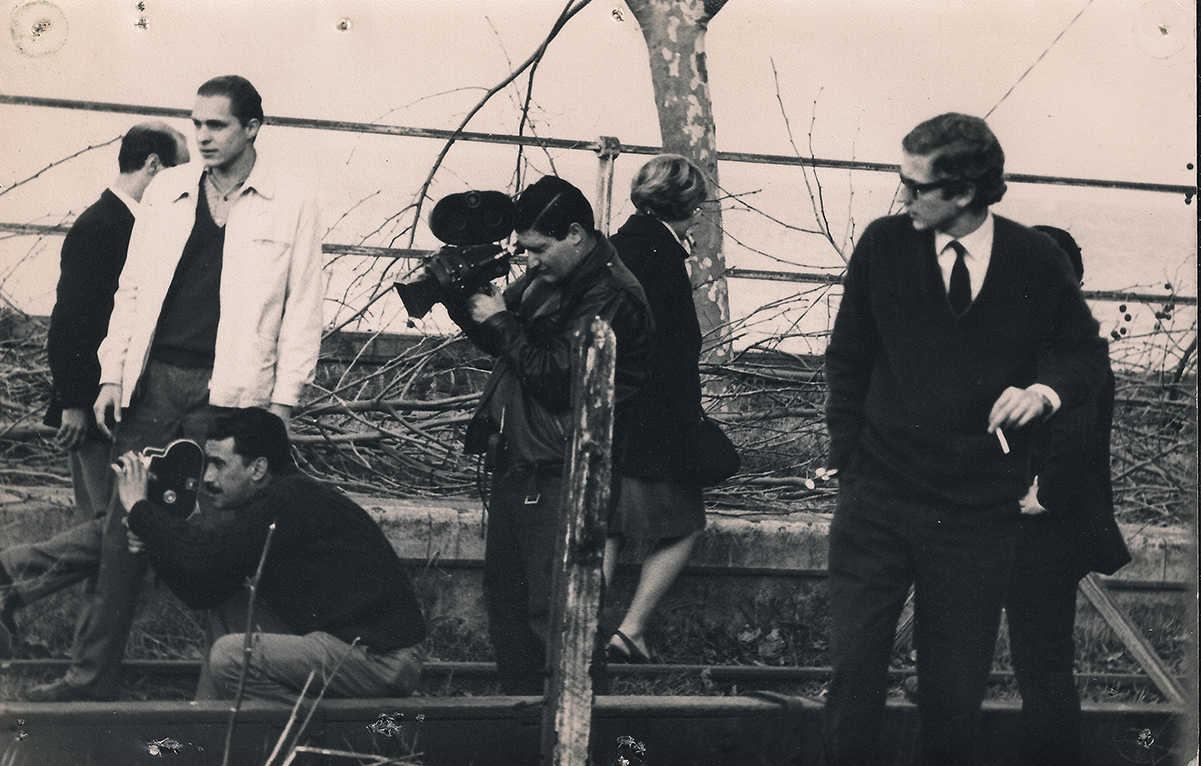
In the early years of the movement, Rafael Squirru gave his dynamic support to the new artists. For an exhibition by Delia Puzzovio, married to his brother Carlos Squirru, he writes in the catalogue: “I have wished, in these brief introductory words, only to pay my simple tribute to this artist, who stands in the front rank of our creators.” And for Marta Minujín: “In the name of all new men, I buy from you everything you make and everything you will make until the day you go on making, and I propose the museum of your works, which will be this universe as far as the corner of Jehoshaphat.”
We will discuss Romero Brest's action when we turn to the C.A.V.
In 1966 Thomas Messer published an important book, “The Emergent Decade,” on modern Latin American art. He has been to Argentina three times and corresponds with Samuel Paz (of the C.A.V.). Although he is not a declared supporter of Op and Pop Art, in his book he names and presents, among other Argentine artists, Delia Puzzovio, Marta Minujín and Pablo Suárez.
During the interviews we frequently observed the artists' special interest in obtaining recognition of any kind from abroad.
Newspapers and magazines: According to their own statements, the artists did not feel represented or correctly interpreted by any press outlet. They complain that “when they talk about us they insist on the scandalous, sensationalist or shocking note.”
Some more accepted critics, such as Masotta, “have no platform”; Rafael Squirru “is in Washington.” However, if one considers the space that printed media generally devote to the visual arts, it can be said that the artists of the group received sufficient press coverage. But the artists' criticism is perhaps more accurate when they maintain that they have not been interpreted at the level they wished.
We think such interpretation is made more difficult by the fact that at no point did they set out their main aesthetic guidelines in a manifesto or a publication. They demand an immediate understanding of works that oppose everything that has traditionally been done in the visual arts in the country.
Galleries: The galleries do not fully meet the artists' needs, perhaps because the artists cannot fully meet the galleries'. These institutions presuppose, at least in principle, a traditional stance toward the visual work: “that it can be exhibited in order to obtain the recognition and the investment of the public.”
A gallery director who does not show avant-garde art says: “Pop and objects divorced the quiet investors from the avant-garde. These new movements and forms are praised by the critics, disseminated by the Instituto T. Di Tella and some galleries, but they are not accepted by collectors” (13).
It should be noted that before 1955 the galleries of Buenos Aires were simply rooms taken by a painter who rented them to show his works. From 1955 on, the picture changed under the impact of the following developments: a) the creation of the Museo de Arte Moderno, under the direction of the unconventional Rafael Squirru; b) the complete change in the visual arts orientation imposed on the Museo Nacional de Bellas Artes by J. Romero Brest; c) greater spending in the art market; d) differentiation of galleries according to preferred current or style.
But these innovations favored traditional painting more than avant-garde works, as far as sales are concerned. When the public buys, it chooses painters who are already established and removed from controversy.
The group of artists studied found several galleries that offered them their premises through a free invitation. On several occasions the work exhibited made it necessary to modify the traditional practice of exhibition. Such was the case of a presentation by Pablo Suárez, who turned the room of the Vignes gallery into “the work itself.” The aim was to upset what visitors to art galleries normally expect, offering them the same space but entirely modified by a partition and dividing lines “like those of a basketball court” (14).
In other cases, the artists' only role was to organize a noisy opening party for a gallery. For example, when a branch of the Rubbers gallery showed works by other painters as the “setting” by Marta Minujín and David Lamelas (1966).
The galleries of Buenos Aires include no committed strongholds of the avant-garde studied. One can nevertheless distinguish: a) a core that stresses traditional values, represented by the Asociación de Anticuarios y Galerías de Arte, made up of seven galleries and presided over by the director of the Wildenstein gallery; b) a broad group that does not keep entirely aloof from occasional experimentation. A representative of the first group says of the second: “They are the ones that enjoy the most publicity, but the new expressions they cultivate are leading them to the abyss (…) Only old art bears fruit” (15). The artists who “bear fruit”: Vicente Forte, Spilimbergo, Daneri, etc.
Most of the artists interviewed exhibited in the galleries by invitation. A few began by renting the room, and in several cases still owe the rent. Invitations are always arranged through some well-known critic and through the mutual support the artists give one another. For almost all of them the galleries have been: a) the place of first encounter (seeing each other's work, they met those who were engaged in the same visual search); b) a place of study for learning the public's reactions; c) the starting point for personal dissemination.
In short: The galleries are a decisive factor of promotion and dissemination. Even the most enthusiastic reformers of visual expression are aware of this and use them. Of course, they add, “the galleries willing to take part must change their rules.”
Museums: The museums are closely determined by the lines proposed by their directors. The Museo de Arte Moderno (Hugo A. Parpagnoli) and the Museo Nacional de Bellas Artes (Samuel Oliver) take a somewhat more reserved position toward the total experimentation proclaimed by the group studied (although the latter director considers himself a pupil of Romero Brest). In general these museums have lent their premises for highly institutionalized prizes (e.g., “Ver y Estimar,” “Braque”) or for exhibitions of great interest such as “Plástica con Plásticos.”
Prizes: In recent years the three prizes mentioned have remained open to the artistic manifestations of the group studied. The good relations among the three juries and the presence of some members on two or all three of them may have contributed to this. A remarkable consistency of judgment can be observed in the prizes awarded over the last two years.
It is easy to imagine the impact this attitude has on the art world: the artist may assume that the more he presents himself in line with this approach, the better his chances of aspiring to some distinction. Some artists told us frankly that they worked in response to the expectations and suggestions linked to these prizes; this emerges with special clarity in relation to the Premio Nacional T. Di Tella, in which participation is by invitation and where artists are usually asked to submit the plans of their works in advance, so that they may be approved or receive possible suggestions for changes.
Another invitational prize, “Ver y Estimar,” is closely linked to the C.A.V. through the personality of Romero Brest. Standing out in it may be the first step toward receiving an invitation to the Premio T. Di Tella. “You have to try to get invited,” says G. Derbecq. “The artists themselves introduce their friends. Besides, we live as if in a small town, everyone knows everyone else. Most important of all: you have to be in the core of the young.”
The “Braque” prize invites after a formal application. One has to submit a curriculum and slides, and there is a greater difference of criteria compared with the other two prizes.
The Centro de Artes Visuales of the Instituto Torcuato Di Tella: We will analyze this institution in some detail because it shows a theoretical continuity that is fundamental to the development of the group studied. Unlike the prizes and the galleries, the very physical place of the Institute is a meeting place in constant use. The Director of the C.A.V. and his collaborators state openly their intention to exert pedagogical effects on the group. “In creating the C.A.V., great account was taken of the implications that art and the artist's work have in the social milieu in which they develop, attending to the energy they breathe into that milieu, to the expression of freedom that is proper to them and to the great deepening of our world they achieve, by tracking down phenomena that appear confused and unnoticed to everyday vision and raising them to the sensible surface of form” (16).
To these aims, which amount to a general ideological statement, are added other, more specific ones:
- to maintain contacts with similar centers and with people linked to the visual arts, in the country and abroad;
- to offer the artist a meeting place and backing;
- to attract a large public through various forms of promotion and put it in contact with the art it considers avant-garde.
These aims are surely similar to those of the galleries named above, but the C.A.V. offers an institutional framework containing an essential element: the allocation of funds that do not come from the sale of the products it promotes.
As for the national and international contacts mentioned, the C.A.V. has been above all an important bridge for its artists (or what it calls “the Di Tella line”). There has been an effort to turn it into a true “meeting place”; this is directly due to the style of human relations practiced by the director of the Center, his wife, his secretary and the deputy director. “They ask me about anything,” says Romero Brest, “and when they're abroad they write to me as they would to a father. My wife and Samuel Paz also have very good relations with them.” “They always invite us to their parties; we often go, even if only for a while. Lately we've won over even the most reluctant and communist-leaning ones, like Carreira and Jacoby.”
Its director defines the C.A.V. as a center for experimentation. He calls himself a politician. “I have many friends and enemies. I wish my enemies would sink. I write in Art International only to promote our people. I also try to organize exhibitions for them abroad. We were very successful with the exhibition ‘New Art in Argentina’ held in Minneapolis two years ago.”
How does the C.A.V. find the new artists it promotes? This is a complex but informal process. As we have already noted, the artists themselves introduce their artist friends. “We have many contacts in the art world and we know many creators.” There is also great interest in what happens in the provinces. Contacts have been made with artists who meet the experimental requirements of the C.A.V. in La Plata, Mar del Plata, Rosario, Bahía Blanca and Córdoba. Only one artist in the group expressed rejection of the C.A.V.: “Being in it is like being in an Academy (…) It's something like a charitable institution.”
The action of the C.A.V. is often confused with that of the Institute as a whole. As a result of its indisputable influence on the art world, it has received interpretations steeped in subjective elements.
Attracting the public to the C.A.V. is helped by its central location, in an area where most of the galleries are found. Also influential are extensive press coverage (both favorable and unfavorable) and the participation or involvement of several influential figures, especially from industry.
The Institute has recently created a department to foster public relations: the “Departamento de Adherentes a los Centros de Arte del Instituto T. Di Tella” (Department of Members of the Arts Centers of the Instituto T. Di Tella). The current director of this department, Mrs. Uribelarrea, became acquainted with the membership department of the Museum of Modern Art in New York and proposed a similar institution to the director of the Institute, the engineer Enrique Oteiza, who was enthusiastic about the suggestion. It began operating under her direction, with three advisers (two of them the architect Ghieso and the painter and physician Florentino Sanguinetti, Jr.), in July 1966. It now has more than 800 members, including institutions such as Ford, Fiat, Escuelas de Artes Gráficas, etc., who pay a small fee and regularly receive the programs of the three Centers. People join freely through personal contacts. Most are under 30.
A novel aspect worth noting is the practice of renting works of art. Some members of the group studied have been invited to bring works to show in the rental room, but they have not delivered them. On the other hand, the director thinks it hard to rent them, since “people want pictures to hang on the walls.”
Two characteristic reactions: The action of the disseminators mentioned has provoked, in art circles of a different orientation, reactions worth noting for the emotional intensity with which they are expressed. Social essayists have also dealt with them. We would like to quote one example of each.
a) An artist: “It's a curious finding: in Buenos Aires the same thing happens as in Europe with regard to the international scene. There, a large group of pseudo-artists makes a tremendous racket to disguise their incompetence. Backed by the marchands and the commercial galleries, they prevent people from knowing that other, smaller group of authentic artists who work quietly, tenaciously, without seeking publicity. Nothing interests them but their art. That is why the view of contemporary art people want to give is false, since it has that majority in mind. In Buenos Aires, the group of official bodies (Museo de Bellas Artes, Museo de Arte Moderno, etc.) and some institute with enough financial muscle to make the same racket that keeps the music from being heard manage to create a false idea of artistic practice here too. Until those causes disappear, people will go on insisting on the error and those who are worth something will be pushed aside. The other evil, perhaps the worst, is that the young are disoriented, misoriented” (17).
b) A social essayist: A. Moffatt, analyzing the “culture of executives,” maintains (18): “This culture has its artists and its scientists. A painter in this structure is first promoted, then ‘quoted,’ and finally ‘established in the market.’ To show how valuable an artistic creation is, people state the pesos (or dollars) paid to acquire it. The Instituto Di Tella, closely linked to the Museum of Modern Art in New York, is the coordinator (and financial backer) of the ‘executive artist,’ who plays by the same rules as if he wanted to launch a new ‘Coca-Cola,’ perhaps promising it will be ‘more exciting!’”
Leaving aside any attempt to evaluate these passages, we believe our pages contain material drawn from reality that adequately corrects this kind of approach.
2.b. The Action of the Unexpected Disseminators
1. The exhibition of the Cámara Argentina de la Industria Plástica, mentioned above, invited a group of artists to make works with the material produced by the sponsoring companies. A short preliminary course was organized to explain to the artists the possibilities of the material and the techniques for working it. There was also laboratory practice, and the artists received technical advice at any point in their work.
The jury was made up of G. Derbecq, Th. Messer, Michel Ragon and Aldo Pellegrini.
2. The disseminating action of the architect O. Ghieso has several aspects. He has placed some objects made by members of the group in his house and in his office. With other artists he has carried out interior decorations. He also secured their collaboration for the decoration of a perfume shop, but when he had already finished the plans, the Helena Rubinstein representative intervened against the project. He has decorated his new architecture office with the participation of several artists of the group and wants to set up there a meeting and entertainment place for the group and its followers. The installation of a swimming pool, a grill and a garden decorated with works by D. Lamelas favors this aim. He plans to extend these collaborations to furniture design.
The boutiques give some artists the possibility of an income while also helping dissemination, since in that setting new objects are accepted more easily. The colors, forms and symbols characteristic of the group appear on earrings, bracelets, plates, mirror frames, tapestries, etc. To a certain extent they prepare perception for the work proper, free of any practical function.
2.c. Conclusions
The analysis of the action of the main disseminators of the group studied allows us to draw the following conclusions:
a) The few disseminators work intensely to spread an experimental art, but the artists judge the effort insufficient.
b) According to the artists, the disseminators have an inadequate understanding of the artistic phenomenon they disseminate.
c) The character of the works makes their traditional dissemination difficult and leads to changes among the disseminators themselves.
d) Within the small group of disseminators there is a tendency to support one style of visual expression with a certain continuity, regardless of the fact that other artists, seen individually and outside the promoted style, have produced valuable works.
e) Relations between disseminators and artists are informal and based on very frequent personal contact.
f) For this purpose they move within a particular area of the city where most of the galleries, the bars they frequent and the C.A.V. are located.
g) The “key” Argentine disseminators serve as a bridge to disseminators abroad.
h) The unexpected disseminators offer several possibilities for continuing the artistic function in connection with a practical function: the limit is set by the client's degree of acceptance or rejection.
i) The present disseminators of our group's art are identified as such among other disseminators, and are attacked or celebrated for that reason.
j) As for the steps of promotion (through exhibitions and the main prizes), we can observe the following process (see diagram 2):
1) exhibition and consequent dissemination through a particular gallery;
2) the endorsement expressed on that occasion by prominent critics (Squirru, Romero Brest, etc.);
3) the consecration of some through a prize and exhibition in several other galleries;
4) the pioneering gallery is all but abandoned once the most prized awards have been won;
5) dispersal of the places of exhibition.
This last step coincides with geographic dispersal (trips by most of the artists to Europe and the United States) and with the disappearance of the group as such.
3. How Do the Disseminators Interpret the Production They Disseminate, and What Value Do They Assign to It?
In this section we will quote mainly positive positions, since the disseminators will show preferential attitudes toward what they disseminate. Interpretations and value judgments are hard to group, because they form a very intricate mixture of elements: resolutely subjectivist positions appear mixed with claims to objectivity; historical interpretations with metaphysical ones, commercial and promotional interests; commitments of every kind and great uncertainty in evaluation, which stems from the diversity of artistic production and makes a clear position toward the group as a whole difficult (it contains Pop elements, geometric abstraction, etc.).
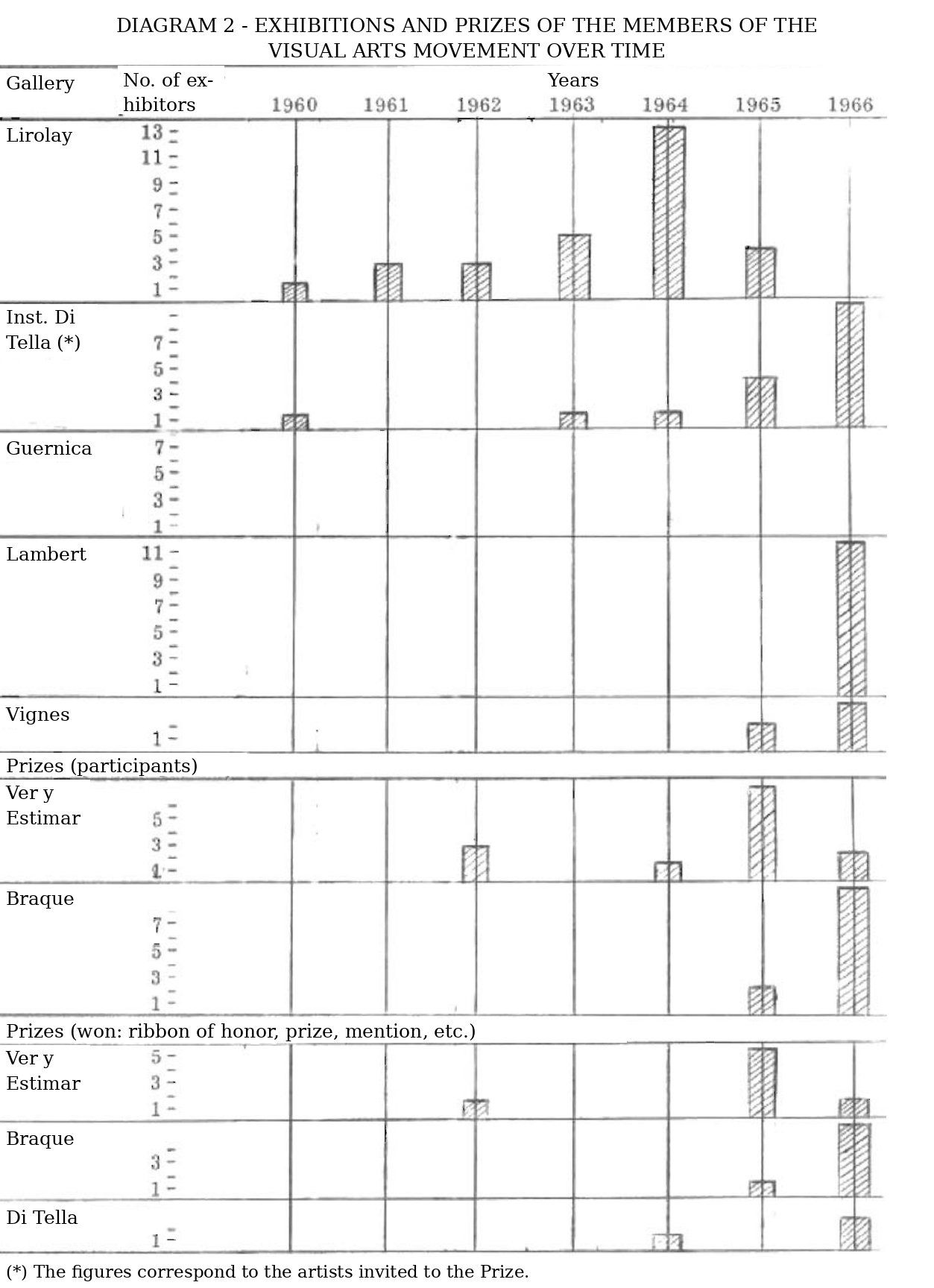
3.a. Historical Overview
We summarize a historical overview drawn from the statements of the interviewees:
1959 G. Derbecq sees innovative works (among them some by Alberto Greco and Kemble) at the Museo Sívori. When the
1960 Lirolay gallery is created she organizes, as artistic director, the first exhibition with these artists. Two years later there appear in
1962 the same gallery Santantonín with “things” and Marta Minujín with “collages.” At this moment the movement of the geometric artists that existed before is in decline. Some experimenters inspired by American Pop art appear and move with great dynamism. Delia Puzzovio, Carlos Squirru and the Cancela-Mesejean duo join Marta Minujín and Rubén Santantonín. The first spectacular appearance takes place
1964 in the joint exhibition held at Lirolay. These appearances continue in the following years: “It meant bringing Argentine visual art up to the international level of experimentation.” Masotta says: “There is an obvious relationship between the boom in the media and Pop. This has also happened to some extent in Buenos Aires. Besides, the artists know what is happening elsewhere, essentially through magazines, which means the visual arts today have an international character.” According to G. Derbecq, Pop “appears as the realism of our present life, it means having your eyes open in the street.” “There was always a love of objects; it showed itself in different styles and expressions. Lately too much has been done in painting, there is a certain weariness among the creators. That is why there is now greater interest in objects.”
Professor J. Romero Brest remarks: “I understand those who are offended by the attitude of the young. The habit around here was to paint or sculpt well, making works that were meant to last, whereas what matters to these iconoclastic creators is the changing attitude, in pursuit of a truth that can never be grasped once and for all, but for that very reason rich and authentic (…) In this country there was awareness of the image, but not awareness of imagining (…) (But) the lack of an economic base founded on abundance and on a carefree attitude toward consumption (here there are few buyers of new works, nobody has sold an inherited collection in order to acquire them) may abort the situation that is leading us to be regarded as producers of good merchandise with international value. If the hard-to-define groups (…) between the wealthy and the workers (including many merchants and industrialists) lean in their tastes toward works of the distant or the recent past, except for those lacking press approval, it is because, just as they have no precise place in the social structure, they have none in the cultural one (…) Despite which, it is among them that the few who support the new artists are recruited” (19). R. Brest also foresees the emergence of a new movement: “From the very first moment there were some covert geometric artists who now, with the search of a Pop character exhausted, are showing themselves more clearly.”
3.b. Subjective Positions Mixed with Objective Intentions
G. Derbecq: “You have to be with the young.”
Romero Brest: “On the one hand I am a politician of art, an agitator, insofar as I consider a social valuation of the work; and on the other I am someone who enjoys art, beyond any determination and any ideology, insofar as I make art, beyond any determination and any ideology, insofar as I make judgments of contemplative valuation” (20).
Mario Fano (Lirolay gallery): “We are devoted to the avant-garde. We want to show what the new movements are doing. We have a preference for artists who don't make things just to sell, but who paint out of a search and care about creating something new.”
Lawrence Alloway: “The artists I have seen here are extravagant in the extreme; they are looked on with suspicion: that doesn't mean the artists are abnormal. They are normal; Argentine society is the subnormal one, exaggerated, punctilious, controlling” (21).
At the first Salón Hisisa de Arte Aplicado (another effort by an unexpected disseminator, similar to the case of the Chamber of the Plastics Industry), an industrialist was heard to say: “This salon will undoubtedly be the most accomplished exhibition of art with a genuine community spirit. The exhibition will join art with industry; and industry will be responsible for bringing within the reach of the people the works that our most prestigious artists will show.”
On the group and some of its members: “They do what befits a young generation. They put everything on the line, they're authentic” (O. Ghieso). “Many are experimenters and their importance is fleeting. This is, for example, the basis of M. Minujín's anguish: she suddenly feels she has no more substance for creation” (F. Sanguinetti).
“When the best become stereotyped, I leave them and move on to the others: that's how I leave a trail of casualties behind me, including some I defended.” “A critic is not a man who marries anyone. When Marta Minujín starts doing silly things, I'll be the first to sink her” (22).
3.c. Conclusions
The analysis of this selection of quotations allows us to suggest that:
a) The union between disseminators and artists covers a very brief span, which only in a few cases extends beyond four years (1962–1966).
b) The movement, as it appeared at the time of the research, shows signs of exhaustion.
c) The further development of movements of this kind is curtailed by the social and economic limitations of our society.
d) The innovative impetus meant bringing the tendencies of the Argentine visual arts avant-garde up to date with what is happening abroad.
e) An economically advantageous union with the socioeconomic institutions of society could mean a definitive turn toward the applied arts.
f) The disseminators celebrate the notes of youth and experimentation that characterize the group.
g) Those who show an exhaustion of their innovative capacity run the risk of being abandoned by their main disseminators.
3.d. Note
Before analyzing the main results of the material on the disseminators set out above, we must complete the information with two additional reports drawn from samples A and B.
1. The most effective forms of self-promotion an artist can attempt in Buenos Aires.
2. The characteristics of the art market in Buenos Aires.
1) The interviewees answered the question What must an artist do in Buenos Aires to make himself known? as follows:
a) Be everywhere and make contacts: 10 times.
b) Exhibit and win prizes: 8 times.
c) Get in touch with critics and other people: 7 times.
d) Have contacts with other artists: 1 time.
The importance of the first answer is also reflected in the following remarks:
“Some make a single work a year, but they're everywhere, and they're better known than a guy who really ‘slogs away.’” “You need great physical stamina and to promote yourself.” “There are legitimate and illegitimate ways. The illegitimate ones consist of chasing someone who is a critic and leading an intense social life, so as to be seen, to seduce and to convince.”
The disseminators interviewed answer the same question as follows:
a) Get connected with the Di Tella: 3 times.
b) Enter the prizes: 2 times.
c) Personal contacts: 2 times.
2) On the characteristics of the art market in Buenos Aires we gathered the following opinions:
“There is no market for the avant-garde” (three); “it's narrow” (four); “there is a market for traditional art” (four); “there is a market for those rated highly by the critics” (one). Most maintain that painters sell well up to the level of Berni, Castagnino and Alonso. According to the artist Rodríguez Arias, “there is a gap between creative capacity and purchasing capacity. There is a great deal of activity but little absorption.” Santantonín: “The market is also narrow because the things one makes aren't useful, they can't be hung on walls and it's hard to know what decorative value they have.” Ghieso: “Their possible place (that of the works) is not really intimate space, but public space.”
As for the market for avant-garde works, the disseminators think that it is improving (two); it is small (one); it is still traditional (one).
4. What Influence Does the Process of Dissemination Exert on the Production of This Movement?
Since the end of Romanticism, the artist has been increasingly pushed aside as an autonomous force and the disseminators have gained prominence. According to the thesis of Levin Schücking (23), art in its definite forms depends on certain bearers of taste, and the degree of success of these groups depends in turn on the degree to which they control the mechanism of aesthetic life. How is the dependence of these “definite forms” articulated? Or, in other words, how are they defined? Our research suggests some explanations.
The group of artists studied presents itself as an avant-garde group, not only in terms of its own aspirations and the valuations of its most declared disseminators, but also in relation to certain features of the traditional disseminators, who must partly modify their patterns in order to disseminate the new art. At the same time, we ask ourselves to what extent art itself changes because the intermediaries are willing to change themselves. A mutual rapprochement takes place that makes art a product of both. Noé says: “It is no longer only the artists who work for Pop art, but fundamentally the merchants” (24). Although in our case the merchants played little part, the other disseminators had an important role in determining definite forms of art. In a way equivalent to McLuhan's idea that “the medium is more important than the message,” we suggest that, for our group, the disseminator is more important than the work. We try to explain this through two observations.
1. A key element for the avant-garde intention of a work to be perceived is the relationship between the traditional disseminator and the work that claims to be avant-garde.
The great majority of individuals have well-defined expectations of certain institutions and roles. When the cultural model on which they rest changes, a reaction arises that may be one of acceptance or rejection. In either case, the avant-garde work, in order to be perceived as an innovative artistic intention, requires the traditional framework it breaks or sets out to destroy. In an ideal, fully modernized world there would be no avant-garde. It is defined by its divergence from the traditional, which it modifies while modifying itself. For example: in their most extreme expression (the latest works of Lamelas, Carreira, Suárez), these works need the framework of particular exhibition halls, whose traditional facilities provide the background that, once refitted, allows the new elements to stand out. In this sense they constitute themselves as works insofar as they are “exhibited works.” A new fact follows from what has been said:
2. The relationship described between the traditional disseminator and the avant-garde work implies that, as long as a traditional disseminator exists, permanent experimentation must be sustained.
We observe that institutions change more slowly than artistic creations, but that their relative importance increases prodigiously.
Generally their staff is changed first. They go on being “galleries” and “museums,” but their directors change and breathe a new spirit into them. A typical example is the recent search for the right man to direct the Metropolitan Museum in New York. One feature (indispensable in capitalist society) had to be maintained: “The man who runs this colossal institution must be not only an art expert but also a connoisseur, a brilliant social host, a tireless administrator and a raiser of donations.” He was found in Thomas Hoving, who is not only a “master in the art of charmingly extracting money from those who have it” but also has a second, and new, characteristic: “a sense of staging that borders on the happening; a pyrotechnic sense of humor” (25).
The institution will go on guaranteeing the new director's most unexpected spectacles.
Although traditional disseminating institutions endure, and as such fulfill an important function in defining avant-garde art, individual traditional disseminators are of less and less importance for the avant-garde work. The works seriously consider neither permanence in collections nor a long commercial history. For their characterization the temporal criterion is as important as the spatial one. Disseminators tied to the enduring character of the work cannot play an important role in relation to these new creations.
Experimentation does not necessarily mean the development and deepening of any particular aesthetic conception, but the search for new contrasts that guarantee the avant-garde role. Schücking observes: “In present-day artistic life, one is struck by the number of people who take part, out of intellectual interest, in experimenting with new means of art” (26). But he did not see this as something inherent in the new relationship between disseminator and artist, in which, as he himself pointed out, the weight tilts toward the former.
5. Conclusions
We have asked ourselves four basic questions about the area lying between the artists and the audience: who the disseminators of the avant-garde movement studied are, how they act, what they think and how they influence the artists.
Summarizing the results, we can say:
- They are a small but important set of people and institutions, with contacts abroad, who are not devoted exclusively to disseminating this movement. They are accompanied by some unexpected disseminators who belong to sectors of industry, commerce and the professions.
The set, recognized by others as the movement's disseminator, acts with an intensity not always perceived by the artists. It does so through informal contacts and within a particular urban area. In pursuit of its aims, it does not refuse to adapt partly to the changes in dissemination practices that the works of art demand.
Artists and disseminators are united by a brief history that seems to be coming to an end since, according to the disseminators, the economic and social limitations also limit the movement.
The disseminators celebrate the youth and experimental spirit of the artists, but are prepared to abandon them if their innovative capacities run out.
The possibilities offered by the unexpected disseminators could channel the impulses of innovation toward a transformation into applied arts.
The relationship between artist and disseminators determines:
a) its avant-garde character;
b) the predominance of experimentation over deepening and refinement;
c) the heightening of the role played by institutions through their most dynamic individuals, to the detriment of individual disseminators.
IV. THE RECEIVERS OF THE WORK
1. The Audience as Seen by the Creators
To think about the work of art from the artist's point of view means asking who are imagined as its receivers at the moment it is conceived. In the questionnaire for sample A we approached this problem through five questions: 1) Whom do you paint for?; 2) What does the audience mean to you?; 3) What do you consider your audience to be?; 4) What is the Argentine audience like?; 5) How do you imagine the ideal audience?
The answers show that:
a) no interviewee thinks that his work responds to an expressive need that is satisfied in the very act of creation;
b) it can be said that the work always has receivers (from the point of view of those who create it), that is, a potential audience.
How is the audience made up, in the broad sense? We agree with Rosemberg and Fliegel (27) that a division into four groups can be considered:
1) An “intimate,” primary, immediate group, made up of the artist's personal friends and sometimes of other artists. In our case it would include members of other related artistic currents or of similar currents within other arts (such as the musicians M. A. Rondano and Dellechega, the members of the magazine “Airón,” and the dancers Marilú Marini and G. Martínez, all mentioned by the interviewees) and other personal friends.
2) A group of critics, collectors, marchands and institutions, which we discussed in the previous section.
3) The general group of those who buy, without being particularly identified (nonexistent in our case).
4) The group of “those who look,” which is the one that best matches our artists' image of “the audience.”
When we asked “Whom do you paint for?”, most did not answer (eleven) and one did not know. Of those who gave an opinion, seven work for “the public” that comes to look, and one for “the small minority” that follows his work.
The artists who do not answer also fail to do so when asked “what the audience means” to them. Of the ten subjects who answer, for three it is “the basic thing,” for another three “what matters to us, a source of stimulus,” and for one it means nothing and he “doesn't take it into account.”
Of special interest are the three individuals who confess that for them the audience is something “incomprehensible, anonymous and abstract”; “because you put the work out there and know nothing more. You don't know what faces they make or what they feel.”
We tried to make the image somewhat more concrete by asking “What is the artist's specific audience like?”
Thirteen do not answer; one describes his buyers very concretely (a small bourgeois minority, with some knowledge and with money); seven subjects describe it as “modern, sophisticated, free of prejudice” (it is curious to see that they repeat the image usually used to describe them). They become very hesitant again when asked their opinion of the Argentine audience. The largest number is still that of those who do not answer (nine). The rest group around two tendencies: four subjects complain of its “superficiality” and “lack of interest,” while the remaining seven suppose that it “is tending to improve, to show itself more interested and emotional,” although they say so without much conviction: “maybe it's not as negative as people think”; “it participates more than in other countries” (Brazil and Italy are mentioned).
To sum up: If we tried to build a scale to measure the connection between artists and audience, we would have three markers:
1) The point of greatest rejection: this would correspond to a little over half of the group, who do not wish to answer whom they paint for, what the audience means to them, whether they have an audience they consider their own, or give an opinion on the Argentine audience. For them the disconnection is total and takes the form of denial.
2) The point of intermediate rejection: this would correspond to the small group that sees the audience as “abstract, incomprehensible,” as well as “cold, superficial and apathetic.” The disconnection is still marked, but at least it appears worked through by the possibility of putting it into words.
3) The point of moderate acceptance: this corresponds to the group that tends to regard the audience as the logical receiver of its creations and is interested in it (although with varying degrees of intensity). They describe it as “improving in its attitudes toward art.” The connection is not very solid, but a position of confidence appears.
It can be seen that there is no sector that can be equated with a frankly positive connection.
The fifth question remains to be answered: How do they imagine the ideal audience?
The contrast with the previous data is evident and somewhat pathetic. All the artists have an “ideal” image of the audience. Twelve would like an audience that is “vital, interested, that understands them and takes part in the work.” An audience like “the one the Beatles have, very young, very enthusiastic, that dives in without asking questions.”
Another four artists extend their wish for communication to the whole of society: “one's fellow man, directly”; “the whole public in the streets.” Two still think of a minority: “made up of cultivated people: university people or members of intellectual circles.”
Finally, another two (a couple) put the emphasis on economics and would like an audience made up of “big businessmen.”
To sum up, we can see that the prevailing utopia corresponds to an intense and total connection, absent from the reality they live. Only in fantasy is the marker of “greatest acceptance” reached, the one we lacked to complete our hypothetical scale.
2. The Audience as It Really Is
We explained in the section on methodological remarks that from the total audience sample we isolated 92 subjects with a closer relationship to the Instituto T. Di Tella and to Pop shows. The criteria by which we selected this group allow us to assume that they represent the kind of people who usually attend manifestations of avant-garde visual art.
In this part we will use the word Pop as equivalent to “avant-garde visual art,” not because we believe they are really synonyms (we have already said that avant-garde visual art includes various movements), but because that is the term we used in the audience questionnaires.
2.a. Description of the Audience
(All the data are in the tables attached in the appendix.)
As was to be expected, most of the audience is Argentine and lives in the Capital and Greater Buenos Aires. Fifty-nine percent of the sample is between 18 and 30 years old. There are more men (61%), and 59% are single.
The educational level is very high: 97% have begun secondary studies, 44% have incomplete university education (presumably the sample includes a large number of students still pursuing university degrees) and 25% are professionals. Thirty percent of these professionals are architects and 25% come from the Faculty of Philosophy and Letters and the teacher-training colleges. The other high percentage (17%) corresponds to the Faculty of Law and Social Sciences. It can be said that there is a large majority of professionals connected with technical-visual and humanistic interests.
In addition to these studies, 43% of the people have undertaken others connected with artistic activity, and 60% engage in activities of an artistic kind or are directly connected through their work with people who do.
Fifty-one percent of the people have a paid occupation and 25% are devoted exclusively to study.
Eighty-seven percent decided in advance to go to the theater. If we go by the index of “interest” P. Gibaja uses in his study (28), this would be a very interested audience. This definition should be taken with some caution in our case, since the difficulty of getting tickets (above all for the show of the dancer Graciela Martínez) made this attitude somewhat obligatory.
We nevertheless believe that to the advance decision to go to the theater we can add indicators that show this audience to be genuinely interested: a) previous attendance at other similar shows; and b) the kind of information they use before making the decision. Forty-three percent had learned beforehand of the existence and quality of the show through newspapers and magazines, and 36% had heard about it from friends and relatives.
It is interesting to note that 51% of the audience reads the weekly Primera Plana, which we have counted among the traditional disseminators of avant-garde visual art. As is to be expected in an audience with a high level of education, these are avid readers. Seventy-two percent read newspapers every day (the most widely read are “La Nación” and “La Prensa”) and only one person says he does not read books. They choose mainly “poetry, literary criticism or theater” (29%), “novels or travel books” (27) and “history, politics, philosophy and economics” (19%).
On the other hand, this interest in cultural manifestations extends to other areas of intellectual activity: 47% attend exhibitions and go to the cinema “more than once a week,” 25 percent go to the theater just as often, and 19% to concerts as well. Despite going to the cinema a great deal, 48% see little Argentine cinema and 26% see it fairly often. National theater seems somewhat more appreciated: 33% see it fairly often, although an almost equal percentage, 31%, see very little of it. Seventy-four percent find time to listen to the radio, but almost always tune in to music programs (classical music 39%, and popular music 26%).
Comparative Table of the Characteristics of the Pop Art Audience and the General Art Audience
| Characteristics | Pop audience | Art audience (*) |
|---|---|---|
| Age | Between 18 and 30: 59%; over 40: 10% | Between 18 and 30: 41%; over 40: 22% |
| Sex | Male 61% | Male 50% |
| Educational level: a) formal education | Secondary 28%; univ. incompl. 44%; univ. compl. 25% (architecture 30%; philosophy 25%) | Secondary 48.7%; univ. incompl. 22.9%; univ. compl. 19.7% (engineering, philosophy, law) |
| b) Art studies | 43% | “Close to half,” percentage not specified |
| Occupational status | Paid occupation: 51%; students: 25% | Paid occupation: 54%; students: 23% |
| Interest in the show: decided to attend in advance | 87% | 76% |
| Engage in artistic activities | 60% | 54% |
| Newspapers: reads daily; preferred | 72%; 1. La Nación 28%; 2. La Prensa 22% | 63%; 1. La Nación 48%; 2. La Prensa 24% |
| Preferred magazines | Political, general interest: 38% (Primera Plana 25%, others 13%); foreign 14% | Foreign: 42.2%; political, general interest: 15% |
| Radio: a) Listens to radio “yes”; b) programs chosen | 74%; music 65% | 84%; music (not specified) |
| Television: own one; how often they watch | 100%; every day 5% | 59%; 22% |
| Cinema: frequency; Argentine | More than once a week: 47%; very little: 48% | Weekly: 34.2%; very little: 44% |
| Exhibitions: frequently | 47% | 55% |
| Preferred type of music | Classical and popular 31%; classical 19% | 28%; 60% |
| Preferred reading | 1. Poetry, lit. criticism, theater 29%; 2. novels, travel 27%; 3. hist., politics, econ. 19% | 1. novels, biogr., travel 36.4%; 2. philos., hist., science 29.8%; 3. poetry, lit. crit. 22.8% |
(*) “Art audience” according to the data of P. Gibaja's study (29).
(*) “Art audience” according to the data of P. Gibaja's study (29).
The comparison between the audience we selected and Gibaja's shows the following significant differences:
a) the audience is slightly younger;
b) the Pop audience has a somewhat higher educational level;
c) the Pop audience appears less interested in classical music and goes to concerts less;
d) although the Pop audience owns more television sets, it watches less television;
e) the Pop audience reads fewer foreign magazines and more “political and general-interest” magazines. However, this figure is not easily comparable, since this type of magazine boomed after Gibaja's study.
f) The Pop audience sees more national theater. Again the element of time appears, since in recent years an interesting core of Argentine playwrights has emerged.
To sum up: in points a) and b) we find only an accentuation, in the same direction, of the characteristics of both audiences. In points e) and f) we find differences that could be explained by factors of social change.
The differences in point d) agree with studies carried out on “art audiences and mass media” in other countries. Only point c) remains as a marked difference between the two audiences. It could perhaps be related in part to the greater youth of our audience, since “in a culturally more complete milieu, greater (chronological) maturity leads to greater attention to expressions such as ‘good music’” (30).
The data we have so far can be summed up by saying that these are audiences made up of young individuals with a high educational level who have paid occupations or are devoted to study. They appear interested in every kind of cultural manifestation, whether through their high rate of attendance, the special studies they have undertaken, or the activities they carry out or connections they have with the art world.
From this comparison we must conclude that we are dealing with an audience that can be considered as belonging to a cultural minority, or an “art audience” in general. We have no grounds, however, for concluding that the audience in our sample can be defined as a Pop audience, in the sense of an audience that follows this avant-garde movement in the visual arts.
We would like to develop this view by analyzing the motivational aspects we incorporated into our work.
Thirty-two percent of the audience attended the show out of “curiosity” or a “general cultural interest,” while only 3% attend in order to “see something new or different.” This seems to indicate that the interest is directed more toward general cultural forms than toward specific aspects of innovation or experimentation.
When asked their opinion of the reasons that had brought the rest of the audience, 29% lean toward “snobbery,” 28% believe they see a real “interest in the show” and 22% believe it is “interest in culture in general.”
Asked their opinion of other Pop shows and other shows of the Instituto T. Di Tella they had seen, we obtained the following result:
C.10 Comparative Evaluation of Other Pop Shows vs. Other Shows of the Instituto T. Di Tella (ITDT)
| Evaluation | Pop % | ITDT % |
|---|---|---|
| Very good | 7 | 33 |
| Good | 37 | 41 |
| Fair | 22 | 12 |
| Poor | 2 | – |
| Very poor | 4 | – |
| Other opinions | 13 | 6 |
| No answer | 15 | 8 |
It emerges very clearly that attitudes toward the shows presented by the ITDT are much more positive, not only in overall percentages but also at the extremes. It seems fair to conclude that this audience is much more an audience of the Instituto T. Di Tella than an audience of Pop shows.
One may ask: a) To what extent is this an audience that attends Pop shows “incidentally,” because they take place within an institution that is evaluated positively?
b) To what extent will this audience go on attending Pop shows if the ITDT (or other institutions that disseminate art and are accepted as such by this circle) stopped supporting this kind of artistic manifestation?
Finally, we wanted to know: a) how the aims of the creators of the shows surveyed were perceived; and b) how the audience reacted in relation to its perception of those aims. The questions asked for this purpose in our questionnaire gave the following results.
C.11 Comparison Between the Aims the Spectators Believe They See in the Creators of the Shows and Their Responses to Them
| Positive | Doesn't know / neutral | Negative | Other | No answer | Totals | |
|---|---|---|---|---|---|---|
| See aims | 49% | 11% (doesn't know) | 11% | 6% | 23% | 100% |
| Evaluate | 52% | 13% (neutral) | 12% | – | 23% | 100% |
The data seem to indicate that, broadly speaking, the assumptions hold, that is, a negative evaluation coincides with disagreement about the aims of the show, and vice versa. The results are somewhat obscured by the high percentage of people who did not answer the questions. Although the larger part of the audience tends to see positive attitudes and also responds positively, too many subjects abstain from answering or have neutral attitudes for us to describe it as a group of “followers of this kind of show.”
3. Conclusions
We believe we have sampled an “art audience” or a “cultural minority,” but not an audience we can describe specifically as a “follower of avant-garde visual art.”
This audience is characterized by a general interest in cultural activities much more than by a specific interest in experimental or innovative aspects.
It seems above all to be an audience that follows an institution we can define as a “traditional disseminator of the avant-garde movement in the visual arts.”
We have no reason to suppose that this audience will go on supporting this movement if it is abandoned by the art disseminators.
V. FINAL REMARKS
We were analyzing the material gathered among the visual artists when a study by Rosenberg and Fliegel (31) came into our hands whose aims and technical features were very similar to ours. The authors saw seven women and twenty-two men, painters and sculptors.
There, apparently, the similarities between the two studies ended, because:
1) with regard to the sample:
- They limited their inquiry to a sample of artists, without interviewing disseminators or audience.
- They selected established artists to prevent the possible frustration caused by failure from producing incidental elements of alienation. No subject belonged to the younger generations.
- All were in a comfortable financial position.
- All belonged to artistic movements immediately preceding Pop art (the data were gathered between 1961 and 1962).
2) With regard to the sociocultural context:
All developed their artistic careers in a period of great boom in which New York became the world center of art, taking the place Paris had held until then.
The art market is greatly favored because:
a) there is a large amount of money in circulation;
b) social values favor support for the visual arts;
c) these facts drive a large number of new collectors (advised by specialists) who invest their surplus funds in cultural objects. They thus achieve a double purpose: they avoid taxes and at the same time consolidate their social position.
d) the prevailing norms favor nationalism in art. Collectors go so far as to sell inherited collections (made up of European artists) in order to replace them with works by American artists.
The Second World War brought an influx of famous European artists who for years had devoted themselves exclusively to the practice of their profession. This was a revelation for American artists, who realized that one could be an artist and nothing else. This awareness of their possibilities of professionalization, together with the preceding factors, gave them the feeling of being the makers of a true cultural revolution.
But, and this is what interested us most, despite the differences in sample and in sociocultural context, the variables bearing on the artist-society relationship remain remarkably similar in the two studies.
1) The artist appears as not alienated with respect to his work, because:
- he derives satisfaction and fulfillment from this work;
- he believes in the social function of the art he practices and sums it up in three fundamental ideas: a) valuing the present in its everyday forms; b) pointing out change; and c) anticipating the future.
2) The artist appears in conflict with society at large, because:
- he speaks out against its prevailing values (whose typical representatives he believes he sees in the middle class);
- he denies any class self-affiliation.
3) The artist appears in conflict with his membership and reference groups, because:
- Although he admits the influence of criticism and seeks its approval, he considers it inadequate for the aims it supposedly preaches.
- he needs and uses the support of the traditional disseminators, but complains of the pressure they exert on his creation.
- the membership group seems to be much more integrated in the U.S. But although mutual evaluation and production are respected, the inevitable individualism of one's own creation is accentuated, as in Buenos Aires.
- In both cases there is conflict with the “art market.” Among our artists, because they regard it as dominated by “traditional taste.” Among the American artists (much sought after by it), because they see it as threatening their own freedom of production. In both cases the public “that buys” is considered more an “investor” than a “connoisseur.”
- in both cases there is uncertainty about the possibilities of communication with the public “that looks.” The aim is to “win it over,” but its “potential passivity” is feared.
How are these similarities to be explained? Two positive notes appear:
a) one is common to both samples: the artist's non-alienation in relation to his work. Of all that has been said and written on the subject, we would like to retrieve two elements: the craft character of the work, which includes every stage of the creative process, and the fact that in both societies there is a positive valuation of the creative function (this does not mean ignoring the implicit features of ambiguity).
b) the other positive note appears only in the American group and concerns much stronger ties within the group.
We believe this fact reinforces our assumption that the very small size of the group of disseminators and the dismal conditions of the art market in Buenos Aires heighten the existing elements of internal competition to the point of disintegrating the membership group.
In the American group, the competitive elements appear above all through the intensification of “individualistic” features and through intergenerational rejection.
The common elements of conflict remain to be considered:
a) with regard to society at large: the artists experience the incongruence of their status, by which, in both societies, they are sought after and celebrated for their talent (which in many cases implies an apparent social rise). But by which, at the same time, they are seen as different because of their special sensibility and their apparent nonconformity with prevailing social values.
b) with regard to reference groups: in both societies the growing importance of the groups of traditional disseminators stands out.
This phenomenon seems to branch off from the process of democratization. According to Mannheim (32), the process of democratization always includes three structural elements: a) the essential equality of all human beings; b) the autonomy of the individual; and c) a form of its own for selecting and controlling its minorities.
Parallel to the transition from “community” to “society,” there is a pluralism in social structure and a decentralization of control. A multitude of minorities are selected that theorize about the ideals, values, ideologies and self-interpretations of the whole society.
Thus, alongside minorities that hold economic and political power, there coexist others whose function is the exploration of the cultural world: “… in times of rapid change, there must be small groups that explore new cultural possibilities and carry out live experiments for others. In this way they elaborate new types of experience that may later become the general pattern” (33).
What changes most in this course of democratization, again according to Mannheim, is the social distance between the minority and the man in the street. Thus democratization means “a reduction of vertical distance, a de-distancing between minorities and masses.”
The processes of diversification inherent in the democratic process mean that the exploring minorities are not only linked to and supported by very diverse minorities, but that their experimentation ventures into ever more specialized and “esoteric” fields (34).
The reduction of vertical distance is accompanied by a greater horizontal distancing. The problem arises of communication between the distanced parts, since although languages level out in vertical de-distancing, other languages become differentiated in horizontal distancing.
It will fall to the exploring minorities to search for new forms of communication (or languages), and this results in a reduction of immediate communication between these minorities and the bulk of society, which, as it levels out, reduces the differences of language within itself.
The degree to which a group of painters expresses itself in esoteric or exoteric symbols will therefore depend on:
a) the social strata with which it tries to communicate;
b) the degree to which it represents an experimental minority and has therefore been forced to use an esoteric language that allows it to express new dimensions (35).
In an aristocratic society, the select artists and the aristocracy communicated in the same language. In a pluralistic society, the exploring minorities communicate with “intermediate groups” that function as translators.
This explains the growing importance of these translators (we have called them disseminators) in a society in the process of democratization. They constitute the agency responsible for connecting the experimenting minority with the masses.
But the “possibility” of translation does not necessarily mean the “need” for translation. The proliferation of exploring minorities and the multiple translations that flow over the masses make them, to a certain extent, impassive and uninterested.
This conflict only heightens the importance of the translators. They choose the exploring minority and transmit its language in competition with other agencies moved by the same aim. That is, they add the function of selection to that of transmission. And as the medium of transmission becomes more complex, the translators create new forms for imposing the languages they try to disseminate. They thus add the function of innovation to those of selection and transmission.
This situation introduces spurious relations between the exploring minority and the translating minority. The former do not feel correctly interpreted; the latter demand from the minorities ever-renewed systems that guarantee them a good place in the competition with other translators.
The greater or lesser imbalance in the conflict will depend on:
- the number of exploring minorities;
- the number of translating minorities;
- the more or less favorable conditions the milieu offers for this translation;
- the distance between minorities and masses.
We believe that the Argentine case we present represents a form of heightened conflict between “exploring minority” and “disseminating minority” because:
a) the translating minority is all the more powerful the smaller it is;
b) the translating minority, even when well-intentioned and not guided by material interests, feeds back on its own opinions without any possibility of comparing them with kindred groups within the country (or the Capital);
c) the exploring minority sees its possibilities of choosing among several minorities of translators (disseminators) reduced to a minimum;
d) the exploring minority comes to be “selected” by the disseminating minority, which holds the only possibilities of support and reward;
e) the disseminating minority, forced by environmental difficulties, demands the possibility of collaborating in the very production of the new languages, and of dictating the criteria of orientation for them.
When this situation is reached, the exploring minority ceases to be autonomous and becomes “directed” by others. The same happens to them as to the non-creative “bohemians and rebels” Riesman speaks of (36): “They are carefully tuned to pick up the signals of the defiant group, which finds the meaning of life in a compulsive nonconformity with the majority group.”
Only the disseminators retain an autonomous character, “being self-conscious about the fact of choosing among possible ways of life,” and they become a “saving reserve” insofar as they can make that choice in a “joyful and vital way even in times of confusion” (37).
To sum up: we hope to have made explicit our assumption that the two groups of artists compared present different aspects of the same process of democratization.
The approach to an artistic movement as a unit made up of artists, disseminators and audience in constant interaction seems sound to us. Isolating each component for analysis, we have seen the need to introduce the other two as indispensable variables for interpreting the facts. All are caught up in the same flow of communication. In our search for the comparative importance of each of the three components, we believe we have found a growing weight of the disseminating minority. This disseminating minority acts in a social and economic milieu that gives specific features to its stage of democratization.
Experimentation takes place, as we have seen, in an expanding wave that quickly exhausts its own limits.
These social restrictions limit movements like the one we have just studied and leave them only two ways of combating their exhaustion: the export of their members, or innovation at such a speed that it outstrips the European and American pace.
The situation of the disseminator in a peripheral country (in the sense used by R. Prebisch) thus emerges in all its difficulty: he must often induce movements that appear premature, and introduce experiences detected in settings that, by virtue of their socioeconomic power and degree of democratic plurality, have advanced much further.
Since it is not in our power to resolve the conflict, we wish at least to put it forward as fundamental to understanding the country's intellectual life.
Appendix
Tables for the section “The Receivers of the Works”
C.I Nationality
| Category | Percentage |
|---|---|
| 1. Argentine | 91% |
| 2. foreign | 9% |
| Total | 100% |
C.II Place of Residence
| Category | Percentage |
|---|---|
| 1. Capital | 76% |
| 2. Greater Buenos Aires | 16% |
| 3. Interior | 5% |
| 4. abroad | 3% |
| Total | 100% |
C.III Age
| Category | Percentage |
|---|---|
| 1. under 14 | 1% |
| 2. 14 to 17 | 9% |
| 3. 18 to 30 | 59% |
| 4. 31 to 40 | 20% |
| 5. over 40 | 10% |
| 6. no answer | 1% |
| Total | 100% |
C.IV Sex
| Category | Percentage |
|---|---|
| 1. male | 61% |
| 2. female | 38% |
| 3. no answer | 1% |
| Total | 100% |
C.V Marital Status
| Category | Percentage |
|---|---|
| 1. single | 59% |
| 2. married | 34% |
| 3. widowed | 1% |
| 4. separated/divorced | 5% |
| 5. no answer | 1% |
| Total | 100% |
C.VI Education
| Category | Percentage |
|---|---|
| 1. no schooling | 1% |
| 2. primary incomplete | 0% |
| 3. primary completed | 2% |
| 4. secondary incomplete | 12% |
| 5. secondary completed | 16% |
| 6. university completed | 25% |
| 7. university incomplete | 44% |
| Total | 100% |
C.VII Completed University Studies by Field
| Category | Percentage |
|---|---|
| 1. medicine | 8% |
| 2. law | 17% |
| 3. humanities, philosophy, teacher training | 25% |
| 4. economics, political science | 0% |
| 5. agronomy, veterinary science | 0% |
| 6. architecture | 30% |
| 7. engineering | 4% |
| 8. natural and exact sciences | 4% |
| 9. pharmacy, dentistry | 8% |
| 10. other | 4% |
| Total | 100% |
C.VIII Other Studies Undertaken
| Category | Percentage |
|---|---|
| 1. technical | 4% |
| 2. crafts | 4% |
| 3. commercial | 4% |
| 4. related to art | 43% |
| 5. journalism | 5% |
| 6. humanities | 9% |
| 7. other | 17% |
| 8. none | 6% |
| 9. no answer | 8% |
| Total | 100% |
C.IX Engagement in Artistic Activities
| Category | Percentage |
|---|---|
| 1. engages in artistic activities | 60% |
| 2. does not engage in artistic activities | 29% |
| 3. no answer | 11% |
| Total | 100% |
C.X Occupational Status
| Category | Percentage |
|---|---|
| 1. paid occupation | 51% |
| 2. housework | 8% |
| 3. lives on private income | 2% |
| 4. retired, pensioner | 0% |
| 5. unemployed, looking for work | 2% |
| 6. student | 25% |
| 7. other | 8% |
| 8. no answer | 4% |
| Total | 100% |
C.XI When the Decision to Go to the Theater Was Made
| Category | Percentage |
|---|---|
| 1. had decided in advance | 87% |
| 2. decided when passing the theater | 5% |
| 3. no answer | 8% |
| Total | 100% |
C.XII How the Respondent Learned of the Show
| Category | Percentage |
|---|---|
| 1. through newspapers and magazines | 43% |
| 2. through photographs in the I.D.T. window | 15% |
| 3. through posters | 1% |
| 4. through friends and/or relatives | 36% |
| 5. other | 1% |
| 6. no answer | 4% |
| Total | 100% |
C.XIII Frequency of Newspaper Reading
| Category | Percentage |
|---|---|
| 1. every day | 72% |
| 2. sometimes | 14% |
| 3. rarely | 3% |
| 4. never | 3% |
| 5. no answer | 8% |
| Total | 100% |
C.XIV Newspapers Read Regularly
| Category | Percentage |
|---|---|
| 1. La Nación | 28% |
| 2. La Prensa | 22% |
| 3. La Razón | 11% |
| 4. El Mundo | 10% |
| 5. El Clarín | 8% |
| 6. Buenos Aires Herald | 2% |
| 7. La Crónica | 2% |
| 8. El Día | 1% |
| 9. New York Times | 1% |
| 10. La Capital | 1% |
| 11. no answer | 14% |
| Total | 100% |
C.XV Preferred Type of Books
| Category | Percentage |
|---|---|
| 1. novels, travel | 27% |
| 2. poetry, literary criticism, theater | 29% |
| 3. history, politics, philosophy, economics | 19% |
| 4. detective, fiction, adventure | 4% |
| 5. classics | 4% |
| 6. special subjects: film, mechanics, science | 6% |
| 7. no preference | 4% |
| 8. other | 2% |
| 9. does not read books | 1% |
| 10. no answer | 4% |
| Total | 100% |
C.XVI Frequency of Attendance at Cultural Events
| Frequency | Exhibition attendance | Concert attendance | Cinema attendance | Theater attendance |
|---|---|---|---|---|
| 1. more than 5 times a month | 47% | 19% | 47% | 25% |
| 2. fewer than 5 times a month | 45% | 45% | 42% | 64% |
| 3. never | 1% | 22% | 3% | 4% |
| 4. no answer | 7% | 10% | 8% | 7% |
| Total | 100% | 100% | 100% | 100% |
[Editor's note: In C.XVI, the printed cells in the “Concert attendance” column add up to 96%. The total given in the original is 100%.]
C.XVII Have You Seen Argentine Films in the Last Two Years?
| Category | Percentage |
|---|---|
| 1. fairly often | 26% |
| 2. very little | 48% |
| 3. not at all | 12% |
| 4. no answer | 14% |
| Total | 100% |
C.XVIII Have You Seen Plays by Argentine Authors in the Last Two Years?
| Category | Percentage |
|---|---|
| 1. fairly often | 33% |
| 2. very little | 31% |
| 3. not at all | 16% |
| 4. no answer | 20% |
| Total | 100% |
C.XIX Do You Listen to the Radio?
| Category | Percentage |
|---|---|
| 1. yes | 74% |
| 2. no | 18% |
| 3. no answer | 8% |
| Total | 100% |
C.XX Preferred Radio Programs
| Category | Percentage |
|---|---|
| 1. classical music | 39% |
| 2. popular music | 26% |
| 3. drama | 2% |
| 4. news, commentary (including political) | 10% |
| 5. educational, religious | 1% |
| 6. entertainment, variety | 1% |
| 7. radio drama | 0% |
| 8. household, women's | 1% |
| 9. other | 1% |
| 10. no answer | 19% |
| Total | 100% |
C.XXI Frequency of Television Viewing
| Category | Percentage |
|---|---|
| 1. every day | 5% |
| 2. almost every day | 16% |
| 3. sometimes | 19% |
| 4. almost never | 15% |
C.XXI Frequency of Television Viewing (continued)
| Category | Percentage |
|---|---|
| 5. when a special program interests them | 20% |
| 6. never | 0% |
| 7. no answer | 25% |
| Total | 100% |
C.XXII Preferred Television Programs
| Category | Percentage |
|---|---|
| 1. films | 24% |
| 2. variety | 5% |
| 3. household, women's | 2% |
| 4. drama | 3% |
| 5. news, current affairs | 19% |
| 6. sports | 3% |
| 7. educational | 1% |
| 8. concerts, ballet | 12% |
| 9. other | 3% |
| 10. no answer | 28% |
| Total | 100% |
C.XXIII Class Self-Affiliation
| Category | Percentage |
|---|---|
| 1. I belong to the upper class | 6% |
| 2. I belong to the upper middle class | 37% |
| 3. I belong to the lower middle class | 21% |
| 4. I belong to the lower class | 0% |
| 5. I belong to no class | 20% |
| 6. other | 0% |
| 7. no answer | 16% |
| Total | 100% |
C.XXIV Preferred Type of Music
| Category | Percentage |
|---|---|
| 1. classical | 19% |
| 2. popular | 4% |
| 3. likes both | 31% |
| 4. neither | 0% |
| 5. tango | 8% |
C.XXIV Preferred Type of Music (continued)
| Category | Percentage |
|---|---|
| 6. Argentine folk | 7% |
| 7. foreign folk | 4% |
| 8. jazz | 15% |
| 9. other | 2% |
| 10. no answer | 10% |
| Total | 100% |
C.XXV Reasons for Attending the Show
| Category | Percentage |
|---|---|
| 1. just because, by invitation | 9% |
| 2. on recommendation (friends, relatives, critics) | 9% |
| 3. curiosity, general interest | 32% |
| 4. to have fun, have a good time | 8% |
| 5. prior knowledge and/or prestige of the I.D.T. | 4% |
| 6. prior knowledge and/or prestige of the makers of the show | 10% |
| 7. to see something new or different | 5% |
| 8. other | 5% |
| 9. no answer | 18% |
| Total | 100% |
C.XXVI What Reasons Do You Think the Audience Had for Attending the Show?
| Category | Percentage |
|---|---|
| 1. interest in the work | 28% |
| 2. interest, general culture | 22% |
| 3. snobbery | 29% |
| 4. friendship, prior acquaintance with the makers of the show | 3% |
| 5. publicity for the show | 5% |
| 6. other | 2% |
| 7. no answer | 11% |
| Total | 100% |
C.XXVII Aims of the Creators of the Show
| Category | Percentage |
|---|---|
| 1. to create or express oneself | 16% |
| 2. to amuse, to have fun | 15% |
| 3. to innovate, experiment | 12% |
C.XXVII Aims of the Creators of the Show (continued)
| Category | Percentage |
|---|---|
| 4. to spread what is new | 6% |
| 5. to cause scandal, shock | 8% |
| 6. economic motives | 3% |
| 7. doesn't know | 11% |
| 8. other | 6% |
| 9. no answer | 29% |
| Total | 100% |
[Editor's note: In C.XXVII the printed categories add up to 106%. The total given in the original is 100%.]
C.XXVIII Assessment of the Meaning of the Show for the Audience
| Category | Percentage |
|---|---|
| 1. a contribution through its novelty | 19% |
| 2. an amusement | 21% |
| 3. an expression of art | 12% |
| 4. neutral attitudes | 13% |
| 5. attitudes of outright rejection | 6% |
| 6. no answer | 23% |
| Total | 100% |
[Editor's note: In C.XXVIII the printed categories add up to 94%. The total given in the original is 100%.]
BIBLIOGRAPHICAL NOTES AND NOTES
(1) NOÉ, Luis Felipe: Antiestética, Ed. Van Riel, Buenos Aires, 1965, p. 148.
(2) ROMERO BREST, Jorge: El Arte en la Argentina, in “Primera Plana,” no. 225, 1967, Buenos Aires.
(3) The following artists were interviewed: Oscar Bony, Delia Cancela, Ricardo Carreira, Edgardo Giménez, Roberto Jacoby, Kenneth Kemble, David Lamelas, Florencio Méndez Casariego, Pablo Mesejean, Marta Minujín, Stella Newbery, César Paternosto, Oscar Palacio, Delia Puzzovio, Alfredo Rodríguez Arias, Susana Salgado, Rubén Santantonín, Carlos Squirru, Juan Carlos Stoppani, Pablo Suárez, Luis A. Wells.
(4) SLEMENSON, Marta and KRATOCHWIL, Germán: Sociología del Pop, in “Primera Plana,” no. 191, 1966, Buenos Aires.
(5) GIBAJA, P. E.: El público de arte, Informes de Eudeba, Edit. Universitaria de Buenos Aires–Instituto T. Di Tella, Buenos Aires, 1964.
(6) MEAD, Margaret: La situación actual de las artes visuales, in “Cuadernos del taller,” no. 18, ediciones 3, Buenos Aires, 1960.
(7) BARTHES, Roland: Mythologies, Editions du Seuil, Paris, 1957.
(8) Op. cit.
(9) With small modifications, we have used the code of “psychotypes of class images” as it appears in Nasatir, D.: Estudio sobre la juventud argentina, Instituto de Sociología de la Universidad de Buenos Aires.
(10) KORNHAUSER, Ruth: La estratificación social según Warner, Boletín del Instituto de Sociología, Cuaderno no. 15, Fac. de Filosofía y Letras, Univ. de Buenos Aires.
(11) “Primera Plana,” no. 191, Buenos Aires, 1966.
(12) But we should recall the pages devoted to Pop art and to objects in Romero Brest, J.: Ensayo sobre la contemplación artística, Edit. Universitaria de Buenos Aires, Bs. As., 1966.
(13) “Primera Plana,” no. 222, Bs. Aires, 1967.
(14) “Primera Plana,” no. 206, Bs. Aires, 1966.
(15) “Primera Plana,” no. 222, Bs. Aires, 1967.
(16) Catalogue of the Premio Nacional Instituto Torcuato Di Tella, 1966.
(17) PETTORUTI, E. Interview in “Clarín,” Sept. 12, 1966.
(18) MOFFATT, Alfredo: Estrategias para sobrevivir en Buenos Aires, Ed. Jorge Álvarez S. A., Buenos Aires, 1967.
(19) ROMERO BREST, J. in “Primera Plana,” no. 225, Buenos Aires, 1967.
(20) Ibid.
(21) “Primera Plana,” October 1966.
(22) ROMERO BREST, J., in “Primera Plana,” no. 225, Bs. Aires, 1967.
(23) SCHÜCKING, Levin L.: Soziologie der literarischen Geschmacksbildung, 3rd edition, Ed. Francke Verlag, Bern, 1961, p. 92.
(24) Quoted in “Primera Plana,” no. 225, 1966.
(25) “Primera Plana,” no. 211, 1967.
(26) SCHÜCKING, op. cit., p. 93.
(27) ROSENBERG, B. and FLIEGEL: The Vanguard Artist in New York, Quadrangle Books, Chicago, 1965.
(28) GIBAJA, P., op. cit.
(29) Ibid.
(30) LAZARSFELD, Paul: Interpretación de las relaciones estadísticas como procedimiento de investigación, Cuaderno de Sociología no. 20, Facultad de Filosofía y Letras de la Universidad de Buenos Aires.
(31) ROSENBERG and FLIEGEL, op. cit.
(32) MANNHEIM, Karl: Ensayos de Sociología de la cultura, 2nd edition, Ed. Aguilar, Madrid, 1963.
(33) Ibid.
(34) WATSON, Bruce A.: Kunst, Künstler und soziale Kontrolle, Westdeutscher Verlag, Köln und Opladen, 1961. Watson distinguishes between two types of symbols: “exoteric” ones, which allow communication with the whole of society, and “esoteric” ones, which are understood only by a minority.
(35) Ibid.
(36) RIESMAN, David: “From ‘Inner-Directed’ to ‘Other-Directed’” in Social Change, ed. Amitai and Eva Etzioni, Basic Books, New York, London, 1964, p. 339.
(37) Ibid., p. 339.